 April 6, 1441
 April 6, 1441
My dear Lady Cecilia!
I hope you will not mind my calling you "My Dear" for I only say on paper what I have longed to say in person these many days now.
I know that God smiles on my love (if you will, still) for it is great good fortune that lets me send this letter today. I left Sedbury (with heavy heart) only today. My father Sir Christopher, my brother Christopher, my mother and I left at dawn, hoping to ride straight through to our manor in High Shincliffe, just outside Durham City. But the hand of God sent a heavy rain storm mid day which sent us galloping for Bishop Auckland. We will spend tonight at the Bishop's hunting lodge here.
And by the further grace of God, there is a traveler heading south on the Roman Road who promises to deliver this note tomorrow to your maidservant, Birgid. I do hope she can be trusted, for sure your father would be wroth to know that we do write.
If only he would have more faith in me! He knows not how I do love thee, or he would know that I shall never be a churchman, no matter how long I serve in the Bishop's household or what my father says! I shall find my way in the world. AND I shall find a way to have you with me as my lady!
The Bishop's hunting lodge is quite grand, almost a palace and not at all what I was expecting. I write from the Great Hall - it is thrice the size of our hall in Sedbury and covered all over in rich tapestries. They are hunting scenes mostly, but there is one I can't take my eyes off. There is a maiden in a garden with a unicorn resting its head in her lap. And she looks just like you! If only you were here instead, and I could be the unicorn and lay my head in your lap.....
If the Bishop likes hunting as much as these tapestries suggest, perhaps life with the Bishop will not be so dreadful after all. At least I will have hunting, though it can't take my mind off you. I can fit no more on this parchment, so I must bid you adieu. Pray forgive my wretched script - I have never mastered the pen. Wherefore will they make me a cleric??
Your humble servant, Robert Boynton
April 8, 1441
My Dear Lady Cecelia!
Today I saw a vision of how I should live my life. I know you'll be surprised to learn I saw it in the Cathedral. But it wasn't a vision of endlessly mumbling prayers, but the sword of a man of action. My father wanted to show me the Cathedral. He thought to impress me with its richness. I was more struck by its heavy feel, rather like a castle. While we were there, he showed me the crypt. Now that WAS impressive - the Cathedral certainly has plenty of gold and treasures.
 But the vision
came from the sword. Father got it down from its brackets in the treasure house
and let me take a few swings. It is the sword of my mother's great grandfather,
Sir John Conyers, and it is the sword he used to slay a dragon! I could feel
its power surging through me as my lady mother told the story. About 75 years
ago, there was a dragon terrorizing the area around Croft on Tees. It was eating
sheep and cattle and even people when it could. Many brave men tried to slay
it, but its poisonous breathe overpowered them. Sir John Conyers vowed to kill
The Worm or die trying. He had a special suit of armor made, with dagger like
blades sticking out all over. Then he rode, alone and unafraid, to Croft Bridge
to confront The Worm.
But the vision
came from the sword. Father got it down from its brackets in the treasure house
and let me take a few swings. It is the sword of my mother's great grandfather,
Sir John Conyers, and it is the sword he used to slay a dragon! I could feel
its power surging through me as my lady mother told the story. About 75 years
ago, there was a dragon terrorizing the area around Croft on Tees. It was eating
sheep and cattle and even people when it could. Many brave men tried to slay
it, but its poisonous breathe overpowered them. Sir John Conyers vowed to kill
The Worm or die trying. He had a special suit of armor made, with dagger like
blades sticking out all over. Then he rode, alone and unafraid, to Croft Bridge
to confront The Worm.
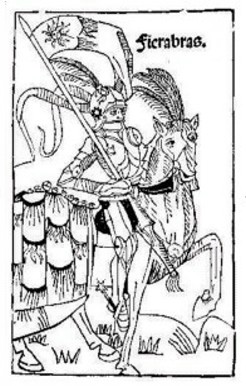
Hack, slash, parry! He had to be fast, despite his weighty suit of armor, to avoid the dragon's poison breath and deadly flames. Thrust, swing, chop! He had to be strong to wield his heavy sword. The dragon was fast and began to twine around Sir John, but his special suit of armor kept The Worm back for just long enough for Sir John to bring the fatal blow crashing down on its head .
Ah, now there is a vision of a life worth living. My father wields a pen in defense of the Bishop's rules and would I do the same. I would rather wield a sword in defense of honor, chivalry, and of course, you my lady. How could my father not see that a knight's life is for me?? He even laughed as I swung the sword. Just because I knocked over one of their precious piles of treasure, doesn't mean I don't know how to fight!
I think my brother Christopher and I are a little joke from God. As the eldest son, Christopher will inherit all my father's estates. There is enough that he could live a life of honor and chivalry, fighting against the French for our country and king. But instead of seizing the opportunity and training for his knighthood, he follows in my father's tracks and studies as if he will become a cleric. Christopher would rather read a book than practice with his sword! What kind of knight does that make? If only I had been born first, he could read all day and become a priest, for all it suits him!
 Ah, my lady,
I hope you are well. Hold up your spirits in the knowledge that I will fight
my way back to you somehow, even if I must do it over the objections of both
our fathers. I will slip out now to find a traveler heading south to carry my
letter, and my heart, to you.
Ah, my lady,
I hope you are well. Hold up your spirits in the knowledge that I will fight
my way back to you somehow, even if I must do it over the objections of both
our fathers. I will slip out now to find a traveler heading south to carry my
letter, and my heart, to you.
Your determined servant - Robert Boynton
April 10, 1441
My Dear Lady Cecilia!
I met Bishop Neville yesterday - we were invited to dine with him at the Castle. Father of course had dined with him many times, but I had never set foot in the Castle till yesterday. Bishop Neville, like his hunting lodge, is not at all what I expected. For one thing, I thought he would be an old man, but he has not a grey hair on his head. I thought he would be surrounded by clerics, and there were some of those, but the company in the hall was mostly fighting men. I thought he would be sober and Godly - instead he laughed loudly, told jokes with his men, and after dinner, called for his minstrel to entertain us. And his Castle! It is a real fighting machine!
Father laughed when I mentioned my surprise. Didn't I remember that the Bishop of Durham is a Prince Bishop? Well, yes, I'd heard him say that before, but I didn't know it would mean Bishop Neville would have so much power. "Bishop Neville is not just head of the church, he has his own army, mints his own money, makes his own laws, has his own courts" my father puffed. "Bishop Neville has a lot to give away, my boy. He's done well by me and might do the same for you, if you prove yourself. Think well on that before your long face and failing heart make you lazy and ill tempered around the Bishop. He doesn't like a long face. But don't underestimate him - underneath his jolly manner is a shrewd judge of character and a calculating mind."
Perhaps Bishop Neville will be of some use after all, once he sees I'm not cut out for life in the church. Perhaps if your father understood what a powerful patron the Bishop will be, he would think better of my prospects!
I will end this now in hopes of finding a southbound traveler. My apologies for the holes in the parchment - I scratched out my errors too hard.
Thinking only of you - RB
April 12, 1441
Dear Lady Cecilia!
I hope this letter finds you well and in good spirits. My own are greatly on the rise, though I am sore grieved we are not together, of course. I rejoice that on the morrow I bid my parents fare well and set them on the road south. (And who would not be pleased to say adieu to a vexatious father and a too perfect brother!) Then I shall finally begin my service to Bishop Neville.
I believe the Bishop to be a man of my own temperament - practical, astute, with a taste for the finer things in life. I am sure we will soon understand each other. When he sees how poorly suited I am to the role of clerk, he will surely find me a more advantageous position in his household, like squire to one of his chief knights. This it is just a matter of time before I can bring you honor with my feats of daring and courage in battle!
Yesterday was the installation of Bishop Neville. It was an impressive ceremony, if you like such things. I could tell Bishop Neville was only tolerating it because he had to, just like me. The ceremony took place with all the monks of the abbey (poor blokes). We met them in the cemetery and paraded into the Cathedral. Bishop Neville and the monks disappeared into the choir for much of the event, which made it doubly dull for us standing in the Nave. After standing around what seemed all morning while the monks trailed about after Bishop Neville through the monastery, the Bishop finally returned said Mass. You could tell he was relieved to have it over with and to be getting on to the feast.

 |
I will send this with my brother tomorrow. I made him take a vow of secrecy. He may be priest materials, but he'll keep his word to the bitter end.
Your up and coming, RB
P.S. Pray don't mind the oddly shaped parchment. My ink spilled (this is a most unstable desk - I don't see how my father tolerates it!) and I had to trim away part.
April 16, 1441
To Robert Boynton, young idler and scoundrel!
You need never trouble your blotchy pen with writing Cecilia again. Your scheme to turn her from her natural duty of obedience to her father was discovered, thanks be to God! Cecilia is betrothed to Sir Henry Gascoigne, with ten times the lands you'll ever hold. And since she is yet TOO YOUNG to marry (though that didn't stop you from seeking to twist her affections with sweet words and love letters!) SINCE she is yet too young to wed, she is sent to the safety of a convent where, under the strict supervision of the good sisters, she will say prayers of thanksgiving at having been rescued from your grip and learn obedience to her father. You need not bother to inquire which convent, as none but I know. And that, sir, is the last word in this matter!
Sir William Mallarey
Postscript:
Cecilia was sad to be betrothed and sadder still to be sent to the convent, but she found the sisters kind and came to enjoy the convent's routine. By the time of her marriage, 2 years later, Cecilia did in fact see the wisdom of marrying a man of wealth. This wisdom was driven home by the fancy new gowns her husband ordered for her for their wedding. Her marriage, though never romantic, was kind.
Robert was heart broken for at least a week after receiving the letter from Cecilia's father. But he soon found the smiles of the castle steward's daughter eased the pain in his heart quite nicely. Robert found that life in the Bishop's household was neither so dull as he first supposed or as exciting as he later hoped. The Bishop quickly learned that Robert had neither the temperament nor inclination for intellectual work. He encouraged Robert to make himself useful with the men at arms and in the stable and kennels - Robert had a way with animals.
Bishop Neville grew to like Robert and gave him a living of £10 per year when Robert turned 20. It was not enough to live in high style, but with some land in East Heslerton from his father it was quite enough to be comfortable. Robert married the castle steward's daughter and founded a long line of Boyntons who grew poorer and poorer with each passing generation, till his descendants William and John moved to America in 1638, almost 200 years after this story takes place.
Just the Facts
Christopher Boynton (the father) was a knight who received many government assignments from Bishop Neville. Robert (the son) did received a living of £10 per year from Bishop Neville, and moved to East Heslerton. Christopher (the older brother) married Agnes Scrope, fathered a son named Henry, and died. Agnes, as you know, was remarried to Richard Ratcliffe. So Robert, the teenager in this story, would eventually grow up to be the brother-in-law of Agnes (and great-uncle of Elizabeth).
The story of Bishop Neville's installation is based on accounts from the time. The story about the sword is based on the Legend of the Sockburn Worm. The Conyers sword is still kept in the Treasury in Durham Cathedral and presented to each new Bishop of Durham in a special ceremony near the site of the great battle.
The rest is speculation on how these facts may fit together.