Muhammad
Khatami gave the journalists a glimpse on Wednesday into the
underground uranium enrichment plant that the United States and Europe
want to shut down.
They spent three hours inspecting the plant at the heart of Iran's contested nuclear development programme.
Under international pressure, Iran has suspended its
work on building a centrifuge programme, but it insists it will not
give it up completely.
The European Union and US think Iran is building the
plant to develop weapons-grade fuel, part of a programme Washington
says is aimed at building nuclear arms.
However, Tehran says its nuclear programme is only for energy production.
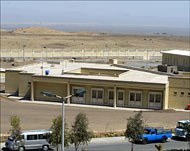
The unfinished complex is underground beneath a barren desert plain at the foot of a central Iranian mountain range.
The area is ringed with anti-aircraft guns. Iran says
the threat of a US or Israeli strike forced it to build underground to
protect its technology.
Western concerns
Thirty journalists were taken underground into a
concrete corridor where Khatami looked over technical documents, graphs
and charts of the site.
Khatami inspected the plant's string of centrifuges -
the core of the enrichment process - but reporters were not allowed to
see the machines or any other enrichment technology.
 |
|
The Natanz nuclear plant was built
at the foot of a mountain range |
The
complex would have been finished and inaugurated last year if Iran had
not suspended work, Muhammad Saeedi, deputy head of Iran's Atomic
Energy organisation, said.
"Our experts are ready to resume work to compensate for lost opportunities during the freeze," Saeedi said.
Semi-built structures that appeared uninhabited were above ground in the 450-hectacre complex, about 250km south of Tehran.
The visit was opened to the media to discount rumors that restricted work was under way at Natanz, Tehran radio said.
Khatami visited the Natanz complex and another one in
Isfahan to underscore Iran's insistence on its right to develop the
entire nuclear fuel cycle, it said.
Iran kept the plant at Natanz secret until word of
its existence slipped out in mid-2002, increasing Western worries over
the country's nuclear programme.
Nuclear watchdog
The plant's string of centrifuges enrich uranium, a
process that can produce fuel for nuclear reactors that generate
electricity but also make material suitable for atomic warheads.
The conversion facility in Isfahan reprocesses
uranium ore concentrate, known as yellowcake, into uranium hexaflouride
gas. The gas is then taken to Natanz and fed into the centrifuges for
enrichment.
 |
|
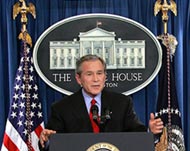
George Bush says Iran is trying
to acquire nuclear weapons |
Insisting
that the programme's secrecy and its purchases of nuclear
materials on the black market are not proof they aim to develop
weapons, the Iranians say they had to resort to such measures even for
a peaceful programme because of US sanctions and European restrictions.
But the discovery of the long-hidden activities
raised European suspicions, moving them closer to the position of the
US, which wants to impose sanctions on Iran if it does not eliminate
its nuclear programme.
Last year, Iran froze its enrichment activities in an
effort to avoid UN sanctions and build confidence in negotiations with
the Europeans. But it says maintaining the voluntary freeze depends on
progress in talks with Britain, Germany and France.
Since 2002, Tehran has been cooperating with the
International Atomic Energy Agency, the UN nuclear watchdog, allowing
inspections at Natanz and elsewhere.