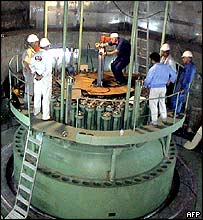
Iran says it is building a civilian nuclear energy programme
|
Iran has rejected a warning by Israel's Mossad intelligence agency
that it could have a nuclear bomb within three years as "baseless".
Iran's foreign ministry insisted its nuclear regime was peaceful and accused Israel of misleading world opinion.
Meanwhile Israeli Defence Minister Shaul Mofaz said
Israel could not accept a nuclear-armed Iran but played down the
possibility of air strikes.
He said diplomatic action should be the priority for the US, the UN and Europe.
Iran has always insisted it is building a civilian nuclear energy programme.
However, Israel and the US maintain the Islamic state is using the energy programme as a front for a covert weapons regime.
Gen Mofaz, speaking in London, echoed a warning by Israel's Mossad spy
agency that Iran was "very close to the point of no return" on the
nuclear issue.
He said: "The way to stop Iran is by the leadership of
the US supported by European countries and taking this to the UN and
using the diplomatic channel with sanctions as a tool, plus a very deep
inspection regime and full transparency."
Gen Mofaz said decisions on further action would have to be taken at the time if diplomacy did not work.
"This is the main threat to Israel and the free world in
the long run," he said. "We know Iran has a high desire to be a nuclear
power. It is an extremist regime."
Defuse tensions
But Iran's foreign ministry spokesman Hamid Reza Asefi
is quoted by the Iranian news agency Irna as saying Israel's
allegations were "unfounded" and designed to distract attention from
its own nuclear capabilities.
Israel "brazenly tries to portray Iran's nuclear
activities as a threat to the world", Mr Asefi said, while continuing
to strengthen its own nuclear power.
Last week US Vice-President Dick Cheney said Iran's
nuclear programme put it "top of the list" of global issues. He also
warned that Israel might launch a pre-emptive strike on its own to shut
down Iran's nuclear programme
Iran agreed in November to halt uranium enrichment under
pressure from the US, Europe and the International Atomic Energy Agency
- but wants to be allowed to continue.
Gen Mofaz dismissed the agreement negotiated by Britain, France and Germany as a way of Iran "buying time".
The BBC News website's World Affairs correspondent Paul
Reynolds says Gen Mofaz was trying to defuse tensions raised by Mr
Cheney.
But he was also laying down a warning for the future and
indicating that only about a year remained during which this issue
could be solved by diplomatic action, our correspondent adds.
|














 E-mail this to a friend
 Printable version
 The unfounded claims were made to deviate world attention from Israel's
organised terror activities and efforts to strengthen its nuclear power
The unfounded claims were made to deviate world attention from Israel's
organised terror activities and efforts to strengthen its nuclear power




