On
Sunday, Shalom, a Sephardic Jew of North African descent, hosted
some 1000 Likud members who he hoped to mobilise against the
proposed national unity government between the Likud and the Labor
parties.
"We must preserve the Likud by preserving its essence. We can't do so by setting up a secular-left government," Shalom said.
"Are you for such a government?" he asked, and the big multitude responded in unison: "No."
Many of the attendants were reportedly religious
members of the Likud espousing the ideas and doctrine of the messianic
Jewish settler movement, known as Gush Emunim, which preaches that the
entire land of Palestine, as well as large parts of the Middle East,
belong to Jews by divine decree.
The meeting coincided with a huge demonstration by
Jewish settlers and their families who formed a human chain extending
some 90km from the Gaza Strip to the Buraq Wall (or Western Wall) in
East Jerusalem.
According to Israeli political commentators, Shalom
realises that he stands to lose his job as foreign minister if and when
the Labor party joins the government.
In such a scenario, Labor leader Shimon Peres is likely to become Israel's next foreign minister.
Hence, Shalom has also been trying to woo the religious parties in an effort to keep Labor out.
"It
is inconceivable that the Likud should be in power, yet its voters are
out of power… We must not mortgage the Likud to the Labor party…
Can we imagine a government without any religious parties? Without
any nationalistic parties," the Israeli newspaper Ha'aretz quoted
Shalom as saying on Sunday.
Internal wrangling
The tug-of-war between Sharon and Shalom underscores
a brewing crisis within the Likud that is partly personal and partly
political.
According to Knesset member Ahmed Taibi, the
"muscle-flexing" within the various wings of the Likud is basically
over "personalities" not "ideas".
 |
|
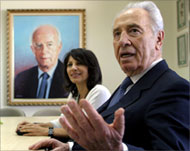
Israeli opposition leader Peres is
considered a diplomatic charmer |
"Sharon wants to appoint Peres as foreign minister in
order to enhance Israel's ugly face at the international arena. And
Shalom wants to keep his job. This is basically the problem."
Taibi says that Sharon, an Ashkenazi Jew originally
from Eastern Europe, would eventually succeed in forming a government
of national unity with the Labor party and some other smaller parties.
He said efforts were being made to cajole Shalom into accepting the post of interior minister.
Deeper crises
This is not the way the crisis is viewed by Lev
Grinberg, professor of political science at the Ben Gurion University
in Bir Sheva.
 |
|
Sharon's disengagement plan is
seen by some as just a US pleaser |
He told Aljazeera.net that the crisis with the Likud is institutional rather than personal in nature.
"I think the Likud is undergoing a deep crisis to the
extent that the party is unable to function properly. The Likud simply
lacks a viable strategy vis-Ã -vis the Palestinians. That is the
crux of the matter."
Grinberg downplayed the political significance of
Sharon's unilateral plan for withdrawal from Gaza calling it "a mere
tactical move by the Israeli military designed to please the Americans
and assuage international public opinion".
Sharon has said that failure to go ahead with the
Gaza withdrawal would risk losing unprecedented US assurances that
Israel would be allowed to keep land in the West Bank.
Risky strategy
Grinberg argued that Sharon will eventually lose status and stature however he behaves with regard to the disengagement plan.
 |
|
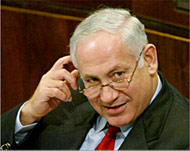
Finance Minister Benyamin
Netanyahu opposes the pullout |
"He
will lose any way, if he sticks with the plan, he will lose his party,
and if he abandons the plan, he will lose his status and stature in
Israel and the United States."
Shalom, like Finance Minister Benyamin Netanyahu, has never been enthusiastic about the Gaza plan.
Both reportedly sought, from behind the curtain, to
incite the Likud rank and file against it, prompting Sharon to threaten
to call for new elections in case they were clinging to their
opposition to the plan.
Shalom has all along argued that the implementation
of the withdrawal from Gaza shouldn't be carried out without a price
from the Palestinian side, possibly in the form of far-reaching
concessions pertaining to the settlement and refugee issues, both of
which considered central to the Palestinian-Israeli conflict.
Post-Oslo deception
Sharon,
for his part, rejects Shalom's way of thinking on the grounds that it
would oblige Israel to resume negotiations with the Palestinian
Authority (PA), an entity which Sharon and his right-wing general,
Defence Minister Shaul Mofaz, view as irrelevant and have made every
possible effort to weaken and virtually destroy.
More to the point, Sharon seems to be worried
that any formal resumption of talks with the PA would ultimately force
Israel to negotiate pursuant UN Security Council resolutions 242 and
338, as well as the land-for-peace formula.
 |
|
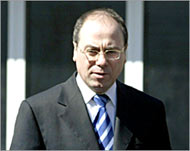
Shalom and Sharon are alleged to
be at loggerheads over FM post |
As
to what Sharon's alternative plan is, Grinberg believes that the
Israeli prime minister is trying to behave very much like former
prime minister Yitzhak Shamir did nearly 15 years ago.