
Israel resumes work on illegal wall
Monday 24 January 2005, 23:39 Makka Time, 20:39 GMT
Israeli
bulldozers have resumed work on one of the most controversial sections
of the illegal separation wall deep in the northern West Bank.
The work began on Monday after an eight-month pause when the construction was halted by a court order.
Palestinian security sources in Salfit town, which
lies just to the south of the Jewish settlement of Ariel, said three
bulldozers began work in the late morning, clearing land belonging to
Salfit and to the neighbouring village of Iskaka.
A spokeswoman for the Israeli defence ministry
confirmed that work had been renewed on a section near the Ariel
settlement after it was approved by Attorney-General Menachem Mazuz.
"The decision to recommence work on the security
fence (in the Ariel area) was approved by the attorney-general," she
said without giving further details.
Court ordered halt
A spokeswoman for the justice ministry was unable to provide any information about Mazuz's decision or the reasons behind it.
Work on the Ariel section of the vast barrier was
halted on 25 June by order of the Israeli supreme court following an
appeal lodged a month earlier by Salfit mayor Shaher Eshtieh.
 |
|
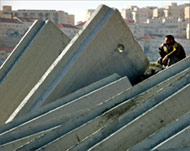
Palestinians say the wall blocks
the creation of a viable state |
In the appeal, Eshtieh warned construction of the
Ariel section would confiscate some 170,000 dunams of land (17,000
hectares) belonging to Salfit and 19 other villages in the area.
In October 2003, the Israeli government decided to
include Ariel and a number of other settlements inside the wall's route
by building a series of horseshoe-shaped fences which would later be
linked up to the main section.
Construction of the Ariel section, which started last
June, is particularly contentious as it is situated very deep
inside the West Bank.
Some 16,000 people live in Ariel, one of the largest of all Jewish colonies.
Clashing opinions
Although the Hague-based World Court
ruled in July that parts of the barrier built on Palestinian land are
illegal, Israel has insisted it will complete the project, which is
eventually expected to stretch some 700km.
Incidentally, the Palestine Society
at London University's School of Oriental and African Studies
School recently organised a seminar and photo exhibition on the
impact of the West Bank wall on Palestinian lives.
|
"The decision to recommence work on the security fence (in the Ariel area) was approved by the attorney-general"
Spokeswoman for Israeli Defence Ministry |
The seminar concluded that the wall
will prevent the establishment of a viable Palestinian state,
create a real humanitarian crisis, and deny Muslims and Christians
access to holy sites.
The participants deemed the advisory
ruling of the Hague-based World Court as very significant, despite the
fact that it was not adopted by the United Nations due to the US veto.
Speaking at the seminar, Azmi Bishara,
Arab member of the Israeli Knesset, said construction of the barrier
wall will continue, but one day it will be removed.
He regretted that there were no
Palestinian or Arab initiatives aimed at enlightening the international
public about the grave implications of the barrier wall.
 |
Tools:
|
|