Rapid-reaction
teams are responding to outbreaks of measles around the province and
teams are spraying for malaria-bearing mosquitoes in the capital Banda
Aceh while doctors struggle to cope with dozens of cases of tetanus.
All are waiting for the first deadly cholera outbreak as a desperate population searches for drinking water from polluted wells.
"I can't think of a situation where so many cards are
stacked against the people," says Dr Muireann Brennan, a medical
epidemiologist from the Centre for Disease Control (CDC) who
specialises in preventing measles outbreaks in disaster zones.
"To have a child who survived an earthquake, a
tsunami, the death of family members, rain, rain and more rain,
terrible living conditions, only to die of measles is not acceptable."
Preventable diseases
Millions of children in the developing world die each
year from preventable diseases such as measles, which proper
immunisation programmes can reduce to little more than a three-day-long
annoyance.
 |
|
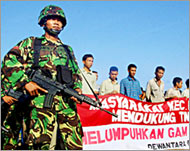
The Acehnese also suffer from
an ongoing separatist struggle |
In
countries including Indonesia, once lauded for its successful national
child immunisation strategy, measles remains a leading cause of death
among children. In 2002, measles claimed the lives of 660,000
youngsters, one-third of them in Southeast Asia.
Immunisation programmes around the country suffered
from the Asian economic crisis, a situation further complicated by the
government's devolving of responsibility for health services to local
authorities four years ago. Since 1999, the number of cases of measles
reported in Indonesia has risen five-fold.
The ongoing war between the Indonesian military and
separatist rebels in Aceh and endemic corruption has further affected
health services in the province. Measles immunisation has plummeted to
between 20 and 40%, according to ministry of health statistics.
Prevention
Measles leaves depleted auto-immune systems
vulnerable to opportunistic illnesses such as pneumonia and upper
respiratory tract infections which thrive in the cool, damp nights of
the monsoon season.
 |
|
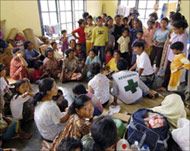
Workers from the UN and WHO
discuss health with the refugees |
International
humanitarian organisations are trying to prevent widespread outbreaks
with an ambitious programme to immunise 1.1 million children between
the ages of six months and 15 years. Vast quantities of vaccine are
being distributed by truck, helicopter and boat to staging grounds in
tsunami-affected areas.
Teams trained to inoculate children are on standby to fly or drive into areas where outbreaks have been reported.
Thus far there have been seven outbreaks but many
parts of the province have seen little or no health services since the
tsunami struck.
Struggle on
In order to prevent its spread, thousands of children
in the areas where measles is reported must be reached within days to
prevent a medical brushfire that would tear through a refugee camp and
potentially claim hundreds of lives.
"We're really struggling to get ahead of these
diseases," says Dr Brennan. "If you fall behind, you will never get
ahead. It can be absolutely devastating. In south Sudan it is not
unusual to find mortality rates of 20 to 30%."
The potential for a breakout of the lethal Plasmodium falciparum
malaria is growing with each passing day, as monsoon rains turn fields
and town sites erased by the tsunami into breeding grounds for the
Asian Anopheles sindiactus mosquito that transmits the deadly disease.
Mosquitoes
"The number of mosquitoes is growing exponentially
... hundredfold increases in a short period," says Richard Allen, a
former head of malaria response at the World Health Organisation whose
organisation Mentor Initiative specifically targets malaria control.
|
"We do not
normally expect to see malaria so early in the season but there have
been reports of many cases in the camps just in the past week"
Richard Allan,
Mentor Initiative |
"We
do not normally expect to see malaria so early in the season but there
have been reports of many cases in the camps just in the past week.
This is the best chance we have to prevent deaths rather than watching
tens of thousands die. This is a disease that will kill more people
than wars and bullets."
Mentor Initiative has begun spraying the interiors of
homes in the Banda Aceh and hopes to spread its operations throughout
the province.
Some malaria prevention strategies focus on killing
the mosquito in its larval stage which requires extensive ground and
aerial fogging.
Emergency conditions
In emergency situations such as Aceh, Allan says, the
best technique is to kill the mosquitoes after they have drunk blood.
Too heavy to fly properly, the insects, which typically bite people in
their homes, head for the nearest wall to digest and reduce their load.
Spraying the walls with chemicals and distributing
insecticide-treated plastic sheeting to the camps will ultimately
reduce the number of mosquitoes. With sufficient stores of the right
drugs, those who develop falciparum malaria, the only variety that
kills, can be treated and make a full recovery, Allan said.
Health officials are also bracing themselves for a
dramatic spike in the number of tetanus cases. Fatal in up to 80% of
cases, it produces agonising spasms and rigidity in patients.
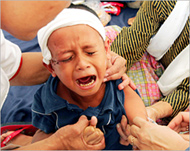 |
|
An Acehnese boy receives his
tetanus shot |
"We
are not seeing the explosive rise in tetanus cases yet but it has a
latency period of three weeks so the tide could be coming soon
especially as the rebuilding starts and people come into contact with
things like rusty nails and so on," says Dr Anton Chang, who has seen
four patients die in the past few days.
"We are doing our best to provide 24-hour care but we
are only 10 (staff) here. I don't know how we will we cope if we get
many more.
"This is a war zone, it was a war zone and it is a
disaster area," says Singaporean physician Dr Chang, whose team is
struggling to keep alive 17 young people suffering from tetanus,
roughly one-quarter of the cases reported province-wide in the wake of
the tsunami. "We are preparing for the worst."