
Sharm al-Shaikh: Another false dawn?
Tuesday 08 February 2005, 23:21 Makka Time, 20:21 GMT
Palestinians
responded to the Sharm al-Shaikh summit with scepticism on Tuesday as
Arab analysts warned the talks did not address any of the key issues
behind the conflict.
Many Palestinians saw the talks as being lopsided in Israeli Prime Minister Ariel Sharon's favour.
They said that while Palestinians agreed to a
ceasefire with Israel, Sharon's government did not give Palestinians
any concessions on the construction of settlements and a separation
wall in the West Bank, or on the release of Palestinian prisoners from
Israeli jails.
"I don't see any achievement in any area," Mustafa
al-Barghuthi, a presidential candidate in the 2005 elections, told
Aljazeera.net.
"I was hoping the Palestinian position would be
stronger on the wall and prisoners. This is much less than anything
that can be described as a breakthrough," he said.
Palestinian grievances
The talks saw the Israeli and Palestinian
leaders commit to a ceasefire, but thorny issues such as
settlements and restrictions on movement have yet to be tackled.
Some analysts questioned how long the ceasefire would hold when such major Palestinian grievances had not been addressed.
 |
|
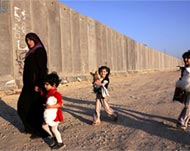
Palestinians say Israelis will not
stop work on the separation wall |
London-based Palestinian analyst and Al-Quds al-Arabi
editor Abd al-Bari Atwan told Aljazeera.net: "What about the morning
after? How long will the ceasefire last and what are Palestinians
getting in return?
"How many Palestinian prisoners are going to be released? What about the other security checkpoints?
He added: "Israelis are betting on Palestinian
patience. What is he [Sharon] going to offer Palestinians to make their
lives less miserable?"
Although Sharon has agreed to release some detainees,
the fates of most of the 8000 Palestinian prisoners held behind bars in
Israel remains unclear.
No stable basis
While optimism about the talks may be thin on the
ground in the occupied West Bank and Gaza Strip, there is no denying
that some Palestinians are hoping that a ceasefire will improve
conditions after more than four years of conflict that has killed
thousands.
London-based Palestinian activist and analyst Ghada
Karmi told Aljazeera.net: "The Palestinians are on their knees. The
Palestinians will almost do anything to get some betterment to improve
their situation. This is not a stable basis for an agreement."
|
"I thought the Palestinians had learned their lesson"
Palestinian analyst Ali Jarbawi |
For their part, Palestinian resistance groups have
been adhering to a de facto ceasefire for almost three weeks now in
order to give newly elected Palestinian President Mahmud Abbas a
chance to open negotiations with Israel. But Hamas says it is not
committed to any official truce.
"There was no agreement," Hamas spokesman in Lebanon Usama Hamdan said.
"There
are Palestinian demands and they were not raised at the summit.
There was no Israeli commitment to the Palestinians. No one can count
on this summit," Hamdan told Aljazeera.net.
Hamdan said Hamas would not accept the discussion of
Israeli security when Palestinian security needs were not
being addressed.
Deja vu?
Rime Allaf, Middle East analyst at the Royal
Institute for International Affairs in London, questioned whether the
Sharm al-Shaikh conference would actually facilitate Sharon's plan to
withdraw from Gaza and allow him to concentrate on the colonisation of
the West Bank.
 |
|
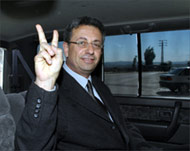
Mustafa al-Barghuthi: I don't see
any achievement in any area | "This
was a big ceremony [made] out of very little," she said. "A ceasefire
is fine, but what kind of steps are being made on the other issues?
"If this ends up paving the way for Sharon to leave Gaza, we are not getting anywhere," Allaf said.
Some analysts saw a repeat of the 1993 Oslo agreement.
"What we have is deja vu. We had Gaza and Jericho
first in 1993. Now we just have Gaza. So in fact we have gone back a
little bit," Allaf said.
Palestinian political analyst Ali Jarbawi said: "I
thought that the Palestinians had learned their lesson and wouldn't
accept the continuation of the building of the wall and the
settlement policy just to accept a ceasefire and go back to 'normal'
negotiations while realities on the ground are being changed."
 |
Tools:
|
|