
Timeline: The peace process
Tuesday 08 February 2005, 20:24 Makka Time, 17:24 GMT
 |
|
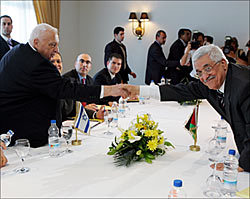
Sharon and Abbas shake hands at Sharm al-Shaikh on Tuesday
|
 |
|
|
The
following is a timeline of the Arab-Israeli peace process
since the Camp David Accords of 2000, said to be the
closest the two sides have come to an agreement to end the Israeli
occupation of Palestine.
25 July 2000
A
marathon summit hosted by US President Bill Clinton between Ehud Barak
and Yasir Arafat at Camp David collapses when they fail to agree on,
among other things, the future status of Jerusalem.
28-29 September 2000
In
a highly provocative move, Israeli politician Ariel Sharon visits
al-Aqsa Mosque, sparking a violent reaction from Palestinians. The
peace process in the Middle East receives a deadly blow as Israel
reoccupies the Palestinian territories amid fighting between the
Palestinian resistance and Israeli army. A second intifada begins
which, according to Israeli human rights organisation BTselem, kills
2171 Palestinians and 194 Israelis by 15 October 2003.
17 October 2000
Egypt
hosts the Sharm al-Shaikh peace summit. The summit announces a plan to
bring weeks of Israeli-Palestinian confrontation to an end. The plan
does not succeed.
6 February 2001
 |
|
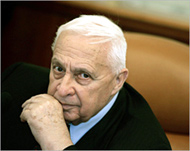
Ariel Sharon was elected Israeli
prime minister in 2001 | Ariel
Sharon of the right-wing Likud party becomes prime minister of Israel
after beating incumbent Ehud Barak in the Israeli general
elections.
21 May 2001
Former US senator George Mitchell releases his long-awaited report (the Mitchell Plan) on the Middle East conflict. It calls for a ceasefire, confidence-building measures and, ultimately, negotiations.
16 June 2002
Israel begins construction of a wall to create a barrier between it and the West Bank.
20 September 2002
Israel
besieges Arafat's headquarters in Ram Allah, demolishing most of his
office complex and confining him there, while simultaneously embarking
on a policy of extra-judicial assassinations and imprisonment of
Palestinian leaders.
26 February 2003
Israel begins a series of incursions, repeated throughout the year, that lead to the reoccupation of parts of the Gaza Strip and the West Bank, inflicting widespread damage and heavy civilian casualties.
27 February 2003
Crown Prince Abd Allah bin Abd al-Aziz of Saudi Arabia announces an Arab peace initiative in the Middle East.The plan insists on Israeli withdrawal from the occupied territories in return for Arab recognition of Israel's right to exist. A similar version but with reservations is adopted later by the Arab League.
29-30 April 2003
Following the invasion of Iraq by US-led
forces, Arafat, under intense international pressure, allows the
election of Mahmud Abbas as Palestinian prime minister. The Israelis
and Palestinians receive the long overdue, heavily promoted road map
formula for peace, internationally backed by the quartet of the US, Russia, the European Union and the United Nations.
4 June 2003
Israeli Prime Minister Sharon and Palestinian Prime Minister Abbas meet at Aqaba, Jordan, to discuss the implementation of the peace road map.
25 July 2003
Palestinian
Prime Minister Abbas visits the White House meeting US President
Bush, in a visit designed to quicken the road map peace
process.
6 September 2003
 |
|
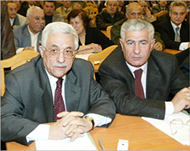
Abbas (L) resigned as premier in
2003 after a tussle with Arafat | Mahmud Abbas, also known as Abu Mazin, resigns amid a power struggle with Arafat and an upsurge in violence.
2 February 2004
Israeli
premier Sharon announces his unilateral Gaza withdrawal plan, shocking
Palestinians, the world, and many members of his own Likud party who
are vehemently against giving up any Israeli settlements in occupied
territory.
22 March 2004
Israel
assassinates the wheelchair-bound spiritual leader of Hamas, Shaikh
Ahmad Yasin, in an air strike which also kills several other
civilians. Palestinians and the rest of the world strongly condemn the
move, warning of greater instability.
17 April 2004
Shaikh
Yasin's successor in Hamas, Abd al-Aziz al-Rantissi, is
killed along with two others in another Israeli air strike, which has
been targeting leaders of the Palestinian resistance. In all,
hundreds of Palestinian civilians have been killed, including
bystanders caught up in Israeli missile attacks from the
air. Experts suggest the killings are an attempt to
weaken Hamas in the run-up to Sharon's plan to withdraw from
Gaza.
11 May 2004
Six
Israeli soldiers are killed in fighting with Palestinian fighters in
Gaza City, the highest Israeli death toll in a single military
operation in nearly two years. Five Palestinians are killed, including
an 18-year-old, and 88 wounded in one of the fiercest battles in recent
months.
10 July 2004
The
World Court at The Hague brands Israel's separation
wall being built between Israel and Palestinian
territories, a de facto land grab on Palestinian land and
tells Israel to tear it down and compensate the victims. Israel rejects
the legitimacy of the World Court.
30 September 2004
Israeli
forces kill at least 23 Palestinians on one of the bloodiest days
of al-Aqsa Intifada so far, as the Israeli army makes a push
into the heart of a Gaza refugee camp.
 |
|
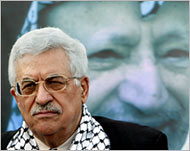
Abbas was elected president
after the death of Yasir Arafat | 11 November 2004
Arafat,
president of the Palestinian Authority and veteran leader and founder
of the Palestine Liberation Organisation (PLO), dies in a military
hospital in Paris, France. Arafat flew to receive treatment due to
a mystery illness two weeks earlier. Arafat had been
virtually under house arrest for the previous two years at his
government compound in Ram Allah due to Israeli restrictions and
threats against his life. The world and Palestinians mourn
the passing of a historic figure.
9-10 January 2005
Abbas,
the former Palestinian prime minister, wins landslide
presidential elections. Abbas pledges to end the occupation and
make peace.
8 February 2005
Abbas
meets with Sharon for the first time since winning the election, at
Sharm al-Shaikh, Egypt. Regional leaders including host Husni Mubarak
attend. Abbas and Sharon declare a truce to al-Aqsa Intifada,
which has killed many thousands of Palestinians and hundreds of
Israelis.
|