As
one of the world's most earthquake-prone nations and, even in recent
years, the victim of what are termed "giant tsunamis", Japan has since
1952 been developing its Pacific Tsunami Warning System.
And while it is regarded as the best in the world, recent events suggest that it still might not be enough.
"The scale of the Indian Ocean tsunami came as a
surprise because events like that, a magnitude 9 quake, only happen
once every 100 years," Masahiro Yamamoto, director of the Earthquake
and Tsunami Observation Division at the Japan Meterological Agency,
said.
"It was too big for us to even calculate its
magnitude at first, and that's very unusual," he added. "It is never
easy to predict the size or speed of a tsunami, but we do our best. Now
we want to learn from this incident."
Tsunami walls
The agency operates six regional centres around Japan
that monitor a network of 300 seismic sensors, including 80 on the
seabed. The gauges record seismic activity and water pressure around
the clock and - if a quake indicates it is likely to trigger a tsunami
based on its location, strength and depth below the surface - they
enable the JMA to issue an alert.
 |
|
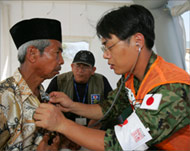
Disaster-prone Japan was quick
to come to the aid of Indonesia |
Local
authorities in coastal regions have also invested in offshore tsunami
walls, quake-resistant shelters and floodgates at the mouths of some
rivers.
The agency aims to have its alert on radio channels
and TV screens within three minutes, according to Yamamoto, although in
reality it is often closer to five minutes.
All Japanese are familiar with the outline of the
Japanese archipelago on their TV screen, with thick red lines marked
along areas most at risk of a tsunami after a major quake, and although
the JMA aims to give a 10-minute warning to allow residents to
evacuate, that is not always enough.
Early on 12 July 1993, a magnitude 7.8 quake off
Okushiri Island, off the west coast of Hokkaido, generated a 30-metre
high tsunami that killed 239 islanders, the worst tsunami death toll in
half a century.
Knowledge gap
"Our warning system is quite well prepared, but still
there is the concern that we may have overlooked something," Masataka
Ando, a professor at Nagoya University's Research Centre for
Seismology, Volcanology and Disaster Mitigation, said.
 |
|
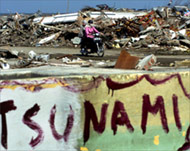
Asia is looking to Japan for help
in tsunami-warning technology |
"We
still do not understand nature well enough to say that we can
absolutely predict tsunami and we need to continue to modernise our
warning system and continually check all the data."
And while the 10-minute warning is the hoped-for
response time, a quake closer to the shore could cut that time
dramatically. In a worst-case scenario, according to projections in
2003 by Japan's Central Disaster Management Council, three simultaneous
quakes could generate a magnitude of 8.7, killing 28,000 people,
including nearly 13,000 in tsunami.
An equally large concern, according to professor
Nobuo Shuto, is that a relatively small earthquake might not be
recognised as posing a major tsunami threat.
Weak point
"The forecasting system is based on 100,000
computer-generated models of a tsunami and is, generally, excellent,"
Shuto, a professor of tsunami engineering at Iwate Prefectural
University, said.
 |
|
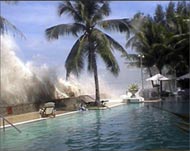
The Asian tsunami's scale took
Japanese experts by surprise |