
Features
Oil prices confound experts
|
By
Adam Porter in Perpignan, France
|
Thursday 03 March 2005, 12:06 Makka Time, 9:06 GMT
Latest
figures from the oil industry have confounded expert predictions
of a price fall in the last two months. As prices have
remained above $50 a barrel, Opec's statements in particular have come
under close scrutiny.
Prices
for the world's most favoured type of oil, light sweet crude, rose to
more than $53 on 2 March, within touching distance of record $55
highs set last October.
Opec was so concerned over the possibility of falling
prices that it was prepared to institute output cuts at its
meeting in Vienna in January.
In the end, it declined to do so. But looking at current data may suggest why.
Demand still rising
The International Energy Agency (IEA) has traditionally been quite conservative on predicting future demand.
Last year it was forced to recalculate its forecasts
on a repeated basis. This year it believes that demand growth will be
1.52 million barrels per day (mbpd) annualised over 2005.
|
"If there is one lesson we have learned from
the exceptional oil market conditions of 2004, it is that the world
economy has become less sensitive to oil price increases than it was
two or three decades ago"
Adnan Shihab-Eldin,
Opec secretary-general |
The bank Societe Generale in Paris, as an example, is working on demand increase of around 2.5 mbpd over the same period.
So already this year to March 1st, global oil demand
has risen around 245,699 bpd by the IEA figures or by 404,109 bpd, if
you prefer those of Societe Generale.
At the same time the most recent IEA report notes that output around the world has been patchy at best.
"World oil supply fell by 645,000 bpd in January to
83.6 million barrels per day, mainly on declines in Opec supply," said
the Paris based organisation. "Non-Opec supply from Canada, Norway and
the US Gulf of Mexico remained curtailed and Russian output fell for a
fourth month."
Economy immune?
In other words Opec did not cut it's supply, but the supply simply "declined".
Yet, speaking in Singapore this week, the
secretary-general of Opec Adnan Shihab-Eldin, formerly director of
research, issued a much more relaxed statement.
 |
|
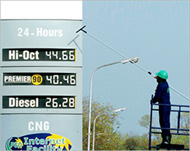
Oil prices continue to climb,
confounding experts' forecasts | "We
hope the fundamental factors, that supply is adequate and Opec will
ensure it has the capacity to maintain adequate supplies, will bring
prices to a level more reflective of fundamentals and we believe that
is $40 to $50 for US crude."
He then went on to say that "if there is one lesson
we have learned from the exceptional oil market conditions of 2004, it
is that the world economy has become less sensitive to oil price
increases than it was two or three decades ago".
"The strong growth of the global economy last year,
in the face of rising oil prices, clearly supports this statement," he
added.
Disingenuous
Yet this sentiment, that high oil prices do not harm
the global economy, is "clearly" not one shared by the IEA. It is
unusual to find these two major world oil bodies at odds with each
other, but the IEA is definite in its outlook.
It says "statements from several Opec representatives
suggesting that the global economy has become immune to any negative
impact from higher crude prices look disingenuous".
|
"Statements from several Opec representatives
suggesting that the global economy has become immune to any negative
impact from higher crude prices look disingenuous"
International Energy Agency |
As well as these 'declines' in output from Opec and non-Opec sources
comes the stated falls in more mature fields. The IEA noted in August
last year that Saudi Arabia has been losing "600,000 to 800,000 bpd" a
year.
If one takes the mean figure of 700,000 bpd this year, Saudi fields have already declined by around 113,151 bpd to 1 March.
Prices have also been exacerbated in the very short term by cold winters in the US and especially in the Mediterranean region.
Also, continued supply disruptions in Iraq, including
attacks on pipelines in the north and infrastructure problems in the
south, have seen Iraqi output fall below pre-war levels.
No indefinite growth
All of these shortfalls, either in increased demand
or supply depletion, have to be met by new fields or by increasing
current production from existing fields.
Increasing production by pumping harder can also lead to field damage.
But perhaps what is more worrying for ordinary people
are the signs that Opec may itself be openly prepared to voice concerns
over the short-to-medium future.
|
"The current exceptional rates of economic
growth cannot continue indefinitely. There is increasing concern over
growing imbalances"
Opec's Shihab-Eldin |
In his speech in Singapore, Shihab-Eldin continued
saying "the current exceptional rates of economic growth cannot
continue indefinitely. There is increasing concern over growing
imbalances, especially ... the large twin deficits of the United States
of America, with the potential associated risks to financial stability".
"We do believe that, if there is [economic] variance,
it is more likely to be on the downside, rather than the upside. This
would then have a serious impact on the revenue expectations of our
member countries."
Wall of uncertainty
The reason that revenues for Opec countries would be
hit is shorthand for a recession. Any recession would dampen global oil
demand, lower prices and cut revenues for Opec.
There is certainly a difference of opinion between Opec and the IEA in some areas.
There are also seemingly conflicting statements from both organisations.
But perhaps one quote from Shihab-Eldin is the most
pertinent for the man in the street in 2005. A quote we may hope does
not bare true.
"When we look at the future," he said "we find ourselves facing a wall of uncertainty."
 |
Tools:
|
|