Two peacekeepers were among the dead in the worst day for the 10-month-old UN mission, officials said.
The Sri Lankan and Nepalese soldiers who died were
the first peacekeepers killed in fighting since the UN troops arrived
in June 2004 to stabilise the impoverished, volatile nation following
the ousting of its leader.
The first clash erupted after UN troops raided a
police station occupied by armed ex-soldiers in Petit-Goave, an
ex-soldier stronghold about 72km west of Port-au-Prince, setting of a
fierce gunbattle, UN spokesman Toussaint Kongo-Doudou said.
"We lost one man," he said, adding that three other
peacekeepers were injured and in a stable condition. Two ex-soldiers
died and 10 others were wounded.
Using a loudspeaker, the Brazilian commander of UN
troops in Haiti, Lieutenant General Augusto Heleno Ribeiro, tried for
20 minutes to get the former soldiers to surrender peacefully when they
opened fire on UN troops, Kongo-Doudou said.
Gunfire
"We wanted to resolve this peacefully but our troops
received a hostile response from the insurgents and so they responded
with force," he said.
Gerard Nelson, a Petit-Goave resident, was sleeping
about a block from the police station when he was awoken by gunfire and
ran outside.
|
"There were bullets bouncing off the walls. People on the street were running to get out the way. It sounded like a war"
Gerard Nelson,
Petit-Goave resident |
"There
were bullets bouncing off the walls. People on the street were running
to get out the way. It sounded like a war," Nelson said.
Afterwards, UN troops moved in on the building and removed at least one fallen peacekeeper on a stretcher, he said.
Later on Sunday, a group of Nepalese soldiers driving
to the central town of Hinche exchanged gunfire with a different group
of former soldiers, UN spokesman Damian Onses-Cardona said.
The ex-soldiers killed one Nepalese and stole one of
their vehicles. It wasn't clear if the ex-soldiers suffered any
casualties.
Ex-soldier stronghold
Later on, Brazilian peacekeepers backed by Haiti's
national police began advancing on nearby Terre Rouge, another
stronghold of ex-soldiers who occupy the town's police station. The
troops reached about 3km outside the town before stopping at nightfall.
"They'll continue tomorrow," Onses-Cardona said. "It
was an area not under control so basically it's a recover and control
mission."
 |
|
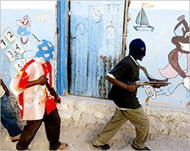
Large parts of Haiti have become
lawless and violent |
The
clashes were the first major confrontation between the 7400-strong UN
force and former members of Haiti's disbanded army, who helped oust
former President Jean-Bertrand Aristide in a 1991 coup and again in an
armed rebellion a year ago.
Haiti, the Western Hemisphere's poorest nation, has
been in turmoil for years. A US-led peacekeeping force was deployed
after Aristide was forced into exile in February 2004, and this force
was replaced by the UN peacekeepers in June.
Despite their presence, armed rebels and former
soldiers still control much of Haiti's countryside and the peacekeepers
have been criticised for failing to curb violence.
UN forces detained 35 ex-soldiers following Sunday's gunbattle, Kongo-Doudou said.
Confrontations
"We are now in control of the police station," UN civilian police spokesman Jean-Francios Vezina said.
The soldiers, many well into their 50s with fading
uniforms and aging rifles, continue to control much of Haiti's
countryside and a handful of provincial towns, bucking calls by the
interim government and the UN force to disarm.
|
"If anybody tries to remove us from this base, we'll know what to do"
Sergeant Michel Alophene,
Commander of ex-soldiers in Petit-Goave |
The
ex-military have won in past confrontations. When Sri Lankan troops and
Haitian police tried to force the ex-soldiers from the former police
headquarters that they took in December, a mob of supporters began
throwing rocks at the peacekeepers, who retreated.
In another standoff that month, a different group of
ex-soldiers took over Aristide's looted estate on the outskirts of
Port-au-Prince.
They only withdrew from the property after the
interim government agreed to give them back pay for the 10 years they
were disbanded.
In a February interview with The Associated Press,
the commander of the ex-soldiers in Petit-Goave hinted at a
confrontation should UN troops attempt to intervene.
"If anybody tries to remove us from this base, we'll know what to do," former Sergeant Michel Alophene said.