
Invasion robs Baghdad of its beauty
Thursday 24 March 2005, 4:53 Makka Time, 1:53 GMT
Baghdad, whose name means the Garden of God, has fallen from grace.
Known
for centuries as one of the most beautiful cities in the world, its
landscape has been marred by concrete blast walls, barbed wire, steel
barricades, sandbags and crumbling buildings pockmarked by bullet holes
or ransacked by explosions.
Things have become so bad that the Iraqi capital
has dropped to the bottom of a quality of life survey of 215 cities,
conducted by the London-based Mercer Human Resource Consulting.
"We used to be under sanctions and the economic
conditions were dire, but never was the city so ugly," Fadhila Dawud, a
teacher who used to take her students on picnics along the banks of the
Tigris, said.
Now they hold picnics in the school courtyard.
Glorious past
Once dubbed the City of Peace, Baghdad was founded in
the 8th century by Caliph Abu Jafar al-Mansur as the capital for his
rising Muslim Abbasid empire. The city soon became the heart of
mediaeval Muslim civilisation - a centre of arts, culture and
architecture.
 |
|
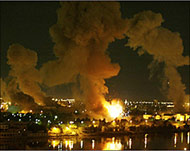
Areas of the city were destroyed
by US bombing in March 2003 |
Forming half-circles on the two sides
of the Tigris, its suburbs, parks, gardens, mosques and marble mansions
earned it the reputation as the richest and most beautiful city in the
world.
Since then, Baghdad has survived the
13th century mayhem inflicted on it by the Mongols, the 16th-century
marginalisation by the Ottomans and two decades of war and sanctions
under ousted ruler Saddam Hussein.
Saddam himself didn't help with
beautification - most of the apartment complexes, government buildings
and palaces built under his orders would not have won any architecture
prizes. And then there were the dozen of statues and oversized
portraits of the Iraqi leader that decorated those buildings.
City of barricades
After the US-led invasion in March
2003, the city of five million became one large military
barricade: Humvees and tanks roaming the streets, helicopters rattling
above, checkpoints and soldiers everywhere.
|
"We used to be under sanctions and the economic conditions were dire, but never was the city so ugly"
Fadhila Dawoud
A teacher |
An armed campaign
against the US-led forces compounded the scars on the city's face,
undermining its ailing infrastructure and tattering the remaining
grace.
Beautiful date palm
groves that lined the 16km-long airport road - a visitor's first
impression of Baghdad - had to be removed to prevent armed men from
hiding in what has become one of the city's most dangerous
battlefields.
The rampant lawlessness
has also encouraged people to take over buildings previously occupied
by government offices and construct squatter settlements.
Tainted walls
Even democracy has
taken its toll on Baghdad. Posters and banners of candidates running in
the landmark January elections - a collage of mismatched colours - are
still plastered everywhere, tainting roundabouts and walls two months
after the vote.
 |
|
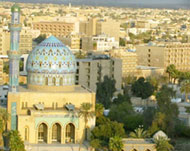
Baghdad endured 13th century
invasions and decades of war |
Huge black banners of religious invocations and photos of Shia saints are randomly scattered around the city.
Alaa
Kadhim, a 25-year-old janitor who's lived all his life in the capital,
said: "It looks so different today - the streets, the buildings,
everything."
"I
lived all my life here, but it's like someone has taken the feeling of
'home' away," Kadhim said, complaining about the ubiquitous blast
walls.
Mayor Alaa al-Tamimi has made it his mission to bring back the city's former glory.
After
taking office last year, al-Tamimi relentlessly nagged coalition
officials to remove the security barriers and open the numerous blocked
roads, his spokesman, Amir al-Hassun, said.
The
city also has many beautification and reconstruction plans awaiting
funds. But al-Hassun said the interim Iraqi government has given the
city just $85 million of the $1 billion it requested - enough to begin
tackling major infrastructure problems only.
City access denied
The
security situation has also denied residents access to many parts of
their city, including the heavily fortified Green Zone that houses US
and Iraqi government offices.
 |
|
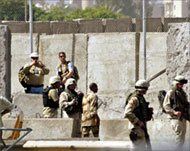
Part of the city housing US and
Iraqi offices has been fenced off |
A
virtual fortress, the 10sq km area is encircled and crisscrossed by
four-metre-high barricades. Its gates are guarded by US Bradley
fighting vehicles aimed at passing traffic.
The US military said it realises the city has suffered but that the measures are necessary.
"Any
soldier of Task Force Baghdad would concede the point that concrete
blocks, blast walls and barbed wire are ugly security tools that
detract from the beauty of any city," Lt-Col Cliff Kent, a US Army
spokesman, said.
But Kadhim, the janitor, said he's hopeful Baghdad will reclaim its beauty.
"Maybe when a new government is formed and things are more stable, these walls will fall, and Baghdad would be free," he said.
 |
Tools:
|
|