The
opening ceremony on Friday will be presided over by Imam Aga Khan, the
68-year-old spiritual leader of Shia Ismaili Muslims who first devised
the project more than 20 years ago.
The park, which lies close to Cairo's
landmark Citadel and was financed by the Aga Khan Trust for Culture,
features Andalusian-inspired fountains, rows of palm trees and flowery
hills and a stunningly intact 12th century wall.
Excavated
from under tons of trash and rubble, the Ayyubi wall - named after
famous Muslim ruler Salah-al-Din ibn Ayyub - is dotted with 15 towers
and boasts several gates.
One
of the gates, Bab al-Barqia, will serve as one of the park's entrances
when the site's restoration is complete in two years, offering a
welcome green space in the over-populated metropolis.
"We went around to see other gates in Cairo to help reconstruct Bab al-Barqia," Elisa Del Bono, an Argentine restoration specialist assigned to the wall, explained.
Traces of blue paint on one of the adjacent towers may indicate it was once blue all over, she said.
Excavation
The
excavation, which began in 1999, uncovered stones dating back to
pharaonic times and recycled by the site's Ayyubi, Mamluk and Ottoman
rulers and artefacts from the Ottoman Empire's late period.
 |
|
Shia Ismaili leader Agha Khan (L)
financed the Cairo park project |
"We've
found dozens of smoking pipes," French archaeologist Julie Monchamp
said, pointing to several boxes filled with ornate handmade pipe heads
made out of clay.
"There
used to be a factory in the area and tubes made of bamboo were affixed
to the heads," she said, also showing fragments of clay jars, some
glazed in vibrant blue hues.
Less
than a metre away from the wall lies a mish-mash of shacks and freshly
painted apartment blocks, part of the low-income Dar al-Ahmar
neighbourhood that was partly rehabilitated under the $30 million
project.
Job
training and employment opportunities were also created for its
inhabitants, some having to do with the restoration of the wall and
landmark buildings in the area such as a 13th century palace, a 12th
century mosque, a 19th century school and an Ottoman house.
"Each
intervention we do is dated so that it's clear it was renovation work
rather than part of the original structure," Dina Bakhum, a young
Egyptian woman, said.
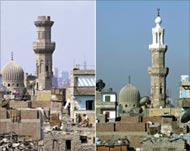
She is overseeing the restoration of Umm Shaikh Shaban mosque whose missing minaret top was reconstructed.
Renovation and revival
At
the site, two men come across a heavy carved wooden door which they
haul to a makeshift workshop in one of the mosque's rooms where young
Egyptian men and women are busy waxing a similar door or delicately
brushing away dust on yet another one to uncover an intricate and
colourful geometric design.
 |
|
The minaret of the Umm Shaikh
Shaban mosque was restored |