Among
his set of six canvases that were mostly covered with images of Saddam
Hussein's two sons was one entitled Al-Jazeera TV, an abstract work
that Wang said represented the role the television channel had played
in challenging the dominance of Western networks.
Followed not just by Chinese artists but also by
government officials and intellectuals, the Aljazeera story has become
a sort of model for China's own attempts to create a globally
recognised television network.
Initially suspicious of the Qatar-based media group
after US statements that it was a mouthpiece for Usama bin Laden,
Chinese television was previously prohibited from using Aljazeera
footage and the Aljazeera bureau in Beijing used to struggle to get
government interviews.
Discarding their original preconceptions during the
Iraq war, Chinese officials are now looking at Aljazeera from a
different angle. How can a developing country produce an
internationally successful television network?
Twofold objective
Often described as a giant, and a not very efficient,
bureaucracy, the state-run China Central Television (CCTV) late last
year launched the first in a series of continent-wide satellite
subscription packages.
Now beaming into North American and Asian living
rooms, the 17-channel Great Wall Package (a combination of multilingual
CCTV and regional Chinese channels) is the start of a five-year plan to
broadcast CCTV across the globe.
 |
|
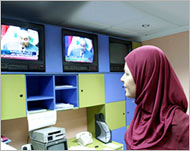
Aljazeera's success has become
a sort of model for the Chinese |
The thinking behind this is twofold. The first is political. The second is economic.
"China feels its voice should be heard
internationally. It wants people overseas to know the truth about the
country," CCTV's head of overseas programming, Sheng Yilai, explained.
Currently international airwaves for Mandarin Chinese
programming are dominated by the Hong Kong-based Phoenix TV and
US-based New Tang Dynasty TV, the latter shunned by Beijing for its use
of volunteers sympathetic to Falun Gong.
Described in its own literature as "a major mouthpiece of the Communist Party", CCTV makes no bones about what it represents.
Official mouthpiece
In recent years updating it image in response to
domestic network competition by introducing live reports and breaking
news bulletins, CCTV news sticks close to the official line.
Believing this to be no bad thing so long as one
understands CCTV's editorial policy, media lecturer Li Xiguang sees the
internationalisation of CCTV as an important component in achieving
China's foreign-policy objective of a multi-polar world.
 |
|
Li Xiguang: Global TV audience is
key to China's foreign-policy aim |
"President Hu Jintao wants CCTV to be a third media balance with Europe and the United States," Li said.
News, however, is only one part of the Great Wall
Package. Aiming to promote Chinese culture and society, the package
includes programming on sports, films, current affairs and soap operas,
an area of Chinese television which has in recent years won plaudits
for its tackling of thorny issues such as domestic abuse and premarital
sex.
Including the domestically well-established English
language channel CCTV 9, which now employs foreign news anchors and
presenters, as well as a recently established French and Spanish
channel, the package is also targeted at non-Mandarin speakers.
Already the North American package has attracted
10,000 subscribers each paying $30 a month. Fifty thousand subscribers
represent the break-even point. Launched in Asia this February CCTV
anticipates a faster pick-up rate amongst the region's sizeable Chinese
communities.
Media power
In addition are the demands of increasing numbers of
Chinese nationals now travelling and living overseas. According to
government figures, 28.9 million Chinese went overseas in 2004 and the
World Tourism Organisation estimate this will grow to 100 million by
2020.
|
"In the long term
CCTV is aiming to become a globally recognised brand and global broadcaster
along the lines of BBC"
David Wolf,
Burston Marsteller,
PR company |
Coming
at the same time as construction begins on its new $1.3 billion
headquarters, a giant, gravity-defying twisted doughnut that is
destined to become the architectural face of modern Beijing, CCTV's
overseas expansion also encapsulates its vision as a major media power.
"In the long term CCTV is aiming to become a globally
recognised brand and global broadcaster along the lines of BBC," David
Wolf of public-relations firm Burston Marsteller says. And with the
Beijing Olympics in three years, CCTV will be well positioned able to
use this global event to build its brand.
In part a reaction to the increasing competitiveness
of domestic Chinese television, CCTV sees overseas markets as long-term
sources of revenue from subscriptions and advertising. Within five
years the average urban family will be able to receive 300 channels
through cable; CCTV currently operates only 13.
Overseas tastes
Currently in negotiations to launch in Africa and
Europe, Shen Yilai sees no reason why local advertisers should not
choose to use CCTV as their media platform once healthy subscription
levels are reached.
 |
|
Painter Wang Mai sees Aljazeera
as an inspiring media presence |
"We
will be considering the tastes of the overseas viewer in our
programming," Sheng says, adding that he anticipates the use of
localised content - in other words, use of Chinese Americans to
make programmes for the North American market if subscription numbers
warrant it.
Since the late 1990s, CCTV has embarked on a series
of internal reforms and revampings, including enlisting the help of
advisers sent from Rupert Murdoch's News Corp.
Persons familiar with the organisation say that while
improvements have been made, doing business with CCTV remains a
frustratingly long-drawn-out process.
Unsure as to how successful it will be, CCTV's Sheng
Yilai is for now emphasising caution. "Lets see how it goes. We are
taking it one step at a time," he said.