A
week after Syrian military and intelligence units withdrew from their
stronghold in Baalbak in the heart of the Beqaa Valley, there was
little to indicate that they once controlled the streets of this sleepy
town.
Besides a few worn posters of Syrian president Bashar al-Assad, change has come swiftly.
Military checkpoints, once painted with the
recognisable red and black of the Syrian flag, have been replaced with
Lebanese cedars. Even a prominent sitting statue of the late Hafez
al-Assad has been torn down and hauled back to Damascus.
For many Lebanese, the withdrawal was a momentous
occasion marking the beginning of what they regard as their path
towards an independent future. But not all parties in Lebanon have
greeted the Syrian departure with such unbridled enthusiasm.
For Lebanon's 400,000 Palestinian refugees, UN
Security Council resolution 1559, and all that has followed it from
unrest in Beirut to Syria's withdrawal, has been met with grave
concern.
"I am very pessimistic about my future here," says
18-year-old secondary school student Wael Issa, who lives in the
Palestinian refugee camp of Wavel, popularly known as al-Jaleel, just
south of Baalbeck.
"I am very worried that they might target us after Syria. It's all laid out in 1559: Syria ... Hizb Allah ... then us."
Fear of reprisals
"People here in the camps are afraid," explains
34-year-old refugee Fadi Yasin, who makes a living selling heating oil
to his fellow refugees during Baalbeck's fierce winters.
 |
|
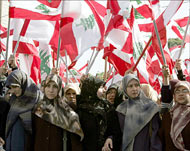
There have already been calls for
Hizb Allah to disarm |
"The
general feeling is that it's our turn now - [the Lebanese government]
wants to get us out of here, the Syrian issue released the floodgates,
and now the tide has turned.
"The state and the opposition have already begun
talking about arms in the refugee camps. But this time there are no
Syrian forces to protect us, and no guarantees for our safety."
Yasin says memories of the Sabra and Shatila massacre
of 1982, where 2800 Palestinian civilians - mostly women and children -
were killed under the watchful eye of then Defence Minister Ariel
Sharon, are all too fresh in the minds of many Palestinians here. For
this reason, they view calls to disarm what little weapons that remain
in the camps with fear, suspicion and hesitation.
"We learned our lesson from Sabra and Shatila. We
disarmed in 1982 after the civil war, and then we were massacred by
Sharon's men, and this was with international protection," he says.
Common view
Issa and Yasin's are views echoed by Palestinians throughout Lebanon.
As refugees, Palestinians in Lebanon live in a state
of constant vulnerability with little to no civil rights. Unwanted by
their host state and unable to return home, theirs is an existence of
seeming permanent impermanence.
 |
|
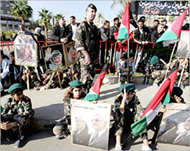
Palestinian refugees have found
themselves living in ghettos |
Their
camps are effective ghettos, with their winding, narrow alleyways;
wall-to-wall cement block shelters; tin-rooftops; abysmal public
services.
They lack day-to-day protection, such as physical
security, freedom of movement, and access to employment. Abandoned
underground bomb shelters - relics of the civil war - are testimony to
the perilous times they have faced - times they fear they may live to
see again.
Indeed, popular sentiment these days in Lebanon seems
stridently against any foreign presence. As a banner in a rally
welcoming home ex-prime Minister Michel Aoun from exile proclaimed in
Beirut's Martyr Square last week, "Lebanon is for the Lebanese."
Analysis
Lebanese analysts insist, however, this is nothing
more than ideological banter aimed at Syria, not Palestinians, and that
while anti-Palestinian sentiment may exist among elements of Lebanese
society, it is marginal and nothing can realistically come of it.
|
"We also seek an end to the effective siege of the Palestinians refugee camps and their status as large group prisons"
Wael Abou Faour
Progressive Socialist Party |
"Yes, there are people who want [the Palestinians]
out, but ethnic cleansing is not politically realistic. Public opinion
would not accept such a move, and the EU wouldn't allow it," explains
Samir Qassir, an influential Lebanese journalist and member of the
Lebanese opposition's media strategy campaign team.
"Even the Shia here can play the Palestinian
card every now and then to avoid disarming themselves, but they will
never accent ethnic cleansing of the Palestinians here."
While sympathetic to the Palestinians that live among
them, Baalbeck's mainly Shia residents also desire to see the
Palestinians return home, but for different reasons.
"The Palestinians should not settle here - in Lebanon," proclaims Hisham Mustafa, a 31-year-old Shia construction worker.
"This is neither because we do not like them nor because we are harmed by them," he explains.
"The Palestinians bring money to this country ...
they enrich the country. We want them to go to back to Palestine
because it is their homeland and it is their right."
Mustafa says he is against disarming the
Palestinians, however, because he considers them the weakest link in
the chain. "If they disarm, it would be our turn next - the Shia and
Hizb Allah."
Improving ties?
Qassir believes the time is ripe for mending
Lebanese-Palestinian ties, and the Palestinian leadership in the camps
should capitalise on this moment, rather than fuelling flickering
fires.
 |
|
The Palestinians have been
denied return by Israel |
"There is a chance now I believe to improve
the relationship, a chance for granting Palestinians their civil
rights here, but we need to save this chance and not compromise it by
making stupid pro-Syrian statements that would only give radical
elements the excuse they need," says Qassir, in reference to
declarations by Sultan Abu al-Ayneen, the PLO's representative in
Lebanon, calling for the rejection of resolution 1559 and refusing
disarmament of the camps.
"We can build on this momentum; but we have also to
disarm radical Lebanese elements who could take a stand against the
Palestinians."
The Lebanese opposition, meanwhile, has taken a
similar stance, saying that Palestinians should disarm - voluntarily,
not by force - and the Lebanese government should reciprocate by ending
its "racist and discriminatory policies" against them.
"Our party's policy is supporting the Palestinian
people who are in Lebanon for reasons outside their will," explains
Wael Abou Faour, a young Druze political leader who has risen in the
ranks of the Progressive Socialist Party - the Druze movement headed by
opposition leader Walid Jumblatt.
"The Palestinians today are part of the
reconciliation between the different Lebanese factions and parties and
the Palestinians are not in any direct confrontation with any of the
parties - unlike the civil war," he adds.
"We dismiss the 1559 which calls for the removal of
the Palestinian resistance from Lebanon - but we call for a voluntary
disarming of the Palestinians, we call on them to give up their arms to
the Lebanese government in return for their civil rights, and for
dealing with the Palestinian camps through the proper Lebanese
ministries as an internal affairs issue rather than a security and
military intelligentsia issue.
"We also seek an end to the effective siege of the Palestinians refugee camps and their status as large group prisons."
Uncertain future
All this is of little comfort to Lebanon's Palestinians, who can only guess at what the future holds for them.
While the Taif Agreement to end the Lebanese civil
war, signed in 1991, outright rejects naturalising them as Lebanese
citizens, Israel denies them the right of return.
|
"We are treated like vermin. Among Syrians, Sri Lankans, and refugees - we are considered the lowest class"
Sameera Abo al-Fool,
Democratic Front for the Liberation of Palestine |
Still,
there has been talk by the Lebanese opposition's Jumblatt in the weeks
following the assassination of former PM Rafiq al-Hariri of
reconsidering the naturalisation option.
But it is neither a solution the refugees desire nor
believe is plausible, explains Sameera Abo al-Fool, a social worker and
political activist in the Democratic Front for the Liberation of
Palestine (PFLP) in Lebanon.
"There is no work here, no source of income. And we
are treated like vermin. Among Syrians, Sri Lankans, and refugees - we
are considered the lowest class," says Abo al-Fool.
She says Palestinians will always be considered a looming threat to Lebanon's delicate political balance.
"Even if they naturalised us, we're branded as
strangers here, and we will never be integrated into Lebanese society.
First of all, we are not welcome. Secondly, we will remain second-class
citizens the rest of our lives. We will always be targeted, we will
always be vulnerable."