
Israeli ruling a jolt for Jewish settlers
|
By
Khalid Amayreh in the West Bank
|
Thursday 09 June 2005, 19:02 Makka Time, 16:02 GMT
The
Israeli Supreme Court's ruling, upholding the Gaza pullout plan
as legal, is a serious setback for hardline Jewish settlers
and a shot in the arm for Palestinians.
The
political left in Israel has lauded Thursday's ruling, describing it as
a "blow to the Jewish settlers' messianic aspirations".
"This ruling ends any question or doubt as to the legitimacy and legality of the disengagement from Gaza. The High Court is the highest judicial body in Israel,
and the settlers and their supporters must respect its rulings," said
Zahava Galon, Knesset member and spokeswoman for the centre-left Yahad
party.
"They should stop claiming that the planned pullout violates their human rights and constitutes a form of ethnic cleansing."
In
ruling the withdrawal legal, the court said the West Bank and Gaza
Strip, which Israeli occupied from Jordan and Egypt respectively 38
years ago, were not parts of Israel.
Cautious Palestinians
Palestinians were lukewarm to the ruling.
|
"They
[settlers] should stop claiming that the planned pullout violates their
human rights and constitutes a form of ethnic cleansing"
Zahava Galon,
Knesset member |
|
The
Palestinian Authority reacted cautiously, saying there was "brazen
duplicity between what the High Court says and what the Israeli
government is doing on the ground".
"We all know that the West Bank and Gaza and East Jerusalem are not parts of Israel.
The question which should be addressed is why the occupation of these
territories continues," said a Palestinian Foreign Ministry spokesman,
Majdi al Khalidi.
He stressed that "our reference is not Israel and its courts, but the International Court of Justice and international law".
Other Palestinian leaders saw nothing in new in the ruling.
"There is nothing new in this ruling. Israel has not officially and formally annexed the West Bank,
but at the same time it built hundreds of Jewish colonies in this
occupied territory," said Mustafa Barghouthi, head of the Palestinian
Democratic Initiative and former presidential candidate.
"If
the court is really true to its ruling, then why doesn't it rule that
this apartheid wall and these settlements are also illegal and ought to
be dismantled as the International Court of Justice ruled," said
Barghouthi.
The
international court in June 2004 ruled that the "separation wall" was
illegal and ought to be dismantled and that all of the West Bank, East Jerusalem and Gaza Strip were occupied territories pursuant to international law.
 |
|
Israeli settlers have vowed to
oppose the pullout plan |
However, Arab
Knesset member Talab al-sanei', himself a lawyer, viewed the court
decision as "an significant precedent" and "a step in the right
direction".
"We
consider this ruling a vindication of our constant stand that
occupation is illegal, illegitimate and must end sooner than later."
But the Arab Knesset member added that "we shouldn't give this ruling more attention than it deserves".
"It doesn't mean that Israeli will wake up tomorrow and decide to end the occupation. The judicial apparatus in Israel is ... used to give the occupation and the administration of oppression a legal facade."
Settlers defiant
The settlers and their supporters have dismissed the ruling as "irrelevant and unacceptable".
"We
didn’t expect anything from this court since the petitioners are Jews
and patriots," said Yoram Sheftel, an attorney for the Gaza settlers. "This was fully expected, there is no surprise, and I am not disappointed because we didn't have any expectations."
Other settler leaders in Gaza vowed to resist the expected evacuation, arguing that their right to the land overrides any ruling by the High Court.
"We have a ruling from God to possess this land," said a settler named Yoram in a telephone interview from Gaza.
 |
|
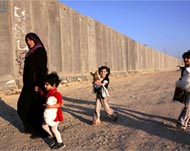
The separation wall was ruled
illegal by the ICJ in 2004 |
Since 1967, Israel has refused to apply Israeli law to the occupied Palestinian territories, except East Jerusalem, which was annexed shortly after the war.
Different laws
The Jewish
state has been applying Israeli law to hundreds of thousands of
settlers living in 280 colonies and colonial outposts in the West Bank
and Gaza, while imposing stringent laws, some of which date to the
Ottoman and British mandate era, on the estimated 3.7 million
Palestinians.
Israel
fears the application of Israeli law to these Palestinians would
confront the Jewish state with two stark choices: to grant Palestinians
Israeli citizenship, which would end Israel's Jewish majority, or risk becoming an apartheid state.
Israeli
leaders, including Prime Minister Ariel Sharon, have sought to
justify the planned withdrawal from Gaza Strip by arguing that this
measure would prevent Israel from becoming a bi-national state as well as help consolidate the occupation of the West Bank.
 |
Tools:
|
|