In
it, the 67-year-old refugee was going back to her house just behind a
young almond tree on a small, breezy hill in the village of Jish.
"Just the way I remember it when I was little," she recalled.
And for a moment, Um Muneer's eyes were not so sad.
Then she woke up.
"It was so real. After 57 years in exile, I was finally returning home."
Um Muneer, who is known in Arabic as the mother of
Muneer, one of two sons who were killed in the region's wars, left Jish
with her family in 1948, terrorised by massacres by Israeli forces in
Palestinians villages, including her own.
The family sought refuge with thousands of fellow
Palestinians in southern Lebanon. From there, they moved to a camp in
Allepo, Syria, then to Beirut's Burj al-Barajneh camp, and finally to
Baalbeck's Wavel camp, popularly known as al-Jaleel, where she lives
today.
Like Um Muneer, about 400,000 Palestinian
refugees in Lebanon and 4 million throughout the Arab world dream of
returning to their homes in Palestine.
Rising numbers
According to the United Nations High Commissioner for
Refugees, the world's refugee population has declined by 4% to 9.2
million this year, the lowest total in almost a quarter of a century.
But the number of Palestinian refugees like Um
Muneer, who are not included in UNHCR statistics, continues to rise in
the absence of a real solution to their plight.
 |
|
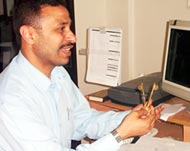
Ali Hweidi said many keep keys
to homes lost decades ago |
Fifty-seven
years ago, about 750,000 Palestinians were forced from their homes by
Jewish forces, seeking refuge in Syria, Lebanon, Jordan, Egypt, and in
what would later become the Gaza Strip and West Bank. Most of their
villages were destroyed as part of official Israeli policy.
Today, the number of Palestinian refugees is equivalent to one-third of the world's refugee population.
Lebanese camps
While they no longer reside in tents, the situation
of Palestinian refugees is abysmal, and the conditions in
conflict-strewn Lebanon are the worst of the lot.
Their
camps are effectively ghettos, "large group prisons" as one Lebanese
politician put it, with winding, narrow alleyways, wall-to-wall cement
block shelters, seeping sewers and leaky zinc-sheet rooftops.
Camps are crowded, and a lack of public electricity and polluted drinking water are constant health hazards.
Lebanon has the highest percentage of Palestinian
refugees who are living in abject poverty and who are registered under
the United Nations Relief and Works Agency for Palestine Refugees
(UNRWA) "special hardship" programme.
Improvements stopped
But Lebanese authorities have vetoed the
reconstruction of camp housing, and until recently the UNRWA had
largely frozen funding improvement of the camps, leading many of the
refugees to say they are neglected and to stage protests on 20 June,
the UN's World Refugee Day, which is marked this month.
Hoda Samra, public information officer for Lebanon's
UNRWA field office, said that since 2003, the UNRWA has stepped up its
role in the camps.
 |
|
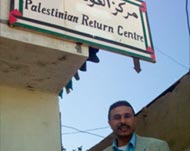
Ali Hweidi urges Lebanon to ease
restrictions on refugees |
"UNRWA
has not frozen its funding for infrastructure in the camps, rather the
contrary. The agency is implementing since 2003 a major environmental
health project in five out of the 12 camps in Lebanon funded by the
European Union in the amount of 8.75 million euros. It includes
construction of sewerage and storm water drainage systems and provision
of safe and adequate quantities of water," she told Aljazeera.net.
But for Lebanon's refugees, the issue is not merely one of basic survival needs.
They lack physical security, freedom of movement, and
access to government services such as health care and education. They
are denied the right to work in dozens of professions by Lebanese
authorities, to receive social security, or to own or inherit property.
Third generation
Abdullah Kayed, 23, is one such refugee. His family
was forced to flee in 1948 from their village of Lubya in Northern
Palestine.
Unlike Um Muneer, Kayed is a third-generation refugee
and has never set foot in Palestine. Nevertheless, he demands his
right to return.
"If I were given the option, I would definitely
return to Palestine. Why? Because it is my country - Lebanon will never
be my country. We never knew Palestine, but it has always been in our
hearts."
Though a recent graduate of pharmacology, Kayed has been unemployed for almost a year.
"Even if we were naturalised, and the [Lebanese]
government gave us our complete civil rights, I would not want to live
here. It's about the principles. It's about our right to return home,"
said Kayed.
Representation
Palestinian refugees in Lebanon complain that they
have no official to represent them in negotiations, though there are a
number of non-governmental organisations that work to further their
cause.
Ali Hweidi is the London-based Palestine Return
Centre's representative in Lebanon and a Palestinian refugee himself.
Like others, he calls on the Lebanese government to ease civil and
political restrictions on Palestinians.
 |
|
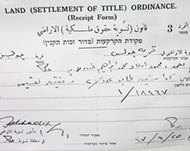
Title deeds are kept to show
claims to Palestinian land |
"The
very least that we demand from the Lebanese government is to provide us
with our basic civil rights, which are non-existent for Palestinians in
Lebanon, so we can fight for our right to return to Palestine, not for
our ability to survive," he says from his office in the Bus refugee
camp in southern Lebanon.
One of the problems facing refugees is that they can't expand their living space horizontally, Hweidi says.
"Keep in mind that the number of refugees in Lebanon
has increased by more than 300% since 1948, and this has clear social
ramifications. As the number of refugees grows, the space to house them
in diminishes," he said.
The walls of his office, like most refugee households
here, are plastered with maps of historic Palestine, labelled with the
lost villages of 1948.
"In every house you will find something that reminds
you of Palestine: A map, a key, a title deed," he says, waving a copy
of a key from one of his camp's elders and pointing out framed copies
of original title deeds to lands in Palestine belonging to refugees in
the Ain al-Hilweh camp a few kilometres away.
Right of return
Hweidi said that establishing peace in the region is inextricably linked to the refugees' right of return.
"The refugee problem has an immense humanitarian and political horizon," he said.
"But we refuse to accept other options, such as naturalisation or being sent to a third country."
Hweidi is uncertain about what's to come, but he is certain that a solution must be found.
"I can't say I have an accurate scenario for what
will happen, but what I do know is that while it is our future at
stake, we will not be given a choice in it. They deal with us as if we
are things, not human beings. There has been no consultation with us so
far, and no formal representative assigned us.
"But so long as there is justice, we are hopeful a solution will be found."