"This is someone's house you know - there's a kitchen in the other apartment," she tells them.
"They don't understand it's rude to just barge into
someone's home here - they have a lot to learn," says Golan about
the internationals who have come to help support Palestinians in
non-violent resistance.
Just another day in cultural training for Golan and
the International Solidarity Movement (ISM), during which the
34-year-old Israeli activist explains to foreign volunteers when they
can snap pictures, how to behave in people's homes and how to respect
local Palestinians.
Golan - activist, mother of two and dedicated wife -
shatters every stereotype an Arab may have about an Israeli Jew: She
fights for Palestinian rights, she lives in Ram Allah, and she is
married to a Palestinian from Nablus, with whom she has two children
(Nawal, 2, and Shaden, 14 months).
Four years ago, shortly after the start of the second
intifada, or uprising, she co-founded the ISM, a non-violent movement
she describes as Palestinian-led and foreign-assisted, in which
volunteers help to raise awareness of the Palestinian plight and to end
the Israeli occupation.
Jewish volunteers
More than 4000 volunteers from around the world have
participated with the ISM. About 20% of these volunteers have been
Jewish.
Things weren't always so for Golan, who grew up in
Tel Aviv, unaware until she was 15 that Palestinians were living on the
same land or, worse, that they were victims of occupation.
 |
|
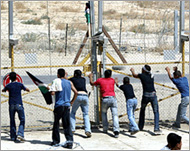
Palestinians and ISM activists try
to bring down West Bank's wall |
"We
went on some kind of school trip, and there was a woman talking about
people who weren't allowed to organise politically, arrests without
charges, homes being demolished, and I said, wait a second - you're
talking about a South American country or something, right?" recalled
Golan, who was born to an ultra-orthodox Jewish mother and a Zionist
father.
"To me it was world-shattering. I couldn't believe
this was happening in Israel. Growing up, I was always fed that we were
the victims, that we had never harmed anyone," Golan said.
During the Oslo period, Golan began to dialogue with Palestinians and met her future husband.
False dawn
For Neta and many others, Oslo brought the promise of peace - a promise that would soon prove false, she says.
"I and many others naively thought things were going towards some kind of solution. For Israelis, the problem was solved. ... So
to hear from Palestinians that there was not even a peace process, that
things weren't fine, to hear them say, 'We're waiting for things to
better,' then after a few years, 'We don't care, it's got to change,
it's unbearable,' was shocking," says Golan.
 |
|
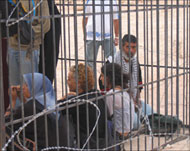
ISM activists in a cage they built
to represent Palestinian captivity |
"The message that we were hearing was that it was going to explode."
According to Golan, nobody wanted to hear that
message, not even political tourists that she and her then-fiancé
Nizar Kammal showed around the West Bank.
"They would say, 'Give it time'. You have time when
your kids have a future, when you have hope. You have time when your
life is bearable, and hope for yourself and your children, but in
Palestine that didn't exist," recounts Golan.
That's when the second intifada started, and with it, the idea for the ISM.
"I thought the international community would be
outraged at the systemic killing of unarmed [Palestinian] youths. I
didn't believe they, or the Israeli community, would accept it. And we
thought if we demonstrate, it could be stopped," said Golan.
"I don't think in my worst nightmare that here we are
five years later, and it's become normal, that unarmed civilians are
routinely shot dead."
Starting with vigils
Golan started by organising vigils in front of the prime minister's office, under the threat of attack by Jewish settlers.
Then the Israeli army began bombing the villages of
Beit Sahur and Beit Jalla adjacent to Bethlehem, which later became a
target itself.
 |
|
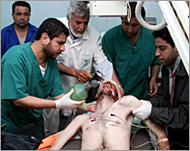
Briton Tom Hurndall was shot by
Israeli forces in 2003 |
Golan
connected with a friend, Luisa Morgantini, from the European
parliament, and put out a call on the internet for people to come join
a series of actions supporting Palestinians.
"And what materialised from that was a march, the
people of Beit Sahur with internationals, to the Israeli military base
there that was bombing the area. We went armed with a letter to
soldiers telling them to dismantle the base," Golan said.
Golan began to organise more protests and interventions, and one incident deepened her sense of responsibility to the movement.
A confrontation broke out between Israelis soldiers and Palestinian villagers who were trying to pass an Israeli checkpoint.
"Another Israeli and I stood in middle - between the
Palestinians and the soldiers and settlers - and I believe it's because
we were there that the soldiers didn't shoot, and the villagers were
able to open the roadblock."
Child killed
The next day clashes broke out again, but this time
Golan was not there. She later learned that a child from the village,
one that she had seen and protected the day before, was killed by
Israeli troops.
In December 2000, Golan joined forces with a
Palestinian-American, Huweida Arraf, who was organising protests of her
own, and Ghassan Andoni, professor of physics at Bir Zeit University
and founder of IMEMC.org (International Middle East Media Centre).
 |
|
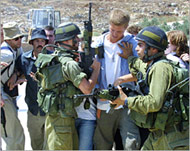
More than 4000 volunteers have
worked with the ISM |
Together, they chose the name International Solidarity Movement for their group and started the website www.Palsolidarity.org.
"If it wasn't the mutual dream of many people, [ISM] wouldn't have happened," Golan said.
Golan's activism has not come without costs.
In April 2001, she was arrested for chaining herself
to Palestinian olive trees targeted by Israeli bulldozers. She spent
three days in prison.
Golan has also had to contend with questioning and a
trial because of her illegal presence in the West Bank. Israelis are
forbidden to enter the Oslo-designated Area A, theoretically
Palestinian-controlled, without permission from the Israeli army.
The fact that her husband is a Nablus resident does
not exempt her from the prohibition. Likewise, Palestinians are
forbidden from entering Israeli-controlled areas without a permit.
New role
"I always joke that we are illegal as a unit.
There's nowhere we can reside legally. He can't be in Israel and I
can't be in Area A. I have to sneak into Nablus and Ram Allah," says
Golan.
After she gave birth to her children, Golan moved
from participating in protests to media and legal support and cultural
training with the ISM office.
 |
|
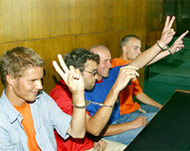
The ISM is foreign-assisted and
Palestinian-led, says Golan |
During the training, newcomers are taught tactics of non-violent resistance.
"We teach them how not to get shot, for example," she says.
In some cases, participation in the ISM has cost the lives of the activists.
Two volunteers, Rachel Corrie and Tom Hurndall, who
were stationed in Rafah in the southern end of the Gaza Strip, were
killed by Israeli forces despite clear markers indicating their
civilian status in April 2003.
Corrie, whom Golan trained, was crushed by an
armoured Israeli bulldozer, and Hurndall was shot by an Israeli sniper
in the back of his head as he was protecting Palestinian children who
were under fire in Rafah.
The soldier who shot Hurndall was convicted of
manslaughter in a rare military court ruling and faces up to 20 years
in prison when he is sentenced in August.
Activists barred
One other volunteer, Brian Avery, was critically
wounded by Israeli machine-gun fire the same year. He has taken his
case to the Israeli High Court of Justice, demanding that the Israeli
military investigate his shooting.
Shortly after the deaths, Israel decided to bar
pro-Palestinian activists from entering the country and has tried to
expel many of those present.
|
"It makes coming here a lot more difficult and
costly. They claim we are 'terrorist tourists', even that we are funded
by the Palestinian Authority or the CIA"
Neta Golan |
More than 80 ISM activists have been arrested, and hundreds have been denied entry.
The deportation was a problem that they could deal
with, says Golan, but denial of entry as was another matter, involving
"serious intelligence work".
Anyone known to be coming to the occupied territories for any kind of solidarity or human rights work was a target.
"It makes coming here a lot more difficult and
costly. They claim we are 'terrorist tourists', even that we are funded
by the Palestinian Authority or the CIA," Golan says.
Harvest campaign
But Golan says that won't stop them. The ISM is
planning Freedom Summer 2005, a 57-day campaign (one for every year of
displacement and dispossession since 1948) against the Israeli
occupation.
 |
|
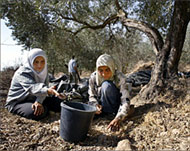
The ISM plans to help Palestinian
villagers harvest olive crops |
After
that, an olive harvest campaign is planned in which foreign activists
help Palestinian villagers safely harvest their crops.
The group continues to support non-violent anti-wall
protests in the villages of Bilin, Beit Surik and Salfit as well as
help protect Palestinian communities suffering from settler and
military violence in the Hebron enclave of Qawawis.
"A lot of people in the world are not comfortable
with the equation that your blood may be worth more than someone
else's," Golan says.
"But that is the reality. And to me, that is definitely the new anti-Semitism: anti-Arab, anti-Muslim sentiment."