The
settlement, one of 21 chosen for evacuation in coming months, has been
the source of much grief - and now speculation - for Palestinians
here.
Abo Ahmed's home stands directly across from Neve
Dekalim, the largest and most ideologically extreme of the Gush Katif
settlements, a bloc established in 1970 - three years after
Gaza was captured and occupied by Israel.
Not far from the settlement is an Israeli sniper
tower, stationed along with hundreds of soldiers, to protect the
illegal settlers from their Palestinian neighbours and original
inhabitants of the land. Gunfire from the tower has left pockmarks the
size of apples in the wall of Abo Ahmed's second-floor living room.
 |
|
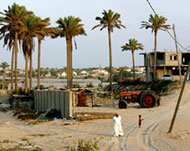
The Mawasi enclave is sealed off
by the Gush Katif settlement bloc |
Aside from this, the view from the window of the abandoned room is striking.
"It's beautiful, right?" he said, laughing, looking back at his cratered wall. "If only we could enjoy it."
For several years, Abo Ahmed had not ventured up to
this room for fear of becoming a target. And though the beach is a
five-minute walk away, it is off limits to Palestinians.
Anxious
Like
most refugees here, Abo Ahmed is anxiously waiting for the day Jewish
settlers leave Gaza and for his life to return to semi-normality.
"The settlements are one of the biggest obstacles for
us, and we feel it more than anyone here on the front lines. We suffer
on a daily basis," he said.
"All I remember from the past few years is that there
were always martyrs, always injuries and always tanks down the street,"
he recalled.
His sister-in-law, Zakiya Musa, held a nursing
three-month-old in her arms. "I just can't wait for them to leave, so
we can relax, for our children's sake. They are mortified of the sniper
fire they hear every night," she said.
Palestinian Authority
How the settlers will leave and what role the
Palestinians will have in all this remains a mystery to most, including
the Palestinian Authority (PA). Until now, Israeli Prime Minister Ariel
Sharon has largely refused to coordinate his withdrawal from Gaza with
the Palestinians, said Palestinian Deputy Prime Minister Nabil Shaath.
"There is very little coordination going on ... the
Israelis only talk about coordination, but it hasn't happened," Shaath
told Aljazeera.net.
The PA also has to figure out what to do with the
land that will return to Palestinian control and how gains will be
distributed.
Initially, the Israeli government said it would
demolish the settlers' houses after they were evacuated, then
Palestinians would clear the land of the debris. Israeli officials
backtracked on the agreement this week.
Shaath says a special court will deal with the claims
to private land, which constitutes 5% of the total amount of land. The
other 95% is government land that cannot be bought or sold for six
months after disengagement.
"After this, we will implement a plan of privatising
the agricultural areas through a transparent bidding process. In other
areas of land, we plan to build housing units for those in most need,
such as refugees whose homes have been demolished or families of
martyrs," Shaath said, referring to Palestinians who have been killed
by Israeli forces.
Living space
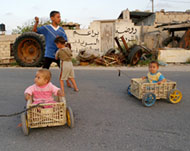
But the idea of building apartment units for the space-starved refugees in Gaza has met with mixed reactions in Khan Yunus.
 |
|
Many Palestinians do not want to
live in overcrowded apartments |
"We
would rather build on a piece of land anywhere, or even stay here in
the camp, than live in cramped apartment buildings," said camp resident
Abo Walid, whose house has been threatened with demolition by Israeli
forces because of its proximity to Neve Dekalim.
"We would leave our house every night for fear they
would demolish it on top of us. We couldn't sleep during the night
raids. We were living in daily trauma," he added.
Abo Walid, whose brother was killed by an Israeli
sniper two years ago in the camp, says the first thing he will do after
the settlers leave is head to the beach.
His friend, Abu Khalid, a teacher in the nearby
elementary school, is quick to point out that it is not just about
enjoying the beach.
"If it was just about having access to a beach, we
would go to Gaza City. It's about our right to live freely. It's about
occupation, which will continue even after they withdraw," he said.
 |
|
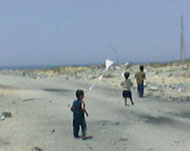
Abu Ibayd: We want to have fun
without the fear of getting shot |
"Remember,
they will still control Gaza's borders, airspace and sea. And they are
relocating all the settlements to the West Bank. They are simply
restructuring the occupation."
For others in Khan Yunus, the question of what should be done after disengagement is simpler.
"We want to be able to have fun without the fear of
getting shot, to go on outings and play, to go to the seashore," said
10-year-old Kifah Abu Ibayd.
She and some other children trotted off into the horizon, close to the sniper tower, trying to fly a handmade paper kite.
Mawasi enclave
Nearby, Mawasi resident Subhi Astal, 57, waited for
Israeli forces to open the Tufah checkpoint. Mawasi, a Palestinian
enclave within the Gush Katif bloc, has been sealed off from the rest
of the Gaza Strip for more than four years.
Special permits must be obtained to pass the
checkpoint, and Palestinian residents often wait for days before they
are allowed to enter.
"The settlers are leaving in the right time. There is
nothing left for them here. They took everything and have completely
abused the area's resources.
"They overdrilled the area for water wells such that
the water salinity has increased in Gaza. They are even taking our
earth," said Astal, pointing out several trucks of golden Gaza sand
being transported, at 2000 shekels ($437) a load, to Israel for
construction purposes.
"I would like to see things improve in Gaza. I think
they should turn the settlement lands into a tourist area and some of
it into agricultural land. I think the land should be returned to the
people, and the returns should be distributed fairly. But I guarantee
this won't happen," Astal said.
Preparations
Shaath insists the post-disengagement process will be
transparent and that the Palestinian Authority has bigger things to
worry about after disengagement.
 |
|
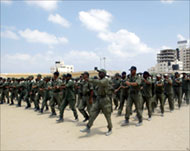
The PA has set up a security
force to take control of the land |