The
issue is not the omnipresent Israeli-Palestinian strife, nor the
increasingly contentious elections, in which each party seeks to assert
its presence.
The issue is the summer carnivals. The Palestinian
Authority, along with some liberal and secular circles, sees them as a
recreational activity for a people in need of respite from the Israeli
occupation.
The increasingly powerful Islamists, on the other
hand, view these activities as an expression of moral permissiveness,
fraught with sexual suggestions, an assault on Islamic morality and
conservative traditions.
This is not a straightforward showdown between the
ruling Fatah party and Islamist Hamas. Significant sections within
the Fatah rank and file are against what they view as aspects of moral
decadence. Some local Fatah leaders think the mainstream movement
stands to gain in popularity by opposing such events.
Concert in Nablus
This past week, dozens of armed men affiliated with
Fatah’s armed wing, the al-Aqsa Martyrs Brigades, cut short a rock
concert by a popular Palestinian signer in Nablus, the largest town in
the West Bank.
Rock star Ammar Hassan came on stage 45 minutes late
on Tuesday and was rushed off less than an hour later by guards after
masked men fired guns into the air.
Following the incident, opponents and proponents
traded the usual accusations: The concert organisers and their
supporters called the objectors "dark forces and reactionaries", while
the conservative public accused the organisers "and those who stand
behind them" (an allusion to the Ministry of Culture) of "seeking to
spread immorality and promiscuity under the pretext of cultural
openness".
Promiscuous mixings
The interruption of the Nablus concert was not an isolated incident in the battle over the hearts and minds of the Palestinians.
 |
|
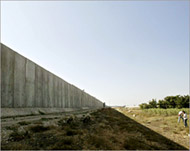
Palestinians herd sheep near
Israel's wall near Qalqilya |
The
previous week, the pro-Hamas acting mayor of Qalqilya, Hashem al-Masri,
imposed a ban on another event that organisers, including the
Palestinian Folklore Union, wanted to stage in the conservative city.
According to al-Masri, the carnival would feature
foreign troupes with performances deemed offensive to local culture and
Islamic sensibilities.
"We are Muslims, and we respect our faith and
culture. If others have an identity crisis, let them keep it for
themselves. We will not allow any wanton display of immorality and
indecency in this town," al-Masri said.
He said most townspeople were firmly opposed to staging these "permissive concerts" in Qalqilya.
"We are answerable to the people who elected us. The
secular elements have no right to impose their views and ideas on us.
We have our way; they have theirs."
Another municipal official, Nidal Jal’oud, opposed
the carnival, pointing to the Israeli wall surrounding the city except
for a small opening that is often locked by Israeli soldiers.
"Qalqilya is literally a detention camp. True we
don’t have gas chambers, but our town is surrounded by a huge
concrete wall… it is a thousand times worse than the worst Jewish
ghetto that ever existed in Europe."
He accused concert organisers of wanting to inflict an additional insult on Palestinians.
"They think that wanton mixings of young men and
women is an expression of civility and modernity, but, to us, these
things are an expression of permissiveness and vice."
Dark forces
The opposition by the Islamist forces to summer
carnivals, which often is expressed during Friday sermons in
Palestinian mosques, is met with exasperation from liberal and secular
circles.
Yahya Yakhluf is the PA minister of culture and a
moving force behind the summer carnivals. He spoke to Aljazeera.net via
telephone from his Ram Allah office on Wednesday.
He castigated those who oppose the foreign troupes
and concerts in Palestine as a "bunch of ignoramuses and fanatics who
want to promote the culture of darkness at the expense of the culture
of light".
"They are practicing intellectual terrorism. They
want to control the movement of life in accordance with their whims and
moods. They claim that popular dance and singing encourage promiscuity."
Yakhluf denied that he was encouraging a secular anti-religious culture at the expense of the Arab Islamic culture.
"We are Muslim and we are proud of our Islamic culture, and we believe there is room in Palestine for all cultural trends."
Yakhluf’s views, however, are rejected by Sheikh
Hamed al Beitawi, a senior Muslim cleric in the West Bank and head of
the Palestine Religious Scholars.
He said the "wanton concerts and carnivals" were "decidedly incompatible with the teaching of Islam".
"We oppose these things for two reasons: First of all
there is promiscuous singing which is fraught with sexual suggestions,
and, second, we continue to suffer on a daily basis from the crimes of
the Israeli occupation."
Beitawi said "these activities" were having a divisive effect on the Palestinian people.
"I call on the minister of culture to respect and
show deference to the feelings of our people. Besides, the money
we squander on these permissive performances should go to feed the
hungry and the poor among our people."