Ziyad
Abu Ziyad, a member of the Palestinian Legislative Council, was
reacting to the move by Tel Aviv to extend the
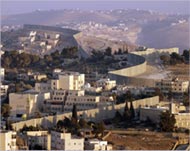
barrier so as to separate more than a quarter of the Palestinian population of Jerusalem from the rest of the city.
The
revised route will mean that some 55,000 residents of East Jerusalem,
which was seized by Israel in 1967, will no longer be able to travel
freely throughout the city.
About 230,000 Palestinians live in the city.
The
decision prompted a furious reaction from Palestinians, who accused
Israel of trying to impose a unilateral solution on the fate of
Jerusalem.
"What is happening now is Israel's implementation of
a unilateral decision to set Israel's borders, despite all Palestinian,
Arab or international consideration," Abu Ziyad told Aljazeera.
"They
(Israel) have invented a cover to implement their plan. This cover is
the lie of Israeli withdrawal from the Gaza Strip," he added.
Europe,
the US and the rest of the world refuse to talk about anything related
to the Palestinian-Israeli conflict, continued Abu Ziyad.
"They
say they would wait until the Israeli withdrawal from Gaza is
completed. The withdrawal is being carried out along with the
implementation of a Zionist project in the West Bank," he stressed.
Neighbourhoods separated
The new path will cut through two Palestinian
neighbourhoods as well as the Qalandiya refugee camp on the eastern
outskirts of the city.
 |
|
The barrier dramatically changes
Jerusalem's demographics |
But
Deputy Prime Minister Ehud Olmert insisted that Jerusalem citizens who
found themselves outside the route of the barrier would not lose their
access to services to which they were entitled.
"They
will continue to be the beneficiaries of the social and municipal
services which they are entitled to as holders of residency cards,"
Olmert told public radio.
The minister, a
former mayor of Jerusalem, also said that "building work should be
completed in September" around East Jerusalem.
The barrier reshapes the boundaries of the disputed city and dramatically changes its demographics.
It
leaves four Arab neighbourhoods with 55,000 residents, including a
refugee camp, on the West Bank side, while including the largest Jewish
West Bank settlement, Maaleh Adumim with close to 30,000 people, on the
Jerusalem side.
The 55,000 Palestinians face daily trips through
Israeli checkpoints to enter the main part of their city, while the
rest of the West Bank's 2.3 million Palestinians are banned from
entering Jerusalem at all times because of Israeli security
restrictions.
PA powerless
Asked
what the PA intends to do in reaction to the Israeli plans, Abu Ziyad
said: "The PA is not an equivalent of the Israeli side. It does
not have the ability and power to face and stop these Israeli
actions."
 |
|
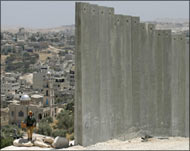
The US is financially aiding the
set up of the wall, says Abu Ziyad
|
He said there was "a clear American prejudice concerning this issue".
"The
US has dedicated $50 million to install electronic observation
equipment at the gates established at the separation wall inside the
West Bank and around Jerusalem city," said Abu Ziyad.
"We cannot even convince the Americans to use their money and authority to force Israel to respect The Hague's decision.
"There is no specific Palestinian strategy to deal with the separation wall."
Court rulings
Construction has been slowed down in the Jerusalem
area following recent rulings by the Israeli Supreme Court that said
the fundamental rights of some civilians were being infringed by the
current plans.
The rulings forced the government to redraw parts of the route and implement extra access measures.
Chief
Palestinian negotiator Saeb Erikat said the move had the potential to
destroy the already deeply troubled peace process as it appeared that
the Israelis were trying to impose their own solution on the status of
Jerusalem.
|
"This is a very critical development which has the potential to destroy the entire peace process"
Saeb Erikat,
Chief Palestinian negotiator |
"This is a very critical development which has the potential to destroy the entire peace process," Erikat told journalists.
"With this step, they are trying to decide the fate of Jerusalem.
"We are urging the Bush administration to stop Israel dictating the situation and from imposing unilateral measures."
Wall illegal
While the government has taken account of the Supreme
Court's rulings, it has ignored the non-binding judgment of the United
Nations' International Court of Justice.
The ICJ ruled that parts of the separation barrier which jut into the West Bank are illegal and should be torn down.
Palestinians
point to its route as proof of an intention to pre-empt the borders of
their promised future state, while Israel insists that it is a security
measure designed to prevent attacks on its soil.