At
first glance, Oman mirrors Western stereotypes of Arabia perfectly:
scorching summer heat, scores of oil wells, acres of sand dunes and a
powerful monarch.
But a closer look tells a different story. On the
streets of the capital, Muscat, Urdu and Swahili vie with Arabic as
languages spoken by many natives.
The standard headdress is not the flowing kuffiya
scarf favoured by Arab men from Aleppo to Abu Dhabi but an East African
cap, the kumma (with the distinctive Omani turban, the massar, reserved
for more formal occasions).
Oman is making regionally unusual efforts to preserve its wealth of cultural and natural riches. This includes four World Heritage sites, wildlife sanctuaries of unrivalled global significance, plus about 5000 castles and other monuments.
Add miles of unspoilt beaches, a sunny climate and a
safe, relaxed atmosphere, and one of the Middle East's least explored
countries is poised to become a major tourist destination.
Cultural capital
With several celebratory events planned, Muscat dons the title of Arab capital of culture for 2006.
Once the centre of a mercantile empire active from
the western coast of India to East Africa, Muscat was the conduit not
only for Oman's famous trade in frankincense and spices but for
cultural exchanges with other regions bordering the Indian Ocean.
 |
|
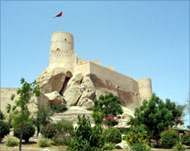
Oman has an imperial past and
boasts 5000 historical sites |
One
way of gauging this cultural cocktail is to look at Muscat's popular
eateries, where Indo-Pakistani curry houses jostle Lebanese restaurants
and branches of Starbucks. The imaginatively named American Tikka
restaurant sums it up nicely.
Listen carefully, and you will hear members of the
Lawatiya tribe chat in Kochki, a tongue derived from the Indian
subcontinent's Sindhi and Gujarati. Meanwhile, the Balush community
speak a dialect of Baluchi (found in Iran and Pakistan).
And the country's links to East Africa - Zanzibar was
until the 1960s home to thousands of Arab colonists - are reflected
today by many Omanis' use of Swahili.
Style police
Muscat's architecture reflects a variety of
influences: Indian, East African, Portuguese and British, plus a
resurgent Arab genre thanks to a conservation-minded policy.
"From the early 1980s, the government issued us with
strict guidelines regarding building design," said Ali al-Muscati, a
civil engineer based in the capital.
One striking result is the lack of glittering
skyscrapers like those towering over nearby Dubai. Traditional
architectural styles are promoted instead.
"The sultan himself takes a lot of interest in this
and oversees the design of major buildings," says al-Muscati. "For
example, the central bank - which follows classic Islamic styles."
Traditional touch
Arched windows, parapets and other stylistic touches
adorn the majority of Omani homes and offices, and Muscat boasts
several international-prize-winning constructions. Many old buildings
have been carefully preserved.
 |
|
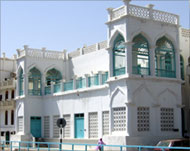
Properties on the seafront show
a blend of Arab and Indian styles |
The
port district of Mutrah boasts some of the most appealing examples. An
attractive arc of two- and three-storey whitewashed buildings lines the
seafront.
The crescent of graceful arches and overhanging
balconies is interrupted by the blue-tiled al-Rasul al-Aazam mosque and
a covered souq, where the scent of spices wafts through a labyrinth of
shop-lined alleyways.
Nearby, two 16th-century Portuguese-built forts stand
sentinel over the sea approaches, while a dozen or so hilltop
watchtowers overlook residents from their vantage points - relics of
more dangerous times.
Greater Muscat's architectural landscape features
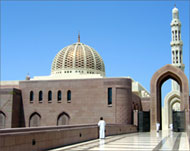
several beautiful new mosques - including the breathtaking Grand Mosque
with its stunningly decorative interior and golden dome that glows at
night.
Historic treasures
But it is the past that offers Oman's greatest
treasures. About 200km west of Muscat lies Bahla, home to a remarkable
medieval fort and a centre of traditional handicrafts such as pottery.
Centuries of annual rains eroded the fort's mud-brick
walls and towers. But Bahla joined the UN's World Heritage List in
1987, and a major restoration programme began.
 |
|
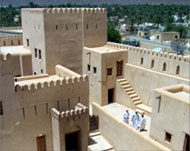
Nizwa fort, the biggest in the
peninsula, has been restored |
You
can get a taste of what awaits Bahla at the nearby city of Nizwa, the
former capital of the Omani interior about 170km from Muscat.
Built in 1668, Nizwa fort is the biggest in the
Arabian Peninsula - its central keep stretches 50m across with walls
more than 30m high. Attractively restored, it nestles beside a bustling
souq specialising in jewellery, khanjars (traditional Omani daggers)
and handicrafts.
Also near Bahla is another 17th century castle, Jabrin. The former ruling imams of Oman once resided in its decorative rooms.
World heritage
"In terms of major cultural heritage, Oman is the
only country in the Gulf region that has anything like this," says
Professor Clive Holes of the Oriental Institute at the University of
Oxford.
"This is because Oman developed urban societies long before the other Gulf states," he said.
Three other locations feature on the World Heritage
List. The ancient northern site of Bat and its environs form one of the
most complete collections of settlements and necropolises from the 3rd
millennium BCE in the world.
The list also includes the frankincense trees of Wadi
Dawkah, plus the remains of the caravan oasis of Shisr/Wubar and the
associated ports of Khawr Rawri and al-Balid.
These recall the legendary trade in frankincense -
burnt to produce aromatic smoke - which was one of the most important
luxury commodities of the ancient and medieval world.
According to the Bible, one of the Three Kings
presented frankincense to the baby Jesus. Tourists too can buy
packets of the resin (preferably for adults), in souqs across the
country.
Animal attraction
But the fourth Unesco World Heritage site emphasises
that Oman's cultural significance is matched by its environmental
importance - the Arabian Oryx sanctuary.
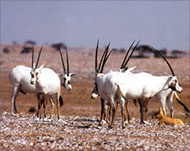
This rare antelope survives arid conditions thanks to morning fogs that dampen the vegetation it eats.
 |
|
The striking Arabian Oryx was
close to extinction |
The
sanctuary is home to striped hyenas, Nubian ibexes, gazelles,
caracal lynxes, foxes, badgers, wolves, hedgehogs plus a variety of
rodents and reptiles.
Elsewhere, the Arabian leopard, once thought extinct,
has reportedly been spotted lurking in the mountains, much to the
excitement of conservationists.
"Oman overall has great
animal and plant biodiversity because it has mountains, desert, coastal
areas and rich coral reefs," says Salim al-Saadi, director of
biodiversity at the nature conservation department.
"Most of the birds of the Old World can be found
here, as Oman is on a strategic route for migrating birds," al-Saadi
adds. Resident and migratory birds include flamingos, golden eagles,
bustards, herons, plovers, grouse and scores of others.
Marine marvels
Meanwhile, off the Omani coast lies unparalleled aquatic life.
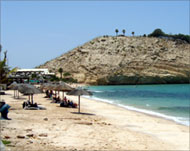 |
|
The Omani coastline is popular
with tourists - and turtles |
"Only
Oman has four species of nesting turtles," says al-Saadi proudly. "We
have the largest nesting population of loggerhead turtles in the world,
especially on Masirah Island."
Indeed, five species of turtles swim the Omani
waters, including the endangered green turtle, the loggerhead turtle
and the olive Ridley turtle and the critically endangered hawksbill
turtle, which all nest on Masirah Island. The leatherback turtle does
not nest here but visits coastal waters.
Oman is one of the few places in the world where
turtles can be watched freely. Ras al-Hadd, where up to 13,000 turtles
come each year, also attracts hundreds of curious human visitors.
So far, the government has established five nature
reserves and 14 protected areas (including nine coastal lagoons), with
more on the way.
Development challenge
Oman faces the same challenges of rapid development
found elsewhere in the oil-rich region but has shown unusual
sensitivity to environmental concerns.
"The central government began conservation efforts
from 1979 - long before anyone else in the region," says the director
of Nature Conservation Planning, Mohammed al-Shuayli.
"But before this, we were known for traditional
conservation. Each tribe would, for example, set aside areas to allow
plants to grow. This was partly as a precaution against drought."
Today, no major development project proceeds without
an environmental impact study. Use of land, within the protected areas,
such as grazing, is strictly regulated while all hunting is forbidden.
"We have rangers all over the sultanate and we're
also raising public awareness," says biodiversity chief al-Saadi. "In
that, we are seeing success."
Tempting tourists
The government aims to wed these efforts to the
development of sensitive, up-market tourism. The sultanate received a
reported 1.5 million visitors in 2004 and hopes to double that figure
by 2010.
 |
|
The translucent dome of the
Grand Mosque glows at night |
Several
major tourist resort projects are under construction. Plans to build
Blue City (al-Madina al-Zarqa), a $15 billion tourism complex 100km
northwest of Muscat, were unveiled in June.
Construction of the 35-square-kilometre resort begins
at the end of 2005 and is to take 15 years. The first stage comprises
five luxury hotels, a club, a golf course, a museum, an aquarium and
housing.
Meanwhile, the construction of roads and visitor centres to serve important historic sites and wildlife reserves is under way.
And so, several centuries after explorers Ibn Battuta
and Marco Polo visited the country and wrote of its splendours, Oman's
days as a little-known destination may finally be coming to a close.