
Features
PA minister: Jerusalem faces many threats
|
By
Laila el-Haddad in Gaza
|
Wednesday 31 August 2005, 13:24 Makka Time, 10:24 GMT
The
holy city of Jerusalem is at the heart of the Palestinian-Israeli
conflict and represents one of its most symbolic and explosive
issues.
In
September 2000, a visit by Ariel Sharon to occupied East Jerusalem's
Haram al-Sharif (Noble Sanctuary) sparked a five-year Palestinian
uprising.
Palestinians claim occupied Arab East Jerusalem as
the capital of their future state, while Israel insists the entire city
is theirs for eternity, indivisible and non-negotiable.
The
Israeli government, under Sharon's leadership, has enacted a raft
of measures in and around Jerusalem in recent months to create a new
political reality on the ground.
Palestinians say the Israeli measures are
predetermining the outcome of a negotiated settlement, rendering their
dream of a Palestinian state with occupied Arab East Jerusalem as its
capital all but impossible.
Against
this backdrop, Palestinian Minister of State for Jerusalem Affairs Hind
Khoury has the daunting task of raising awareness about the
plight of the Palestinians in Jerusalem and the threats facing the Old City.
Though a Jerusalemite herself, Khoury works from an
office in Ram Allah, since Israel closed the PLO headquarters in the
occupied city - the Orient House - in 2001. She was appointed Jerusalem
affairs minister in March.
Aljazeera.net spoke to Khoury by phone in her Ram
Allah headquarters about settlement expansion plans around the city,
disengagement and the fate of Jerusalem.
Aljazeera.net: You hold a unique cabinet position - minister of state for Jerusalem affairs. What does that mean exactly?
This ministry is meant to emphasise the focus on
Jerusalem because of the special threats the city is facing these days
that warrants the work of an entire ministry. Mind you, it's an
inter-sectoral kind of coordinating body because other ministries
contribute to the work of the city and the governorate.
It's
good to put the emphasis on the city of Jerusalem because the threats
facing the city of Jerusalem are very much a microcosm of the threats
facing the entire Palestinian nation.
Israel's strategy, which has always been to take as
much Palestinian land as possible with as few Palestinians as possible,
is mostly apparent in Jerusalem.
What is the significance of Jerusalem for Palestinians?
Jerusalem is our history. It is the city that
holds our national heritage. It is the spiritual, cultural,
economic and social centre of Palestine throughout history and centre
of Muslim and Christian holy sites.
It is also the site of very specialised health-care
institutions, education institutions, and other service providers for
the whole Palestinian territory, especially the West Bank.
Jerusalem is also the main exit for the north-south
link in Palestine, from Bethlehem to Ram Allah, and from northern West
Bank to southern West Bank.
We recognise that Jerusalem is holy to Jews, Muslims
and Christians, and it cannot be exclusively for only one religion. But
Israel as a Jewish state refuses to recognise Jerusalem as a
pluralistic city and has purposely taken measures in changing the
demographic composition of Jerusalem.
Christians and Muslims are excluded form city while additional illegal Jewish colonies are constructed in and around it.
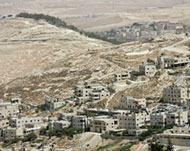 |
|
Israel is increasing the number
of settlements around Jerusalem |
Israel announced some weeks ago plans to
expand one of its settlements into the occupied East Jerusalem area of
Burj al-Laqlaq, land originally belonging to the Islamic
Waqf. What do you believe are the implications of expanding this
settlement so close to Haram al-Sharif?
It's immediately adjacent to the wall of the Old City
and normally no construction at all should be allowed to the wall or
above the height of wall.
In this particular case, the Israeli municipality
approved the construction of 31 housing units with a dome for a
synagogue right in middle of a very crowded Muslim quarter. In the
Old City we have barely 40 square metres per family of six
members. It's the most crowded area.
It certainly threatens peace in the Old City -
putting all these settlers right in the middle of this crowded place
and with segregation in the quality of life and so on.
It's very strange that Israel is so much more
preoccupied with creating more settlements than providing any service
for legal residents and it's equally amazing Israel wants to overcrowd
a very important world heritage that is under threat and has been
defined as such by Unesco.
This settlement is inside the Old City of Jerusalem
and is meant to control as much as possible of the Old City. There have
been various nuclei in the Old City and efforts at purchasing houses
even through forgery if necessary and Israelis hope to influence
political process once we have a discussion on the final status of the
City.
So they want to make Jerusalem, if they control it, irrelevant in final status talks.
The
world's governments and media judged the disengagement plan as
a huge success. How do you see it from your perspective, as
minister of Jerusalem affairs?
The disengagement plan was, yes, partly successful
because there were evacuation of settlers from Gaza and that's a good
thing. But it also meant increased control over Jerusalem and a
Jewish city in the greater Jerusalem area. So Israel has
effectively traded Gaza for East Jerusalem. As the rest of the
world's attention was diverted, Israel's strategy has been playing
itself out in East Jerusalem.
What we are witnessing in East Jerusalem is that the
Gaza disengagement was not meant to really start a peace process but
rather to end one. And the very concept of concept of a two-state
solution is a very major risk. We can't have available a
Palestinian state with 54% of the West Bank.
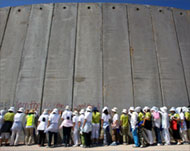 |
|
Israel's separation barrier
encroaches on Palestinian land |
Israel also announced plans to make room for 25,000 more settlers in the colony of Maale Adumim, East of Jerusalem.
Land confiscation orders were issued for 1600 dunums
(400 acres) of Palestinian land to continue to build the wall around
Maale Adumim and to link it to Jerusalem.
Maale Adumim as a colony bloc is about 68sq km
- much larger than the area of Tel Aviv. This is a colony
that goes deep into the West Bank a depth of 14km.
This particular colony is very dangerous to the peace
process and to the whole two-state solution endorsed by President Bush
and the international community.
Israeli officials argue the wall is an effective security measure aimed at protecting Israelis from Palestinian suicide bombers.
The
best way for Israel to have security is to end the occupation. But if
it wants to build a wall, it has every right to do so provided it
builds it on its own frontiers, and those are the 1967 borders. We
would like to never see the wall at all of course. Our idea of peace is
pulling down walls, not putting them up.
It's not about security though. This is a political
wall and it has been acknowledged as such in the Israeli High Court on
a number of occasions. If it was a security border they would
build it on their borders.
The wall goes deep inside Palestinian borders and
built to maximise Palestinian land in the Israeli side and Palestinians
on other side. The wall is about confiscating land, not about
security, and hence the International Court of Justice (ICJ) ruling
which declared it illegal under international law.
The Israeli government has a very clear policy of maintaining the Jewish majority in Jerusalem by a ratio of 73.5% to 26.5%. What are the implications for Jerusalem's Palestinians?
The Israeli policy has been implemented since 1967 in
Jerusalem to reduce the Palestinian presence in the city and these
measures included the controlling and revoking identity card holders
inside the city. Students who continued to study long years abroad
have had their ID cards revoked.
Palestinians who married and stayed abroad lost their right to be residents of the city.
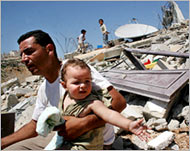 |
|
Israel demolished 150 homes in
Jerusalem last year |
Also, Israel, through its urban plan, has always
controlled the presence of Palestinians through the city by not
providing them with enough space, by not letting them grow.
Many Palestinians could not find housing for years
and sought housing outside the city instead. Now we find 70,000
Jerusalemites live in the West Bank area because they could not find
housing in Jerusalem.
Taxation measures have also been very aggressive in
the city. We've seen home to home campaigns for collection of
taxes, major penalties for people who build homes without licences, and
extensive demolition orders.
At the moment there are 10,000 pending demolition
threats in city of Jerusalem. Last year 150 homes were
demolished. Also Jerusalem sees a lot of land confiscation to
build Israeli colonies.
What is so significant about a Jerusalem ID card?
As Jerusalemites, in 1967 when we were occupied by
Israel, we were given identity cards to indicate that we are residents
of the city. But we are not citizens of Israel - simply residents.
As residents, we are given permanent residency if we
stay in the city, and if our centre of life is in the city. But if we
live outside of city for seven years, then we have no right to
come back.
In practice, it works differently. Students -
including my son - who were away for two continuous years, came
back to find their driver's licence and insurance cancelled.
Palestinians are treated as residents if they stay in
Jerusalem, but many Jerusalemites found themselves in diaspora and
couldn't come back, nor their children. These Palestinians have no
right to come to Jerusalem.
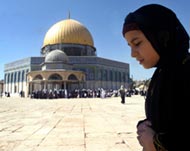 |
|
Many Palestinians have been
stopped from reaching holy sites |
Now with the latest law, Jerusalemites who marry West
Bankers cannot live in Jerusalem because their offspring cannot get the
right of residency.
This way slowly but surely Israel is getting rid of
as many Jerusalemite Palestinians as possible and maintaining
demographic control over the city.
The wall has been used to control demographics in Jerusalem and if we look at the routing of wall, it's a sinuous routing.
Along the way it has carved out as much land as
possible and left out on the Israeli side as many Palestinians as
possible, and created five or six ghettos in the process.
Shaafut refugee camp is a good example. It is
barely 2km away from the Old City, yet a wall will be built around
it, carving it out to be on the Palestinian side and hence getting rid
of 10, 000 Jerusalem ID holders. Of course they tell them they will
pass state-of-the-art crossings, but really these people live like
prisoners.
And, over the years, they will have difficulty
getting to Jerusalem and lose the centre of life in the city and right
of residency.
What's being done on the Palestinian side -
by the PA and your ministry - to try and put a stop to Israeli
encroachment on Palestinian land in Jerusalem, and to draw
attention to the issue?
That is what we do. We try to being more and more
attention to all the issues as much as possible, which means every one
of these intensive measures.
We do meet with international diplomats and inform
them of the threats to Jerusalem as well as remind them of obligations
to uphold and enforce the Fourth Geneva Convention against Israel. Most
recently, on August 27, the diplomats were taken into the field to
witness the area of new land confiscation orders around Maale Adumim.
Is the international community receptive to Palestinian concerns about Jerusalem?
It's very unfortunate that the international community has not done anything about this.
I must say I'm very disappointed by the international
community's failure to hold Israel accountable for its violation of
human rights and international law, and the failure to discourage
Israel from going ahead with all these drastic and perhaps inhuman
measures against Palestinians, which also empower Palestinian
extremists, and even makes moderate Palestinians extremists as well and
leads to more violence.
They are receptive, they do acknowledge that
Jerusalem is as occupied as Gaza, but they are not able to do anything
about it. This is the bottom line.
What's the American role in all of this?
The
US is Israel's chief benefactor and provides billions in taxpayers'
dollars to fund projects. But even the US opposes construction of
new settlements and for years has called for a freeze of settlement
building.
So I think it would be in US national interest to
demonstrate that it does believe in the rule of law, democracy and
defence of freedom. And its failure to do so undermines US
credibility. And that's not only bad for peace but also bad for US
interests around the world.
Sharon recently renewed his vow that
Jerusalem will remain united as the eternal capital of the Jewish
people, never to be divided, never to be negotiated. How do you,
as a ministry, see your role in the face of such maximalist claims?
These statements are part of Sharon's unilateral
solution to the Palestinian problem that includes the Gaza
disengagement. My role and the role of the cabinet is to directly
confront Israel's strategy and preserve Jerusalem as a pluralistic city
equally sacred to Jews, Christians and Muslims and try to do our best
to provide Palestinian Jerusalemites the right to live in dignity in
their own city.
 |
Tools:
|
|