
Features
Activists hear Palestinians' woes
|
By
Khalid Amayreh in the West Bank
|
Monday 22 August 2005, 11:54 Makka Time, 8:54 GMT
When
Corinna Vicenzi and her mostly Italian delegation of about 120 women
arrived in the West Bank this week, they expected widespread optimism
about the Israeli withdrawal from the Gaza Strip.
Instead,
what the peace activists witnessed was more roadblocks, a further
expansion of Jewish settlements and a giant wall encircling Palestinian
population centres and cutting off East Jerusalem from the rest of
the West Bank.
The Women in Black tour is aimed at fostering peace between Israelis and Palestinians.
The international peace movement of Women in
Black began in January 1988, one month after the first Palestinian
intifada (uprising) broke out.
Regular vigils were held by a
group of Israeli women to protest over the occupation, and soon their
idea spread from country to country, wherever women sought to
speak out against injustice in their own part of the world.
Testimony
On
Saturday, the Women in Black delegation, which was in Jerusalem for the
movement's 13th international conference, visited the southern
West Bank town of Hebron.
 |
|
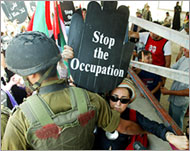
Women in Black supporters
oppose the occupation |
There they heard of the suffering by ordinary
Palestinian women whose sons, husbands and other relatives have been
killed, maimed or imprisoned by the Israeli occupation army, especially
since the outbreak of the al-Aqsa intifada in September 2000.
The mostly Italian delegation, which included a few
other European women activists, heard testimony from Sarah Karajeh,
president of the local Palestinian women's union, whose husband was
killed by undercover Israeli soldiers three years ago.
Karajeh, who described the Israeli occupation as "an
act of rape", called on women around the world to stand up for justice
and not be "deceived by the negative stereotypical images about our
people and our cause".
"We don't have the means to defend ourselves. And I
don't reveal a secret when I say that we essentially rely on the world
public opinion, people like you, for our survival. So don't let us
down."
Tribunal demanded
Another Palestinian woman, whose 14-year-old daughter
was seriously wounded by a stray bullet fired by an Israeli
soldier near the Ibrahim Mosque in downtown Hebron last year, demanded
the creation of an independent international tribunal to which
Palestinians could go for justice.
 |
|
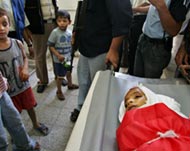
Palestinians say a world tribunal
to deal with injustices is needed | "Every
Palestinian family has been gravely wronged by Israel, and the Israeli
justice system doesn't and can't give us true justice. The occupation
and justice are after all starkly incompatible."
"Hence, we demand the creation of a genuine judicial body to which Palestinians can approach for redress," the woman added.
A third Palestinian woman, Sara Abu Sharar, dismissed
Israeli claims that repression of Palestinians was a response to
"suicide bombings".
Abu Sharar said her husband, Salim Safi, died of torture at the hands of Israelis inside a torture cell on 6 January 1971.
"There were no suicide bombings then, there was no
intifada. Yet, they killed my husband and tormented my family and me
personally for many years to come."
'Slow death'
Dua'a Takruri, 21, who spoke in English, described
the "slow death" being meted out to more than 9000 Palestinian
prisoners in Israeli jails, including her father, Haroun Takruri, who
has been behind bars for 20 years for resisting the Israeli occupation.
 |
|
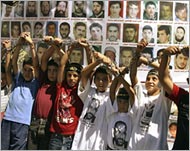
More than 9000 Palestinians are
imprisoned in Israeli jails | "When
I visit my dad, I see him only through double glass. They don't allow
any physical contacts. They treat us like animals, and after five
minutes, they tell us time is up."
Vicenzi described the "separation wall", as Israelis
call it (Palestinians call it the apartheid wall) "a totally inhumane
structure".
"It is something very very remote from anything relating to humanity," she told Aljazeera.net.
She added that her group adopted the slogan "The wall must fall".
"When we return to Italy, we will communicate to the Italian public everything we have witnessed and encountered."
EU lobbying
 |
|
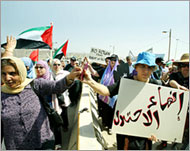
Israeli, Palestinian and foreign
women joined hands in peace | Asked
if she would lobby EU political institutions to urge them to take a
tougher stand on the wall, Vicenzi said her delegation's priority was
to build a grassroots movement in Italy and across Europe to promote
peace and justice in Palestine and Israel.
"We very strongly believe that a strong public
opinion can prompt change provided it has the correct information,"
Vicenzi said. "This is why we are here."
An Austrian member of the delegation, Paula
Abrams-Hourani, said it was essential that European peace activists
concentrated on the "terrible problem of Palestinian political
prisoners, especially children".
Assault
At the end of the meeting, which took place at the
Palestinian University Alumni Union building in downtown Hebron, a
Palestinian woman, Nawraz Kawasmi, spoke about the Israeli withdrawal
from Gaza, saying it was "the fruit of our struggle and sacrifices".
|
"Israel must leave the West Bank and Jerusalem. Jerusalem is the heart of Palestine, and Palestine can't live without her heart"
Nawraz Kawasmi,
Palestinian woman | "It
is not a gift from Israelis. It is the price of our blood and
sacrifices. This withdrawal is not a solution. Israel must leave the
West Bank and Jerusalem. Jerusalem is the heart of Palestine, and
Palestine can't live without her heart."
After the meeting, the activists toured the old town
of Hebron, where Jewish settlers threw stones, eggs and rotten tomatoes
at them.
Three women were hit in the assault.
 |
Tools:
|
|