
Features
Israeli exit fuels hope for Gaza economy
|
By
Laila El-Haddad in Gaza
|
Saturday 27 August 2005, 16:39 Makka Time, 13:39 GMT
As
the Israeli disengagement from the Gaza Strip draws to a close, hopes
for economic prospects in this impoverished, strife-torn land have been
renewed.
Already, the EU has pledged investments in Gaza,
with 700-800 million euros of mainly infrastructure projects by June,
according to Antoine Eric de Haulleville, head of the EU's
International Management Group mission in Palestine.
The
US government transfered $50 million to the Palestinian Authority in a
ceremony in Ramallah on 24 August. The money will go mainly to housing
restoration, roads, water facilities, schools and health clinics.
But Gaza's prospects of economic success are clouded if it remains cut off from the West Bank and from the rest of the world after the Israeli withdrawal, experts have said.
According
to the World Bank, a lot more than dollars and disengagement is needed
if the Palestinian economy, now a shambles, is to revive.
"Disengagement
in and of itself will not make an appreciable difference to the
prostrate Palestinian economy," said World Bank country director Nigel
Roberts.
A
December report issued by the bank warned that if the Israeli closure
regime that has crippled the Palestinian economy was not changed,
poverty and alienation would deepen.
Quick dismantlement
For the economy to benefit from disengagement, these border closures will have to be dismantled quickly, Roberts said.
"Restrictions
on the movement of Palestinian goods and people imposed during the
intifada … have so severely distorted and compressed the functioning
of the economy that returns on investment are now for the most part
negligible."
 |
|
Daher says transportation costs
in Palestine are excessive |
The high cost of crossing the borders has made it more expensive to ship goods between Palestinian cities than from Israel to China, says a Palestinian executive.
"If
you get a product out from Nablus to Ram Allah, because it has to go
through the back-to-back system of service delivery, it's much cheaper
to ship something from Ashdod (Israel) to China," said Sani Daher, CEO
of Paltrade, the private-sector, government-mandated national trade
promotion association of Palestine.
Costs of trade
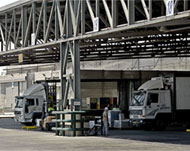
Daher continued: "So you can see the effect this has on our economy. Under the 'back-to-back' system, goods must be unloaded from one truck, extensively checked and reloaded to another truck.
"The process, which can take two days to two weeks, increases the costs of trade in Palestine so much that businesses are no longer competitive."
Paltrade
faces the formidable task of developing Palestinian trade as a driving
force for a sustainable economy, while every aspect of that economy is
under the control of an outside power.
The
trade organisation works with key Palestinian businesses, helping them
develop a strategy to become more competitive and meet market access
requirements. But Daher fears the organisation’s work will be
rendered meaningless by Israeli restrictions.
"I
think our efforts without freedom of movement of goods and people to a
certain extent will be moot because if there are physical impediments
to the movement of goods, there is nothing we can do in terms of trade
development and trade promotion," Daher told Aljazeera.net from the
trade group's Gaza offices.
Inconclusive
So
far, talks on changing the Israeli-controlled border regime have been
inconclusive, according to the Palestinian Minister of Economy Mazen
Sinnokrot, who met a Jordanian trade delegation on Sunday to
discuss on trade relations.
 |
|
Gaza's borders remain hostage
to a web of Israeli controls |
"Up
till now, discussions are going on in earnest, experts from the
international community are present, representatives from the [Middle
East] Quartet and the World Bank are also attending.
But
so far we have not reached breakthroughs that we can report on the free
movement of goods into Gaza," Sinnokrot said, adding that Israeli
officials had turned down proposals by third-party security experts to
update security screening techniques.
A slew of laws and regulations have been enacted in recent weeks to create incentives for investors - both Arab and Palestinian - to come to Gaza Strip.
Uncertainty
But Daher says pumping in foreign aid, on which Gaza’s economy has stayed afloat for the last few years, or encouraging investment is not enough for economic renewal.
Uncertainty about the future is hindering growth.
"There are $4 billion of deposits in Palestinian banks from the Palestinians themselves in Palestine. There is no shortage of money in Palestine," Daher said.
"We
don't need foreign direct investment. People aren't investing because
they don’t see what would happen to their investments."
Others point to government mismanagement and say a clear economic strategy is lacking.
"We
are facing a host of problems that render the prospects for a
successful economy minimal," said Mahmud al-Farra, a
Palestinian-American private investor who co-built the Palestinian
Flour Mills and the Palestinian airport in the 1990s and lost much of his profit to a Palestinian Authority takeover of the mills in the late 1990s.
"First,
there is no government planning. Second, people are simply not up to it
- there is no appetite for investments. And, finally, the purchasing
power is non-existent."
"We also have to ask ourselves - who is out of his mind enough to come invest in Gaza?
I don't think we'll see change in the coming two years, and even then
not much will change on the ground politically speaking."
Palestinian recovery
|
"We expect that in a couple years you will see a similar surge in unemployment in the West Bank"
Sani Daher,
Paltrade CEO |
Echoing
the December World Bank report, Daher said that a Palestinian recovery
can only come through a change in the border regime followed by export
development and a government strategy for economic development.
"[I]f
there’s a concerted effort to develop exports with a reformed border
regime for facilitating the movement of goods, you could see a
significant drop in unemployment as much as 11% by year 2006," he said.
Trade development and export development, in turn, will drive all other aspects of the economy, including investment.
"It's all linked to facilitating the movement of goods and people," Daher said.
Ultimately, the real test is in the West Bank, says Daher, whose fate he fears will mirror that of Gaza’s in recent years.
"There's a reason why the unemployment in Gaza is double that in the West Bank. It's not because Gaza people are lazy. It is because Gaza has been surrounded by a wall for seven or eight years and products cannot get out easily. The problems of al-Mintar [commercial crossing] have choked the Gaza economy to unbelievable levels."
Electric fence
After Israel
built an electric fence around the impoverished strip in the mid-1990s,
unemployment and poverty soared and the economy has been crippled. Only
40 truck shipments of a possible 150 are allowed outside of Gaza "on a good day", Daher says.
The same back-to-back commercial crossing system used on Gaza's borders is to be put in place in seven locations across the separation wall in the West Bank in coming months, according to Daher.
"It is like a bottleneck for the whole Palestinian economy in Gaza. And that's what's coming to the West Bank when the Israelis in a few more months will close down the wall, and people don't realise that," Daher said.
"We expect that in a couple years you will see a similar surge in unemployment in the West Bank. This is a serious threat not only to the economy but I believe to peace in the region."
 |
Tools:
|
|