
Features
Pullout closes chapter for Gazans
|
By
Laila El-Haddad in Gaza
|
Monday 05 September 2005, 21:23 Makka Time, 18:23 GMT
At 72 years of age, Hajj Ali Tayish has lived to see many changes in the Gaza Strip.
Growing up, Tayish saw Gaza ruled by British forces.
In 1948, he saw its population triple almost
overnight with an influx of about 200,000 Palestinian refugees from
neighbouring villages, many of which he took into his own home and who
today make up two-thirds of his hometown of Dair al-Balah.
But what Tayish remembers most is seeing some of the
first Jews come settle in Gaza, only a few metres from his house in the
now-vacated settlement of Kfar Darom - and recently, seeing them go.
Tayish says he treated those early settlers as neighbours.
"I would serve tea and dinner and sit down with their
community leader. We never imagined it would turn out this way. They
took advantage of our kindness," he said, fixing his headdress and
supporting his frail figure with a lacquered wooden cane, with his
grandchildren giggling behind him.
First colony
Kfar Darom was the first Israeli colony established in Gaza in 1946.
The original colony was a "tower and stockade"
outpost, a walled-in compound founded by a group of religious
Zionists known as the Hapoel Hamizrachi, on a small plot purchased by
the Jewish National Fund.
The group had hoped to influence the deliberations of
the Peel Commission and the expected partition plan for Palestine at
the time by establishing such colonies as "facts on the ground"
throughout the country.
During Egyptian rule of Gaza after the 1948 war, settler activity in Kfar Darom subsided.
The colony was partly abandoned upon orders from the Israeli army.
Resettlement
After Israel conquered and occupied the territory in
1967, Kfar Darom was re-established as a strategic military colony that
formed the base for the Israeli Nahal Corps, a paramilitary youth
organisation.
Gradually, the settlers returned. This time,
alongside them were sniper towers and Israeli troops. Later came tanks
and helicopter gunships.
 |
|
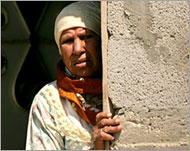
A Palestinian woman watches
Israel's pullout from Kfar Darom |
Today, save for its red-roofed villas and sniper
towers, all that remains of Kfar Darom and its colonists are vestiges
in the Palestinian town that surrounds it: pockmarked houses,
burned-out buildings, demolished homes, razed greenhouses and farms,
even a destroyed well - one of three that served Dair al-Balah.
"It used to be one of the quietest areas around.
People would actually flee to Dair al-Balah from the Israeli army,
because they thought it was safer here," said 23-year-old Ayman
Taleeni. His home, 100 metres from Kfar Darom, is riddled with bullet
holes.
"We were under a daily curfew every night. One time they came unannounced to our house," he said.
"Instead of using the front door, they knocked down
the back wall of the house with their tanks, running over the goats and
chicken, and then got out of the tank and occupied the house for
several days."
Horrible days
During the past four years of the Intifada, Israeli
troops would often raid Palestinian households here, like the Taleenis
and the Tawayshas.
One man's house, Khalil Bashir, is still occupied and off-limits to reporters.
Um Muneer Tayish - Hajj Ali's wife - recalls one time
when soldiers occupied their own house, kicking them out of their
bedrooms and forcing them to sleep downstairs on the ceramic tiles. The
rooms were defecated in, she said, and their son was used as a human
shield.
"When the soldiers went back to the settlement, they
would take my son with them as a human shield, pointing a rifle at his
head the entire way," she said.
"We have seen some horrible, horrible days."
The Israeli army says "occasionally" its troops have
conducted searches around and inside houses here to "monitor and foil
suspicious and hostile activities." Army spokesmen neither confirmed
nor denied the use of Palestinians as human shields, a practice
that has been outlawed the Israeli High Court of Justice.
 |
|
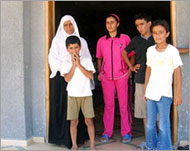
Um Muneer Tayish with grandchild
Islam Tayish in forefront | Next door, Hajj Ali's daughter, Subhia, talked about the bitter irony of living with the occupation in their own house.
"I actually had to apply for a permit and get
military clearance to wash my clothes - my washing machine was on the
roof of my house and I wasn't allowed to access it," she said,
laughing.
She bought a new washing machine instead.
The east wing of the Tawaysha household - including
the kitchen - was off-limits during evenings and nights because it
overlooks the settlement and the sniper tower guarding it.
"For five years we were scared to even get near that
window. The sniper was directly in our face, and a tank was standing at
the door. We would bring our dinner to the living room and wouldn’t
dare go out at night."
Eventually, she left the house after one of her
13-year-old twin sons began to suffer from psychological problems -
involuntarily urination, fits of crying, trouble speaking and sleeping
- from the constant shelling around them.
Neighbours convinced her to move back a few months
later, citing concerns that nearby Israeli troops would occupy or
demolish the house.
Her son Islam still has trouble speaking.
Media coverage
Subhia says she resents the foreign reporters who
descended upon Gaza to cover the disengagement, only to focus on the
suffering of the settlers leaving their homes.
 |
|
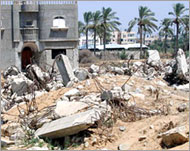
The rubble of a razed home
remains in Dair al-Balah | "What
about us? Where were they when we were being shelled, when we were
placed under complete lockdown with a tank in our back yard? What about
our tears?"
Like his daughter, Tayish has no sympathy for the settlers.
"No one asks about the Palestinian refugees of 1948,
many of whom are now living in Dair al-Balah. Aren't they human beings
who were forced out of their homes, too, to which they are not allowed
to return? No one feels their pain," said Tayish.
The
Tawayshas look forward to safer, happier times when they can worry
about school grades and government services, not bullets flying through
their windows.
"I want security. I want a new life, a government to
care for us and, most importantly, I want the ability to live with
dignity to raise my children free from fear. We've had enough."
Dair al-Balah's municipal leader Ahmad al-Kurd hopes to help her - and the community -recover.
Goals
Plans are in the works to repave and reopen the
wrecked roads that split this refugee town, to fix the electricity
grids and to beautify the graffiti-plastered public park, according to
al-Kurd.
"And those are only the short-term goals," he said.
For Subhia, though, the disengagement is not over
until the sniper tower visible from her window is dismantled and the
soldiers nested in it are finally gone.
"The evacuation of that sniper tower will mean we can finally sleep at night without fear, without crying."
In the distance, for the first time in nearly five
years, her sons played football in an empty lot of razed farmland
outside of the house - without the fear of being shot.
 |
Tools:
|
|