Alpha
Oumar Konare on Wednesday said the underlying economic and social
reasons had to be tackled, to avoid a repetition of the scenes in which
African immigrants died trying to enter the Spanish enclaves of Ceuta
and Melilla in North Africa.
"It's not security measures, it's not prisons in
Madrid and walls in Africa that will solve the problem," said Konare
after talks with European Commission head Jose Manuel Barroso in
Brussels.
"These youths that we're seeing today defying barbed wire and walls are not ruffians, they're not bandits," he said.
Fourteen people have died in recent months while
trying to break into the enclaves, some of them shot by Moroccan
security forces.
The African leader said the underlying problems which fueled an exodus of poor Africans had to be tackled.
"We have to have the courage to broach the problem of
farm subsidies, which weaken our economy and impoverish out rural
areas," he said, in a clear reference to the EU's long-controversial
generous farm aid system.
More immigrants repatriated
Morocco, which has come under fire for dumping
hundreds of the would-be immigrants in desert areas near the Algerian
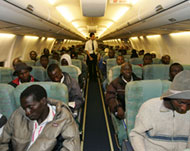
border, flew 139 illegal immigrants to Mali on Wednesday, government
officials said, according to a Reuters report.
 |
|
Senegalese are repatriated from
Morocco by plane on Monday |
Rabat expects to reach a new accord with Spain to bolster its struggle against illegal migration, they added.
"More Malian migrant groups will be flown on four
similar flights later today and on Thursday from Oujda to bring the
total number of Malians to be deported to 606," said a senior
government official, who declined to be named.
Oujda is 540km (337 miles) east of Rabat and is an entry point for illegal migrants from Algeria.
The Moroccan government, which deported 549
Senegalese migrants to Dakar on Monday and Tuesday, vowed to deport
more illegal sub-Sahara African migrants to their home countries.
EU warning
Meanwhile, the European Union on Wednesday said
thousands more illegal migrants were heading for Spain's North African
enclaves, Reuters reported.
The EU's top immigration official said the problem of
immigrants gate-crashing Melilla and Ceuta or finding other ways to
reach Europe was enormous, and it was time to act.
"Intelligence suggests that around 20,000 immigrants
are waiting in Algeria ready to begin their journey to Morocco and then
Ceuta and Melilla with another 10,000 already waiting in Morocco,"
Justice and Security Commissioner Franco Frattini told EU ministers
according to a copy of his speech notes.
 |
|
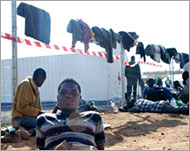
Immigrants lie exhausted after
crossing the Morocco-Melilla fence |
"This
is a clear indication of the mounting migration pressure on Morocco and
Europe. There is no indication that the present high migratory pressure
... will decrease in the short term," he told justice and interior
ministers of member states.
Frattini said the 25-nation bloc and Morocco
should step up border cooperation as well as their fight against
trafficking in people, and that the EU should help Rabat train border
guards.
Britain's Europe minister Douglas Alexander, whose
country holds the EU's rotating presidency, acknowledged that the
border deaths highlighted the problem facing Europe.
"The tragic loss of life of .... those seeking to
cross the European Union's borders illegally has sharply brought into
focus the problems we face in managing migration flows and tackling
illegal immigration," he told the European Parliament in a debate on
immigration.
The crisis at Ceuta and Melilla and the southern
Italian island of Lampedusa, which is also an arrival point for many
illegal immigrants, highlights the gap in wealth between poor countries
in sub-Saharan Africa and prosperous European states.