
Kashmir fort defenceless in quake
Saturday 29 October 2005, 22:50 Makka Time, 19:50 GMT
Invaders
over the centuries failed to bring down the walls of the Red Fort in
the capital of Pakistan-administered Kashmir, but the massive 8 October
earthquake did so in seconds.
The
500-year-old fort looks north over the entrance to the Neelum valley,
set on a point of land in a kink in its river and commanding an ancient
route from the high Himalayas to the lowlands.
"Enemies always failed to undermine this fort, but we
are helpless against nature," Mehmood ul Hasan, director of Pakistani
Kashmir's information department, said as he surveyed the ruins of the
devastated city's main historical site.
The epicentre of the 7.6-magnitude earthquake was
10km (six miles) or so to the north. It killed more than 55,000 people
in northern Pakistan, most in Kashmir.
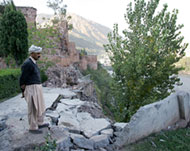
When the quake hit, many parts of the fort's thick
walls of oval-shaped river stones and pinkish mortar crumbled, spilling
out onto a main road along one of its sides.
Six of its eight battlements and three ramparts have been destroyed, some debris tumbling into the Neelum river.
No key needed
The main gates to the heart of the fort are locked,
and in the chaos after the earthquake, no one knows who has the key,
but nimble visitors can scramble up a pile of collapsed wall stones,
squeeze along a ledge and enter along a rampart.
 |
|
A caretaker surveys the damage
to the Red Fort |
All of the fort's corners, where torches were once
fixed to light it, have collapsed. What was once a stable, where more
than 100 horses were kept, has been reduced to rubble where stray dogs
roam.
A signboard still hanging on a broken fence asks
visitors to "Keep the Garden Clean", but survivors of the quake have
ignored the plea and turned part of it into a latrine.
Restoration
But the authorities in Kashmir hope that one day the
fort can be rebuilt, along with their city where 70% of buildings were
destroyed and another 20% left uninhabitable.
"It's our history, it's unfortunate that it also fell
victim to the earthquake, like the rest of Muzaffarabad, but we will
definitely seek international help to rebuild it," Hasan said.
"It will be an uphill task because of the extent of
the damage; but we will ask for international help and hope that the
world community will hear us."
Centuries of history
Inside the fort, signs in Urdu and English tell its tale.
The first people to build a fort on the site were the
rulers of the Chuk people, a Persian tribe, in 1549, to check attacks
from the Mughal rulers of India.
Sultan Muzaffar Khan, the founder of Muzaffarabad, which was once known as Chakrhi Bahk, completed construction in 1646.
Mughals, Afghans and Sikhs all controlled the fort over the centuries, but its importance as a defensive position waned.
The fort was badly damaged by floods in the 1990s,
and city authorities built barriers along the river to protect it from
high water.
Despite the damage, the people of Muzaffarabad are
determined the fort, with its splendid views over the mountains and the
snaking Neelum river, will survive, Hasan said.
"We're hopeful that this landmark will remain."
 |
Tools:
|
|