The
painstakingly restored baroque church, originally built in 1743 and
capped by a spectacular dome, is seen as a positive symbol in Germany's
often dark past.
The German Der Spiegel magazine described it as "a sign of a civilized German patriotism".
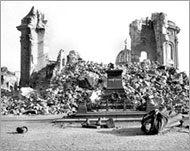
Brought
down by British and US bombs in the devastating air raids on the
eastern city in February 1945, just months before the end of the war,
the Frauenkirche rose from the rubble only after the Berlin Wall fell.
The
ceremony of consecration is the culmination of an 11-year, $218 million
project. Two-thirds of the funding was from private or business donors.
Ludwig
Guettler, the chairman of the Society to Promote the Reconstruction of
the Frauenkirche, said he was moved that so many nations had played a
part in helping to restore the Protestant church to its former glory.
Multi-cultural contributions
"I
am enormously grateful. Not just for the donations, which have just
kept coming, but for the level of interest shown by other countries,"
he said.
"And
the donations have been from Christians, Muslims, Buddhists - so many
people have contributed. We can truly say that we have rebuilt a piece
of world culture."
The Duke of Kent, who has helped raise funds for the reconstruction, will represent the British royal family at the service.
Although
just 1700 people will be able to attend the ceremony inside the church,
which starts at 0800 GMT, tens of thousands are expected to follow it
on giant TV screens.
The
bombing of Dresden, one of the most controversial Allied operations of
the second world war, killed at least 35,000 people, although many
German estimates put the death toll far higher because refugees had
flooded into the city from the east shortly before.
And the city, dubbed Florence on the Elbe for its baroque splendour, was practically wiped out.
Reunited German effort
Germany
was divided and for nearly half a century the communist East German
rulers left the blackened ruins of the Frauenkirche where they fell
after collapsing two days into the first wave of bombing.
It was only in 1994, four years after Germany was reunited, that reconstruction began.
 |
|
East Germany did not attempt to
resurrect the famous church |