Authorities appealed for calm in the face of the streak of urban unrest in France.
Troublemakers on Friday night fired bullets into a
vandalised bus, set a warehouse ablaze, burned 44 cars in a lot in
Suresnes, just west of Paris, and stoned rescuers aiding someone who
had fallen ill and torched the ambulance, police said.
Incidents, mainly fires, were reported in the
northern city of Lille, in Toulouse, in the southwest, Rouen, in the
west and elsewhere - the second night that the unrest spread beyond
metropolitan Paris.
Arrests
An incendiary device
was tossed at the wall of a synagogue in Pierrefitte, northwest of
Paris, where electricity went out after a burning car damaged an
electrical pole.
 |
|
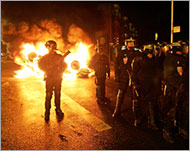
Police who clashed with the youth
arrested about 170 rioters |
"This
is dreadful, unfortunate. Who did this? Against whom?" said Naima
Mouis, 43, a hospital worker in Suresnes looking at the hulk of her
burned-out car.
An Interior Ministry operations centre tracking the
destruction reported 355 vehicles burned around France - one-third
outside the Paris region.
The figure - not definitive - marked
a drop from the more than 500 vehicles set ablaze 24 hours earlier.
However, arrests were up to about 170, the centre said.
A full picture of the night's violence was not expected until later on Saturday.
Mayors meet
Officials in the
Yvelines region, west of Paris, said 60 vehicles were torched and a
nursery school was all but burned to the ground.
About 30 mayors from the Seine-Saint-Denis region
where the unrest began on 27 October met on Friday to issue a joint
appeal for calm.
Claude Pernes, mayor of Rosny-sous-Bois, denounced a "veritable guerrilla situation, urban insurrection".
Marches to call for calm were planned on Saturday in several suburbs.
Discontent
The violence -
sparked after the 27 October accidental electrocution of two teenagers
who believed police were chasing them in Seine-Saint-Denis - has laid
bare discontent simmering in France's poor suburbs ringing big cities.
Those areas are home to large populations of African
immigrants and their children living in low-income housing projects
marked by high unemployment, crime and despair.
A police officer at the operations centre said bullets were fired into a vandalised bus in Sarcelles, north of Paris.
 |
|
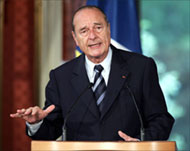
Jacques Chirac's calls for calm
remain unheeded |
Two
days ago, bullets were fired four times, signalling a potentially
dangerous turn of events. The officer, not authorised to speak
publicly, asked not to be named.
The persistence of the violence prompted the American
and Russian governments to advise citizens visiting Paris to steer
clear of the suburbs, where authorities were struggling to gain control
of the worst rioting in at least a decade.
An attack this week on a woman bus passenger highlighted the savage nature of some of the violence.
The woman, in her 50s and on crutches, was doused
with an inflammable liquid and set afire after passengers were forced
to leave the bus, blocked by burning objects on the road, judicial
officials said.
Late on Friday in Meaux, east of Paris, youths
prevented firefighters from evacuating a sick person from an apartment
in a housing project, pelting them with stones and torching the
awaiting ambulance, the Interior Ministry officer said.
Firefighters battled a furious blaze at a carpet warehouse in Aubervilliers, on the northern edge of Paris.
"I'm not able to sleep at night because you never
know when a fire might break out," said Mammed Chukri, 36, a Kurdish
immigrant from northern Iraq living near the warehouse.
"I have three children and I live in a five-story building. If a fire hit, what would I do?"
State symbols targeted
A national police spokesman, Patrick Hamon, said there appeared to be no coordination between gangs in the riot-hit suburbs.
He
said, however, that neighbourhood youths were communicating among
themselves using mobile phone text messaging or e-mails to arrange
meeting points and alert one another to police.
|
"I'm not able to sleep at night because you never know when a fire might break out"
Mammed Chukri,
Kurdish immigrant |
More than 1200 vehicles have been torched since the unrest began, LCI television reported.
Vandals have set fire to schools, post offices and other symbols of the state.
France's Foreign Ministry, meanwhile, said it was concerned that foreign media coverage was exaggerating the situation.
"I don't have the feeling that foreign tourists in
Paris are in any way placed in danger by these events," spokesman
Jean-Baptiste Mattei told reporters, adding that officials were
"sometimes a bit surprised" by foreign coverage.
Calls for calm
The violence has alarmed the government of President Jacques Chirac, whose calls for calm have gone unheeded.
"This is the first time (suburban violence) has
lasted so long, and the government appears taken aback at the
magnitude," said Pascal Perrineau, director of the Centre for Study of
French Political Life.
Abderrhamane Bouhout, head of the
Bilal mosque in Clichy-sous-Bois, where the youths died, said he had
enlisted 50 youths to roam housing projects and persuade youths to stay
out of trouble.
Siyakah Traore, the brother of 15-year-old Bouna
Traore who was one of the two teens electrocuted, on Friday called for
protesters to "calm down and stop ransacking everything".
"This is not how we are going to have our voices heard," he said on RTL radio.