The
deployment of foreign inspectors at the Rafah terminal is a key element
of an emerging Israeli-Palestinian deal on new border arrangements
following Israel's pullout from the Gaza Strip in September.
EU foreign ministers agreed at a meeting in Brussels,
Belgium, to assume third-party responsibility for monitoring the
crossing, Javier Solana, the EU's security affairs chief, said.
Israel closed Rafah just before the withdrawal,
citing security concerns, and the terminal has re-opened only
sporadically since then to allow hardship cases through.
The Palestinians want the Europeans to serve as
advisers, while Israel wants the foreigners to be in charge, with the
authority to carry out arrests or confiscate luggage if necessary.
Israel is concerned about an influx of weapons and resistance fighters.
Control
Palestinian Cabinet Minister Muhammad Dahlan accused Israel of trying to maintain a presence in Gaza despite its withdrawal.
"We don't want any foothold here," Dahlan said. "What
we want is freedom of movement for passengers in and out of Gaza, and
freedom of movement for goods out of Gaza to Egypt."
Touring the border, Marc Otte, the EU's Middle East
envoy, said: "We are not here to control anybody. We are here to help
and assist."
Reopening Rafah under Palestinian control is a
crucial sovereignty issue for Gazans since it would give them authority
over their borders for the first time.
Deprivation
Israeli-Palestinian agreements on Rafah and other
crossings on the Israeli border are also necessary to rebuild
impoverished Gaza.
 |
|
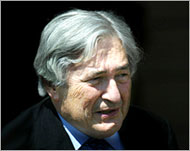
James Wolfensohn will remain
in the region for a week |
The
deployment of foreign inspectors in Rafah would set an important
precedent that could be copied at a future airport and seaport in Gaza.
Israel wants the Europeans there to ensure that fighters and weapons do
not enter Gaza.
European officials met separately on Sunday with
Israeli and Palestinian officials. Palestinian negotiator Saeb Erikat
said the Europeans told him the inspectors were ready to fulfil
whatever role agreed to by the Israelis and Palestinians.
Later on Monday, international envoy James Wolfensohn
was to chair a three-way meeting with Israeli and Palestinian officials
to try to resolve the remaining disputes over Rafah.
Wolfensohn will be in the region for a week and also
hopes to make progress on other unresolved Gaza issues, including
improvements at crossings from Gaza into Israel. Israel is a key export
market for the Palestinians.
Israeli monitoring
A key issue at Monday's meeting will be Israel's
demand to monitor Rafah long-distance, via computer hook-up and
closed-circuit TV, Erikat said. The Palestinians reject the demand,
saying the presence of European inspectors should be sufficient.
Erikat said he hoped an agreement on Rafah could be
reached by the end of the week. Sharon told parliament's Defence and
Foreign Affairs Committee that it was important for Israel to monitor
who is passing through Rafah, said lawmaker Ran Cohen, a committee
member of the opposition Yahad party.
Sharon told lawmakers that Israel must retain the
right to keep monitoring, and that Israel was preparing alternate
crossings under Israeli control if an agreement on Rafah could not be
reached, Cohen said.
Palestinian police
Palestinian workers at Rafah set up checkpoints on
Monday and hooked up security cameras to monitor the approaches to the
terminal. Dozens of Palestinian policemen took up positions along the
perimeter wall and at the crossing's main gate.
 |
|
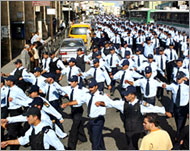
Palestinian police will get training
for three years from the EU |
Also
on Monday, EU foreign ministers agreed to train Palestinian police
forces for three years, beginning on 1 January. The mission is to be
the 25-nation bloc's first security role in the region as part of
international peace efforts.
Sharon, meanwhile, told lawmakers on Monday that if
Hamas participates in Palestinian legislative elections, Israel will
not coordinate with the Palestinians on the vote, and will make it
difficult for Hamas to campaign freely.
The Palestinians say Israeli roadblocks throughout
the West Bank must be lifted ahead of the 25 January election to let
candidates campaign freely and permit voters to travel to rallies and
the polls.
Political role
With Hamas participating, Israel will not help in the
elections, and because of that, there will not be an election, even if
Israel does not "intervene," prime ministerial spokesman Asaf Shariv
quoted Sharon as saying.
Israel has demanded for months that Palestinian leader Mahmoud Abbas disarm Hamas if it is to take part in the election.
Abbas has repeatedly refused, saying such a
confrontation would provoke civil war. Instead, he has brokered a shaky
truce agreement with the resistance groups not to attack Israel and has
worked to bring them into Palestinian political life by having them
field candidates in the parliamentary election.