But calls for peace in restive poor suburbs rang out on Friday from demonstrators in Paris to religious leaders at a Lyon-area mosque in the southeast.
There were isolated reports of violence in parts of France as the unrest continued for a 16th night on Friday.
With a state of emergency in force, several hundred people gathered at the glassy Wall of Peace near the Eiffel Tower to call for an end to the unrest that since 27 October spread from the Paris suburbs across the country.
The
demonstration drew elderly Parisians and youths from the suburbs along
with curious onlookers, all engaging in heated debate over how to stem
the violence and tackle the causes.
Deep-rooted cause
The
authorities have acknowledged that the roots of the problem are
deep-seated. The woes include soaring unemployment, poverty and
discrimination in the working class suburbs that ring the large cities
of France.
 |
|
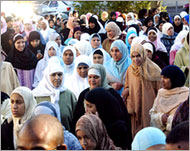
Residents in Montpellier make a
silent march against the riots |
"The
violence of the last 15 days expresses the frustration of 30 years of
denying recognition to the populations living in these neighbourhoods,"
said Hassan Ben M'Barek, a spokesman for Suburbs Respect, a group of
associations that organised Friday's demonstration.
He
asked President Jacques Chirac and the government to listen carefully
to the youths, whose roots are in former French colonies of Africa, including Muslim North Africa, to better fight the "discrimination they suffer daily".
Arson
attacks have declined in recent days. Police said overnight
Thursday-Friday that 463 cars were torched, down from 482 the previous
night.
The unrest has spiralled downward since France
imposed a state of emergency on Wednesday that empowers regions to
impose curfews and conduct house searches. Prefect Pierre Soubelet of
the Landes region in the southwest ordered a curfew for minors on
Friday night in certain towns, the sixth region to use the powers.
Security
The authorities bolstered security in Paris,
deploying truckloads of riot police as Chirac rode in an open Jeep down
the Champs-Elysees to lay a wreath at the Tomb of the Unknown Soldier
to mark Armistice Day, commemorating the end of the second world war.
 |
|
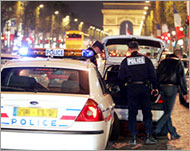
Policemen on patrol in the
Champs Elysees in Paris |
More than 700 police were brought into the capital to bolster security, raising the full deployment to 2220.
Paris police headquarters later banned any gatherings of "a nature that could provoke or encourage disorder".
"Messages distributed in the last few days over the internet and by text messaging have called for gatherings on 12 November in Paris and violent actions," a police statement said.