
Features
Japan's geeks set to inherit the Earth
 |
|
By
Julian Ryall in Tokyo
|

Wednesday 30 November 2005, 13:28 Makka Time, 10:28 GMT
 |
|
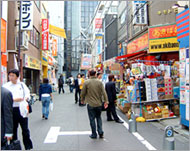
Tokyo's Akihabara district is full of lanes housing electronic stores
|
 |
|
|
With
a shy smile and a self-deprecating wave of the hand, Toshiyuki Takano
tries to avoid the compliment. He takes another sip of his ice tea
before quietly admitting that yes, he really is in the top 5% of
Japan's growing legion of geeks.
While
the labels geek, nerd or anorak are pejoratives to be avoided in most
societies, Japan's otaku are proud - in a bashful way, naturally - of
who they are.
Otaku is loosely translated as geek in English and often refers to someone fixated on anime (animation) and manga (comics).
And a social movement that can trace its roots back
to 1983, when the term was first coined in a magazine article to
describe the people attending a comic book convention in Tokyo, is
finally becoming mainstream.
Japan is home to an estimated three million
otaku, with a recent report by Nomura Research Institute putting their
annual spending power at more than Y400 billion ($5 billion).
With pockets that deep, geeks are an economic force to be reckoned with.
Model figures
"I'm personally not into collecting model figures
from animated movies or computer games, but some of my friends are,"
says Takano, a 19-year-old student of human sciences at Tokyo's
prestigious Waseda University.
 |
|
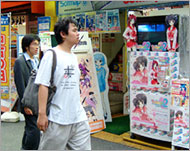
Akihabara's narrow streets hold
a strong attraction for otaku | "I'm
more interested in buying parts and building my own computers or audio
devices, and I'm always the first on the scene when new gadgets go on
sale."
Takano adds: "I also like playing computer
games and I spend a lot of time in online chat groups, making new
friends and exchanging information," he adds, avoiding the eye of the
waitress as she brings another drink.
The Tiara Cafe is a typical establishment in
Akihabara, the home of myriad electronics shops that has become
a magnet for hard-core otaku.
Geek central
In keeping with the fantasy animation theme of the
shop on the ground floor of the building, Tiara is what is known as a
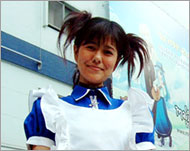
Maid Cafe - where all the staff are female and wear French maid outfits
as they serve drinks.
"The maid costumes are very cute and places like this
are popular because the girls who work here look very young," says
Takano. "But I don't think I could ever ask one of them for anything
more than a drink."
 |
|
Special cafes employ all-female
staff clad in French maid outfits |
He carries a manga comic book with him everywhere he
goes, and has a vast collection of animated DVDs at home. Ask him who
provided the voice for an obscure character in Evangelion - the
defining movie for otaku, who refer to it more colloquially as Eba -
and he replies without having to think.
It is this skill that earned Takano a remarkable 84%
in the first Otaku Certificate examination. Organised recently by
Biblos, which publishes dozens of manga every month, the test was
initially seen as little more than a light-hearted quiz.
"We had no idea that it would be so popular," said
Ryota Ishizuka, the Biblos editor who devised the exam. "We had
expected that maybe 1000 people might take part but our computer broke
down due to the number of people trying to access the website that we
set up."
Manga mania
Nearly 500,000 people attempted to access the site in
the space of two weeks, said Ishizuka, with questions on the
examination ranging from the outlandish to the utterly obscure.
How many more people, for example, attended the Tokyo
Comiket Manga convention in 2002 than in the previous year? What
"cosplay" (costume play) outfits are not permitted at fans' gatherings?
And true or false: A timed incendiary device was planted at a
Comic Market event between 1996 and 2002?
 |
|
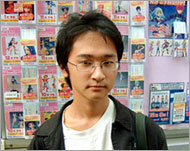
Toshiyuki Takano outside a shop
specialising in movie figurines | "It
was pretty tough in places," admits Takano. "But I have been living
this life for the past five years now and I just seem to know stuff. I
guess that makes me a natural-born otaku."
Takenori Emoto nods in appreciation of his fellow geek's achievement.
"This
is more than a hobby for me; it's more like a lifestyle choice," says
the 22-year-old who is a student of programming and holography at
Tokyo's Nihon University.
Holography is the science of producing holograms, or three-dimensional images.
"The Dragonball animated TV series and games started me off about 11 years ago and I've been hooked ever since," he says.
Emoto is expected to graduate in March and pursue a career as a designer of electronic pinball games.
Geekdom exhibited
The highlights of Emoto's year are the biannual
Comiket Manga exhibitions, which attract about 600,000 devotees over
their two-day runs. He is already looking forward to December's event -
and drawing up a wish-list of things to buy.
"For me, there's nothing better than wandering around
comic markets on a weekend, and there's always one somewhere in Tokyo
every weekend," he said.
 |
|
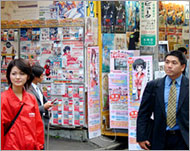
Shops sell peripherals, computer
games, comic books, costumes | "I
also love animated films; Eba is the classic, of course, and my mother
likes it so much that she has got lots of models of characters from the
movie.
"She's a real otaku mum and she thinks it's just a good hobby to have," he adds.
The typical otaku home could itself be something of a fantasy.
Every spare centimetre of space in the average
otaku's home is festooned with figurines, and wall space is devoted to
large pictures of Gundam or Studio Ghibli's animated cult classics.
But it is their very obsessions that have turned
nerds into a new type of fashion icon. In addition to the maid cafes, a
hotel employing similarly dressed women opened outside Tokyo earlier
this year.
Staple of novels
The otaku culture has also become a staple of novels and TV dramas.
Densha
Otoko (Train Man) evolved from an internet bulletin board into a book
and a feature film, and tells the tale of a hopeless computer nerd who
comes to the rescue of a beautiful woman on a train, thereby winning
her heart.
 |
|
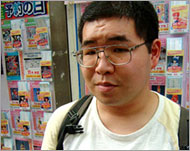
Takenori Emoto spends his
weekends at manga conventions | Not surprisingly, Takano and Emoto dream of something similar happening to them.
"I don't have a girlfriend and I don't go out so much," says Takano.
"Some of my friends from university go out drinking,
but I don't go with them. I don't have the time because I'm usually
either studying or making another computer."
Emoto agrees that he just does not have time to
fit a girlfriend into his busy schedule. "If I have free time, I like
watching baseball on TV," he adds.
The Nomura report, by
Ken Kitabayashi, a consultant on the information and communication
industry at the Nomura Research Institute in Japan, emphasises that the
otaku group "is no longer a niche market" and companies that are able
to tap into their interests are likely to be able to expand their
markets.
Constantly evolving
Nomura identified 12 subdivisions within the otaku
society, but their ranks are constantly evolving, with model train fans
and mobile phone otaku now emerging.
The biggest
financial benefactor of the boom has been the Akihabara district, which
used to be a rather run-down section of Tokyo but has recently been
given a new lease of life.
 |
|
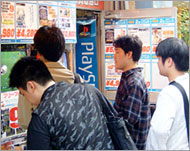
Otaku try out a new computer
game on a street in Akihabara | A huge industrial complex is being constructed, including the first university designed to make the most of young otaku talent.
Digital Hollywood University will offer degrees in technology, animation and design.
And
while their reticence and general inability to interact well with other
people may rule this segment of the Japanese population out of careers
such as captains of industry, politics or icons of music or film, their
combined wealth may enable the geeks to inherit the Earth.
Or at least a good part of Japan.
|