
Iraqis turn to drugs to escape reality
Sunday 04 December 2005, 10:06 Makka Time, 7:06 GMT
On Saddun Street in central Baghdad, there is a pharmacist who does not like to sell his products.
"Dozens
of people come every day to buy tranquilliser pills, but we know now
which ones are addicted and we refuse to sell to them," he said, adding
that many of the addicts are criminals and thieves.
The pharmacy is located next to the Battawin neighbourhood, notorious for its drug and alcohol problem.
"One of them threatened me with a gun and stole my car," said a neighbour of the pharmacist.
But Iraq's rising drug problem is not limited to
select neighbourhoods, as young people are increasingly seeking solace
in prescription drugs to escape a world of violence, unemployment and
despair.
"It is a dangerous plague that has to be confronted
immediately, before it becomes uncontrollable," said Dr Adnan Fawzi,
assistant to the director of the Ministry of Health's national
programme to combat drug addiction.
Finding an escape
Heroin and cocaine use, according to Fawzi, is actually fairly rare, due to the high prices of these drugs.
|
"The unbearable conditions of daily life, whether in society or in my family, pushed me to find an escape"
Ali, 18, an addict |
Instead, people are using pills that are "available for nothing in pharmacies", he said.
Dr Ali Rashid of the Ibn Rushd hospital, who
specialises in psychiatry and drug addiction, explains that these
pills, like illegal drugs, marginalise their users in a conservative
society.
For Ali, 18, his pills allow him to forget his problems. "I float along in another world," he said.
"The unbearable conditions of daily life, whether in society or in my family, pushed me to find an escape," he added.
Social responsibility
Families
and educational institutions have a major portion of the responsibility
to prevent this problem, maintains social worker Nagham Wannass.
 |
|
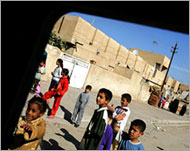
In one area, over1000 homeless,
mostly children, are affected | In
the troubled neighbourhood of Battawin, this problem affects "more than
1000 homeless, most of them children" said an official in the Ministry
of Interior, who declined to be identified.
In addition to drugs, they often abuse alcohol and sniff glue, he added.
The Health Ministry, whose hospitals are already
swamped with victims of the daily violence, is trying to grapple with
this problem and has sent large numbers of doctors and specialists
abroad to receive training.
Border concerns
In November, the ministry organised a conference
entitled: For An Iraq Free Of Drugs, and participants called on the
authorities to tighten control of the borders, particularly with Iran,
to halt the flow of drugs.
A conference of the International Narcotics Control
Board (INCB) in Vienna back in May noted how smugglers were taking
advantage of the internal chaos in Iraq to route Afghani-produced
heroin through Iraq and into Europe.
Right now, however, the drugs are getting into people's hands through the legal means of pharmacies.
The
national anti-drug commission, headed by the Minister of Health
Abd al-Mutalib Muhammad Ali, has called for new rules regulating the
sale of prescription drugs.
The commission, which includes representatives of the
education, labour and interior ministries, has also launched an
awareness campaign.
All over Baghdad, walls are plastered with anti-drug
posters, showing a man in rags slumped against a wall, while lying at
his feet another shoots up with a syringe.
 |
Tools:
|
|