Eric Laursen, one of the organisers, says the Three Cities Against the Wall
exhibition, held concurrently in Ram Allah, Tel Aviv and New York,
showcases paintings, sculptures, photographic montages and audio-visual
installations that depict the barrier as "a form of oppression".
"The message is that the wall represents a form of
oppression that destroys the humanity of both the oppressor and
oppressed," Laursen told Aljazeera.net.
"The former by denying them their human rights and
subjecting them to dispossession, death and military force by an
invader, the latter by rendering them callous and indifferent to the
suffering their own leaders are inflicting."
Selection for the exhibition required that artists reflect the barrier's impact on both Palestinians and Israelis.
'Land grab'
Not surprisingly, said Laursen, much of the
Palestinian art dwells to some extent on the destruction of everyday
life that the barrier represents.
"Much of the Israeli art," he continued, "focuses on
the desensitisation that the wall has engendered in that society, and
how it reflects on what the artists see as the materialism of Israeli
cultural life."
 |
|
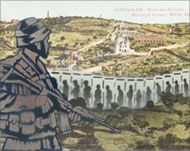
The work of Chris Cardinale, a US
artist, is on display in New York |
The
barrier, built by Israel under the pretext of national security and
keeping Palestinian bombers out, is seen by Palestinians as a
massive land grab.
Dubbed the "apartheid wall"
by Palestinians and activists, the barrier cuts deep into the West Bank
and in some areas, cuts off entire villages, private property and
schools.
Response to the exhibition has been varied and not without problems.
Contributions by American artists
arrived two weeks after the exhibition opened in Ram Allah, due to
problems with Israeli customs, says Laursen.
Varied audience
The showing will be moved to an extra
city, Hebron, in the West Bank, "in part, in solidarity with the
Palestinian community there that is being hard-pressed by the Israeli
army and settlers".
|
"The entire thrust of Israeli policy has been
to make it harder for Palestinians and Israelis to work together and
discover common political ground. Bringing down the wall is going to
require pressure from both sides"
Eric Laursen,
Exhibition organising committee |
A mixed audience has visited the exhibitions, says Laursen.
In the US, a rabbi contacted the organisers to schedule a special tour of the show for his New Jersey congregants.
"This rabbi said he is
not against the wall, but felt it was important ... to see the show to
understand the other side," Laursen adds.
"To us, this indicates
we are not just preaching to the converted and have a real chance to
change some people's minds about the wall and Israeli occupation."
Bridging divides
Even before the showing launched, organisers say it succeeded in many ways.
"It
has helped to establish new contacts and networks between Palestinian
and Israeli artists who share opposition to the wall - which is very
important.
 |
|
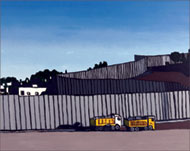
David Reez, an Israeli artist, has
added his voice to the campaign |