
US professor cleared of terror charges
Wednesday 07 December 2005, 3:46 Makka Time, 0:46 GMT
A US jury in Florida has
acquitted Arab-American Sami al-Arian of terrorism charges, but he
could be retried as the judge declared a mistrial after the panel
remained deadlocked on other charges.
The decision on Tuesday was a setback for the US
administration, as the case, built largely on wiretaps and seized
documents, was seen as a test of the controversial Patriot Act that
gave the authorities wider surveillance powers after the 11 September
2001 attacks in New York and the Pentagon.
Al-Arian, 47, was found not guilty of conspiring to "murder or maim people" outside the United States
and of providing material support to the Palestinian resistance
movement, Islamic Jihad, which the US has labelled a "terrorist
organisation".
The federal jury acquitted al-Arian of eight charges out of the 17 against him but was deadlocked on the others.
The former University of South Florida
computer engineering professor wept after the verdicts, and his
attorney, Linda Moreno, hugged him. He will go back to jail until
prosecutors decide whether to retry him on the deadlocked charges.
Federal
prosecutors said al-Arian and his co-defendants acted as the
communications arm of Islamic Jihad, spreading the word and raising
money that went towards bombings that have killed hundreds.
He was considered one of the most important "terrorist" figures to be brought to trial in the United States since the 11 September attacks.
 |
|
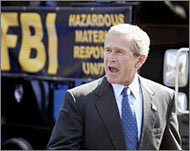
The Patriot Act gave sweeping
powers to the authorities | His indictment in 2003 was hailed by the then attorney-general John Ashcroft as one of the first triumphs of the Patriot Act.
Co-defendants Sameeh Hammoudeh and Ghassan Zayid Ballut were acquitted of all charges against them.
Another, Hatem Naji Fariz, was found not guilty on 24 counts, and jurors deadlocked on the remaining eight.
The US Justice Department had no immediate comment.
Controversy
The
controversial Patriot Act greatly expanded the government's powers and
broke down the wall between foreign intelligence investigations and
domestic law enforcement in the al-Arian case, officials said.
It
allowed separate FBI investigations - one of them a multi-year secret
foreign intelligence probe of the professor's activities - to be
combined and all the evidence used against him.
Al-Arian, a Palestinian who was born in Kuwait, has lived in the United States since 1975.
He was granted permanent-resident status in 1989 but denied US citizenship in 1996. He was fired by the university shortly after he was indicted.
Surveillance
The
federal jury deliberated 13 days after hearing from 80 government
witnesses and listening to often-plodding testimony about faxes and
wiretapped phone calls during a trial that lasted more than five months.
|
"Any discussion of Sami al-Arian being the most powerful man in the [Islamic Jihad] is fantasy"
William Moffit,
Al-Arian's attorney | The government alleged that the defendants were part of a Tampa group
that took the lead in determining the structure and goals of Islamic
Jihad, which the US State Department has listed as a terrorist group.
Prosecutors said al-Arian and other members of the organisation used the University of South Florida to give them cover as teachers and students and held meetings under the guise of academic conferences.
Prosecutor Cherie Krigsman likened Islamic Jihad to the Mafia and named al-Arian as one of its "crime bosses".
Free speech
The defendants said that although they were vocal advocates in the United States
for the Palestinian cause and may have celebrated news of the group's
attacks, the government had no proof that they planned or knew about
any violence.
They said the money they raised and sent was for legitimate charities.
Al-Arian's
attorney, William Moffit, said the professor was being persecuted for
espousing unpopular opinions that should be protected under the First
Amendment right to free speech.
"Any
discussion of Sami al-Arian being the most powerful man in the [Islamic
Jihad] is fantasy," Moffitt said in his closing argument.
Five
others indicted in the case, including al-Arian's brother-in-law, have
not been arrested. The brother-in-law was deported in 2002, and the
others also are out of the country.
 |
Tools:
|
|
|
|