
UN: Palestinian poverty worsening
|
By
Khalid Amayreh in the West Bank
|
Wednesday 14 December 2005, 22:03 Makka Time, 19:03 GMT
Poverty
is worsening in the Israeli-occupied Palestinian territories because of
continued Israeli military activities and the closure of border
crossings between the Gaza Strip and the West Bank, a UN report said.
The
report on the Palestinian economy, presented to the Donors Conference
in London on Tuesday, said further social and economic deterioration
was inevitable unless the Palestinian economy is freed from Israel's
stranglehold.
The report said up to 37% of the estimated 3.7
million Palestinians living in the West Bank and Gaza Strip had trouble
getting food in 2004. Another 27% were at risk of running into such
difficulties.
The report, prepared by UN economic experts, pointed
out that nearly half the Palestinian population was poor, with poverty
rate in the Gaza Strip reaching a staggering 65%.
Up to 16% of Palestinians - 550,000 - were living on
$1.5 a day, with the likelihood that the figure will rise to 35%
if aid is not forthcoming.
Repression
The report spoke of continued Israeli repression,
especially in the West Bank where the occupation army maintains
tight control in population centres.
 |
|
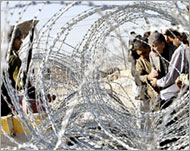
Israeli restrictions have brought
miseries for Palestinians |
It cited the demolition by Israel of 253 homes and
structures in the West Bank over the past 10 months. As many as
5000 Palestinians are living in closed-off areas sandwiched between the
separation wall and the former armistice line between Israel proper and
the West Bank, the report said.
Israel has reaffirmed its refusal to allow safe
passage between the West Bank and Gaza Strip, saying the Palestinian
Authority had to fight "terror" first.
Dan Halutz ,the Israeli chief of staff, was quoted by
the Ha'aretz newspaper on Wednesday as saying that Israel would not
allow bus convoys to move between the West Bank and Gaza for the time
being.
Israel had earlier promised to allow Palestinians safe passage between the two regions by the middle of December.
Poll
The report's findings are generally supported by an opinion poll published in the occupied territories on Tuesday.
The poll, conducted by the Palestinian Centre for
Public Opinion in Beit Sahur and covering a representative sample of
1873 respondents, showed that nearly three quarters of Palestinians
were worried about the livelihood of their families.
More than 53% evaluated their economic condition as
"bad", while two-thirds agreed that the PA has failed to create job
opportunities.
According to Nabil Kukali, who supervised the opinion
survey, Palestinian society is experiencing a grave but silent economic
and social crisis that he said stemmed from the Israeli occupation.
|
"There is a conspicuous deterioration of living conditions which underscores the desperate need for international support"
Nabil Kukali,
Professor of management at Hebron University |
"There is a conspicuous deterioration of living
conditions which underscores the desperate need for international
support," Kukali told Aljazeera.net.
Kukali, a professor of management at Hebron
University, said continued economic deprivation in the occupied
territories would eventually lead to anarchy.
Financial crisis
Nigel Roberts, the head of the World Bank mission in
the Palestinian territories, blamed Israeli restrictions on the
movement of people and flow of goods and services for economic
stagnation in Palestine.
Roberts, who is taking part in the London conference,
told the London-based al-Hayat newspaper that the Palestinian Authority
was no longer able to pay the salaries to its civil servants and
employees.
Roberts opposed economic separation between the
Palestinian territories and Israel, pointing out that 80% to 90% of
Palestinian exports went to Israel.
 |
Tools:
|
|