Born
in 1944, Armstrong began her journey to faith as a Roman Catholic nun
but left her order in 1969 when she embarked on a doctoral study of
Lord Tennyson.
She later left academia and, following a brief teaching stint, began researching the life of St Paul for a documentary series.
This eventually led to a re-examination of religions
and several books on the subject including A History of God: The
4000-Year Quest of Judaism, Christianity and Islam; Jerusalem: One
City, Three Faiths; Muhammad: a Biography of the Prophet; The Battle
for God; and Islam: A Short History.
Armstrong is currently teaching Christianity at
London's Leo Baeck College for the Study of Judaism. Her latest
publication focuses on the birth of compassion in the pre-Christian
Axial Age.
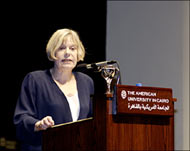
Firas Al-Atraqchi, Aljazeera.net's contributing
editor, recently caught up with Armstrong in Cairo where she was
delivering lectures on religion as part of the American University in
Cairo's English public lecture series.
Aljazeera.net: What is the common denominator linking all the faiths you have studied?
Armstrong: I would say compassion
and the Golden Rule, ("don't do to others as you would not have done to
you") which is what they all teach. I was with the Dalai Lama a couple
of months ago and he said all religions teach kindness. He said: "My
religion is kindness."
Compassion doesn't mean we have to feel warm
affection for people - we have to learn to feel with them, to dethrone
ourselves from the centre of our world and put another there.
We have to do that globally to learn other nations,
other people, are as important as ourselves. If we don't like people
speaking against our culture, bombing or terrorising us, we shouldn't
do it to others.
Which direction is Islam taking in the West?
Why does there seem to be turmoil for Muslims who have lived for
generations in the West?
At the moment, Muslims are reeling under the impact
of 9-11 and it's very uncertain where they are going. Some have put
their heads down and don't want to raise them above the parapet at all
while others are horrified by what happened but find their voices are
not listened to.
|
"Since 9-11, hostility towards Islam has accelerated which is endemic in our society" |
Some
- as we have seen by our own British bombers - are appalled by the
pictures coming out of Guantanamo, Iraq and Abu Ghraib and daily from
Palestine. This feeds into an alienation that they feel from their own
British culture they were brought up in.
Since 9-11, hostility towards Islam has accelerated
which is endemic in our society. On the other hand, these images of
people being beheaded on TV just reinforce these old stereotypes and
make it more difficult for Muslims to feel at home.
It is very difficult to know where they are going.
But there is no clash of civilisations in an ontological way.
At the beginning of the 20th century when Muslims
first began to encounter the modern West, they recognised it as
congenial to their own traditions. But then bad foreign policy -
Palestine, Suez, the support of tyrannical dictatorial rulers, and the
rush for oil (which often meant that ethics were overlooked) - has
alienated many in the Muslim world and made them feel the West is a
double dealer.
On the part of Western politicians, there is a
failure to see the contradictions in their own policies. You can't be
talking about free speech one moment and threatening to bomb Aljazeera
tomorrow. This is not consistent.
I was with Desmond Tutu - I am on a United Nations
committee called Alliance of Civilisations which tries to bring people
together - and he was saying how appalled he was that Tony Blair was
trying to push through a law allowing detention without trial for 90
days.
Tutu recalled when they were fighting apartheid in
South Africa the British had always been coming to the government and
telling them you can't put people in jail without trial.
You can't be democratic or part of the modern world
if you practise this sort of thing and yet here they are doing that,
never mind Guantanamo Bay where people have been held for a very long
time without trial.
The race riots in France and Australia, they involved Arab and Muslim youth. Is this a harbinger of things to come?
I don't know much about the riots in Australia as I
have been travelling, but the French riots had very little to do with
Islam and much more to do with deprivation and ostracising, racism.
There's been trouble brewing in France for so long with the immigrant
communities which are kept in some type of ghettoes.
Similarly, with our British bombers, they were kept
in a part of Yorkshire, in northern England, that I have never visited.
And that is indicative - I wouldn't go there.
 |
|
The riots in France were not
Muslim riots, says Armstrong |
But
there are places where Pakistani youths are at the bottom of the pile.
They have very little chance for advancement. There were in 2001 race
riots there, before 9-11. It is race and second classism, a sense that
there is no way they can make their way forward in society.
Nothing much was done after the 2001 race riots in
the UK. And they are now beginning to reap the rewards of that.
Disaffected people look at images coming from Guantanamo Bay and Iraq
and this ignites something in their soul.
We are not talking about a universal Islamic Jihad
and it was wrong of the papers to call these Muslim riots; these were
just riots about deprivation and discrimination.
In your book, Battle for God, you wrote that
fundamentalist religious movements claim God as their own. What are the
similarities and differences between the various fundamentalist
movements?
I've concentrated only on the ones in Judaism,
Christianity and Islam. Most of them began in fear - a fear of
annihilation. All groups are convinced that modern secular liberalist
society is going to wipe them out.
This is true across the board.
When they feel that their backs are against a wall, that's when they become aggressive, defensive and worried.
A profound hinging on this is a loss of identity -
people not knowing where they are and feeling their values have been
marginalised and kicked out of the way.
This produces a sense of frustration and impotent rage. They have a desire to bring God and all religion back to centre stage.
This expresses itself in an exaggerated vision of the
enemy; all of them have cultivated blown-up versions of the enemy which
reflects a great deal of their own sense of menace.
In some cultures, this fear and dread is hardening
into rage and it was quite clear when I finished this book; some
fundamentalism was becoming more extreme and moving into a new phase.
Why is Christian Fundamentalism such a powerful force in North America?
It has gradually been making its way to the forefront
and many in the US feel alienated by the secularist, intellectualist,
and sophisticated discourse of New York, Harvard, Yale and Washington,
DC.
Many people in small town America have for a very
long time felt colonised by this ideology, just as colonised as people
in Egypt felt by the British or in Syria by the French.
There is therefore a struggle. All culture is always
contested. Since the 1970s there has been a concerted movement to bring
what they call Old Time Christianity back to centre stage, back to the
position it held before modernity really took root in 20th-century
America.
People like George Bush - he isn't as stupid as he is
often depicted, but he is not a great intellectual - represent many of
the values of small town America. He has simplistic views of the Middle
East; he's hardly ever stepped foot out of the country [before becoming
president]. He's not very typical even though he comes from a very rich
family; nevertheless he seems to speak for small-town America.
They have used the democratic and political process
very skilfully to come from a marginalised position and over the years
bring themselves back to centre stage.
It does not have universal support. In the last
election, America was split pretty evenly down the middle and there are
Americans who abhor this type of discourse. There are people in the
Democratic party who are beginning to create a religious discourse on
the left. Jim Wallace is doing that and a rabbi in San Francisco -
Rabbi Lerner - has just written a book called The Left Hand of God
to reclaim religion.
Americans at the moment seem to be more attuned to a religious than secular discourse.
Can you tell us about your new book focusing on the Axial Age?
I just finished it and it will be out in the UK in March and in the US in April. It is already out in Holland.
The Axial Age is the period from 900 to 200 BCE when
all the world's religions which have continued to nourish humanity came
into being or had their roots. You can consider Christianity and Islam
as later flowerings of the Axial Age ideals of monotheism.
This included the emergence of Confucianism and Taoism in China, Hinduism, Buddhism and Jainism in India.
In Europe, you had the Greeks and philosophical rationalism.
It is not just an exercise in spiritual archaeology,
because I hope the book will give some indications of perhaps where we
may be going wrong today. It seems to me that in our various
institutions we are creating exactly the kind of piety people like the
Buddha wanted to get rid of.
The essential teachings of the Axial Age were in
every case - except for Greece - a rejection of violence. And as a
consequence of that the cultivation of compassion and the Golden Rule
"don't do to others as you would not have done to you".
That seems to be the basis of religion; they weren't interested in metaphysics or doctrine or orthodox theology at all.
Some have called you a healer idealist while
others point to your description of Islam and say you must be a Muslim.
How do you describe yourself?
I wouldn't say I am an idealist because I am far too
pessimistic to be an idealist. But I have a strong sense of dread, a
prickly feeling that we have been here before and we can't go down this
road again.
I first got it during the Salman Rushdie crisis - a
feeling that in Europe we have been here before. We have cultivated a
distorted vision of a people for a thousand years and this ended in the
death camps in the 1930s. And we can never go down this road again.
When I started to hear people talking in this
loose-lipped way about Islam, I felt a sense of real fear that
somebody, even if it had to be me, had to correct these perceptions.
Furthermore, I really admire the Muslim tradition so
much. The Prophet Muhammad is the most magnificent example who inherits
the most appalling situation - in Arabia at the time there was a
bloodbath - and brings peace out of it. And at a great personal cost to
himself.
And not only that, but he bequeathed to humanity a
scripture that has helped millions of human beings to make sense of
their lives.
To have such a combination of very strong spiritual genius with political genius is extraordinary. So there is that admiration.
At the height of Islam's power, Muslim theologians
were so pluralistic and daring and affirmative and inspiring; people
like Ibn Arabi and Rumi.
I was very alienated from religion by my own experiences as a young nun and wanted nothing to do with religion.
But it was the study of Islam and Judaism, but Islam
particularly, that brought me back to a sense of what religion could be
at its best.
It gave me an entirely new perspective on things.
Even though I am not a Muslim, I have absorbed so much of Islam that it
has become a part of me.
I used to describe myself as a freelance monotheist
because I draw inspiration from all - I cannot see any of them as
superior. And that has now spread to Buddhism and all the rest.
I see all of them just equal, each with its own genius and with its own flaws.
At the moment, I would describe myself as
convalescent; recovering from a bad religious experience by the study
of these other traditions which continue to inspire me and feed me.
So your books, then, can be considered a spiritual quest?
Yes, yes certainly.
Have you found God?
Oh, yes. But that word - God - is not easy to define
and once you do define it, what you really have is a projection
because, Allahu Akbar, God is Greater than anything we can conceive. I
see my study as a form of prayer.
When I am working at the library or at my desk, I
have moments where I am deeply touched within and lifted momentarily
beyond myself.
The discipline of trying to put myself out of my
post-enlightenment 20th-century rationalism and the feeling of
superiority and into the mind of the Prophet and the mystics of long
ago teaches me about compassion and to feel with others.
And that spills over into my personal life. I get
very upset now by unkindness in any form. I have a thinner skin than I
used to have.
So have I found God? As the Chinese would say: "I am
on the way." The Now is the point; what's important is the why you're
actually on the way and not to be so concerned by the destination.