
Features
Writing was on the wall for Tueni
 |
|
By
Cilina Nasser in Beirut
|

Wednesday 21 December 2005, 7:56 Makka Time, 4:56 GMT
Ghassan Tueni had warned his son, Gebran, the outspoken journalist and Syria critic, not to return to Lebanon for fear of assassination.
But the 48-year-old publisher and legislator insisted. And less than 24 hours after his return, he was dead.
"Children never listen to their parents," said Ghassan Tueni, himself a veteran journalist who turned An-Nahar newspaper into Lebanon's leading daily.
Just hours before he met his death, Tueni had told his father: "I cannot be a member of the Lebanese parliament while living in France."
Tueni, arrived in Lebanon on the night of 11 December. The next morning, he left his home to go to his office at An-Nahar headquarters in central Beirut.
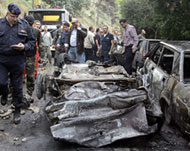
But a parked car packed with 40kg of explosives blew up his armoured vehicle as it passed by in Mukhallis, eastern Beirut. He and three others, including his driver and bodyguard, were killed.
Another 32 people were wounded.
Breaking Syrian taboos
Tueni, publisher and general manager of An-Nahar, had been spending most of the last few months in France out of fear for his life after learning in the summer that he was on the top of a hit list.
His
troubles may have started in March 2000 when he wrote an article
entitled An Open Letter to Dr Bashar al-Assad, who was then expected to
succeed his father Hafez al-Assad, who died in June 2000, as Syrian
president.
 |
|
Tueni's convoy was hit by a 40kg
bomb just hours after his return | Tueni
addressed the younger al-Assad "frankly" as he had put it, saying many
Lebanese politicians meeting the future Syrian president had perhaps
told him what he wanted to hear, not what he should hear.
"You must realise that many Lebanese are uncomfortable with Syrian policies in Lebanon and with the presence of Syrian troops in our country.
"This does not mean that these people are traitors or collaborators with Israel, as some have said. It means only that these Lebanese have aspirations for sovereignty and independence," Tueni had written.
Criticising Syria
The letter sparked wide-scale debate in Lebanon at a time when Syrian troops and intelligence networks maintained a heavy-handed grip on the country.
Editorials written by Tueni continued to be very critical of the then dominant role that Syria played in Lebanon and he repeatedly broke Syrian-imposed taboos.
His criticism reached boiling point when Syria pressed for an extension to President Emile Lahoud's term in September 2004.
His criticism of Syria escalated even more following the assassination of Rafiq al-Hariri on 14 February.
Following
the former prime minister's assassination, Tueni was active in huge
anti-Syrian protests which, combined with international pressure,
forced Syria to pull out its troops from the country in April.
Tueni was then then elected to parliament in May.
Earlier in December, he accused Syria of trying to derail the UN investigation into al-Hariri's assassination after a Syrian witness appeared in Damascus and retracted testimonies he had given to UN chief investigator Detlev Mehlis.
"The
time has come to overcome our fear and abandon our good-heartedness so
that we would be able to face the lies of the Syrian security apparatus
while we wonder: When will this despotic regime come to its senses?" he
wrote.
Risk
Colleagues
and friends of Tueni told Aljazeera.net they were aware that the fiery
legislator would be risking his life if he returned to the country.
 |
|
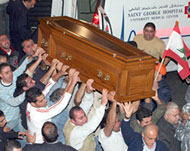
Mourners carrying Tueni's coffin
at Beirut's St George hospital | Sarkis Naoum, a commentator at An-Nahar, said he had advised Tueni to visit Lebanon for very short trips to avoid being monitored and eventually killed.
Tueni had replied: "That's what I intend to do."
Analysts
and anti-Syrian politicians have said his assassination is linked to
his role in turning An-Nahar into the mouthpiece of the uprising dubbed
the "Independence Revolution" that helped rid Lebanon of Syrian
domination.
Akram
Shehayeb, a member of anti-Syrian Druze leader Walid Jumblatt's
parliamentary bloc, said: "An-Nahar newspaper broke the wall of silence
regarding Syrian actions in Lebanon and it's paying the price for that."
"Each voice that calls for freedom and democracy will be accused of treason or collaborating with Israel, and therefore, his or her blood will be halal [sanctioned]."
Smear campaign
Shehayeb referred to a "smear campaign" against Tueni in Syria, saying it helped prepare for his elimination.
"Wasn't Tueni's picture raised in protests in Damascus depicted with a Jewish religious skull cap?" he said.
Tueni's
eldest daughter, Nayla, revealed in a press conference on Friday that
An-Nahar and her father had been receiving a steady stream of hate mail
from a specific country.
At his funeral, she pledged to uphold the work her father started: "An-Nahar will not die. Lebanon will not die. Freedom will not die. This is the pledge of loyalty to Gebran."
Why now?
Sceptics have said Syria was under far too much pressure and public scrutiny to have killed the outspoken journalist.
|
"An-Nahar will not die. Lebanon will not die. Freedom will not die. This is the pledge of loyalty to Gebran"
Nayla Tueni,
Gebran Tueni's eldest daughter | But
Jumblatt believes the Syrian authorities are trying to exhaust the UN
investigators and shift attention off the al-Hariri probe.
Marwan
Hamade, the telecommunications minister who survived an assassination
attempt last year, said the reason was that unlike the late president
Hafez al-Assad, his son Bashar lacked any political wisdom.
Hamade,
also a Druze MP and Tueni's maternal uncle, concluded: "We stopped
allowing them [the Syrians] to interfere in the details of our Lebanese
affairs, which is why they want to destabilise the country and plunge
it into chaos."
In recent months, Lebanon has been hit by a series of bombings and assassination attempts.
Samir Kassir, a star columnist at An-Nahar, and long-time communist leader George Hawi were killed in separate blasts in June.
Defence Minister
Elias al-Murr was wounded in July and female talk show host on the
Lebanese Broadcasting Corporation, May Chidiac, was maimed in September.
 |
Tools:
|
|