Abahlali
Base Mjondolo, the Zulu name for shack dwellers, is the largest group
to emerge from South Africa's "informal settlements", the sprawling
slums of wood, corrugated steel and cardboard shacks that have
mushroomed near cities.
Its leader, 30-year-old gas attendant S'bu Zikode,
gained national prominence last month when newspapers published a
letter he wrote poignantly describing the lives of South Africa's
poorest of the poor.
"There is no holiday in the shacks," wrote Zikode.
"When the evening comes, it is always a challenge. The night is supposed to be for relaxing and getting rest.
"But not in the jondolos (shacks). People stay awake
worrying about their lives. You must see how big the rats are that run
across the babies."
Feelings of betrayal
A soft-spoken father of four who has been living in a
shack for the past 10 years, Zikode says he feels betrayed by the
African National Congress government that came to power at the end of
apartheid in 1994 on a platform to help the poor.
 |
|
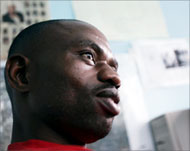
S'bu Zikode: The ANC must use
the power that we gave them |
"The ANC must use the power that we gave them to deliver," said Zikode.
Since the squatters from 14 settlements formed their
movement nine months ago, there have been five marches drawing several
thousand protesters, a meeting with the mayor and a televised debate
between Zikode and Sydney Mufumadi, the minister for local government.
Richard Pithouse, a researcher at the Centre for
Civil Society of the University of KwaZulu-Natal, said: "Right now,
Abahlali is the biggest movement in the country that originates from,
is organised by and is sustained by very poor people. They get no donor
funding."
But Zikode declares all of these actions a
failure, saying that people continue to live in squalor and promises of
housing or upgrades have not materialised.
Basics wanted
The group is however drawing attention as a voice for the estimated 2.4 million South African households that live in shacks.
 |
|
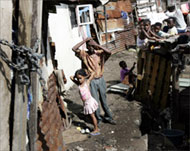
Shack dwellers say they want the
basics: water, sanitation, housing |
"What
do we want? The basics," said Zikode holding out his hand and ticking
off demands on his fingers: "Water, electricity, sanitation, land and
housing."
Zikode's message is resonating among fellow shack
dwellers including Wandile Ndanda, 23, who took part in the
protests organised by Abahlali because he felt the ANC government was
taking too long to deliver on its promises.
"We put these people in power and now they don't want to give us homes," said Ndanda.
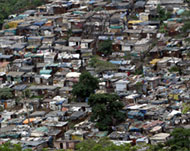
Hugging a hillside in southern Durban, about 1000
shacks in the Foreman road settlement are home to the downtrodden,
where dozens of children can be seen playing in narrow, muddied
pathways, littered with garbage.
Health and safety
Hlengiwe
Sosiba, sitting next to her two children age two and four, points
to the holes in the corrugated steel roof of her shack, where flattened
milk cartons cover the walls and floors.
 |
|
About 1000 shacks make up this
settlement in southern Durban |
"When it rains, the water comes inside. The babies catch flu and all these things," she said.
Most of the squatters said fire is their biggest
worry in the shacks where paraffin stoves are used for cooking and
candles for light.
Pinkie Mxinwa said she lost everything in a recent
fire but her two children, aged one and five, escaped with their lives,
unlike one-year-old Mhlengi Khumalo who died in a shack fire last
month.
Protesters have taken to the streets in townships and
settlements in Cape Town and Johannesburg over recent months to demand
better housing and services, often braving rubber bullets and teargas
fired by police.
With the approach of municipal elections on 1 March
that will measure the ANC's support at the grassroots level, the voice
of the shack dwellers is expected to grow louder, said Zikode, wearing
a red T-shirt emblazoned No Land, No Home, No Vote.