
Israeli soldiers wounded by Gaza blast
Tuesday 12 July 2005, 11:27 Makka Time, 8:27 GMT
Four
Israeli soldiers have been injured after an explosive device
detonated near the Netzer Hazani settlement north of Khan Yunus in the
Gaza Strip, Aljazeera's correspondent says.
Palestinian factions had not yet claimed responsibility for the operation, the correspondent added.
Elsewhere,
the Israeli army imposed a three-day curfew on al-Mghayir town in the
West Bank after a vehicle with settlers came under gunfire on Monday
afternoon on Alon road, Aljazeera correspondent Walid al-Umari reported.
The Israeli army immediately closed all the town's gates, he said.
The
army confirmed imposing a curfew on al-Mghayir, saying it was searching
for those who opened fire at the settlers' vehicle, al-Umari
added.
Jenin raid
Early on Tuesday, Israeli occupation forces raided the West Bank city of Jenin, al-Umari reported.
Many Israeli military vehicles entered the city, while troops carried out search operations, he added.
The incidents come amid vows by the Palestinian Authority (PA) to take its case over Israel's separation wall to the United Nations Security Council.
 |
|
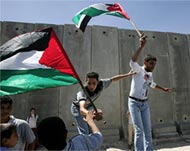
Palestinians fear the wall will
make them second class citizens |
Palestinians living in East Jerusalem who face being cut off from the rest of the city by Israel's giant West Bank barrier fear that they will soon become second class citizens with reduced access to jobs, schools and healthcare.
The Israeli cabinet on Sunday approved plans which will see around 55,000 of the 230,000 Palestinian residents of Jerusalem stuck on the far side of the barrier from September, in a move it justified on security grounds.
The authorities have pledged to ensure that the move will not affect access to services to which Jerusalem
resident card holders are entitled, while the city's mayor Uri
Lupolianski said some $1.7 million will be set aside to ensure
residents do not lose out.
The PA, however, reacted to Sunday's announcement by accusing Israel of wanting to shut down discussion over the future status of Jerusalem which has long been one of the thorniest issues of their conflict.
Khader
al-Dibs, head of the so-called committee against the wall in Shuafat,
said it was nonsense to say that the cabinet decision was devoid of
politics.
"They want people to emigrate voluntarily, cut us off from Jerusalem and from al-Aqsa [mosque]," he said in reference to Islam's third holiest mosque - which lies in East Jerusalem's historic heart.
International pressure
The PA urged the world on Monday to press Israel to abide by international rulings that the wall is illegal.
"Israel must implement the international resolutions and we ask all states... to put pressure on Israel
to implement these resolutions," Foreign Minister Nasser al-Kidwa told
diplomats and representatives of international organisations in the West Bank.
Such
resolutions must also include last July's non-binding ruling by the
International Court of Justice in The Hague that parts of the barrier
built on Palestinian land are illegal and should be torn down, he
added.
Lack of services
"This wall will mean increasing numbers of unemployed because many people used to go to work in Jerusalem," said community leader Jamal Awad.
 |
|
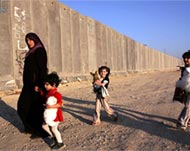
Leaders say the wall will limit
access to education, healthcare |
"It
will affect their education because many pupils used to attend
secondary school nearer the centre of the city after going to primary
school in Shuafat, and it will have an impact on healthcare as all
hospitals are in Jerusalem."
Situated
5km east of the city centre, around 20,000 people live in Shuafat -
either refugees or the offspring of refugees who lost their homes after
the creation of the state of Israel in 1948.
Muhsen
Natshe has lived with his wife Majeda for the last decade in the camp
but their house is about to be demolished by the Israeli army to make
way for the barrier - described as a terror prevention fence by the
Israelis but which takes the form of a towering concrete wall around
Shuafat.
Bulldozers
Natshe,
42, said he had tried to block the work of army bulldozers but his
house looks doomed after receiving a demolition order from the army.
"I
can't sleep at night," he said. "The Israelis have asked me to apply
for compensation and so we can fix on a price but I don't want their
money."
 |
|
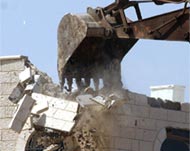
Bulldozers are terrifying children
and causing unrest in Shuafat |
His
wife Majeda said the noise of the bulldozers and mechanical diggers,
which have already begun work in her neighbourhood, was terrifying her
children.
"Each time our beds start shaking, we know the bulldozer is approaching for work," she said.
"They
(the Israelis) are tightening the grip around us day after day. What
kind of a future or destiny do they want for our children? The sadness
and anxiety is spreading through and dominating our lives."
Israeli support
While
the barrier and its route have triggered widespread international
criticism, they enjoy majority support from Israelis who have witnessed
dozens of bombings over the course of the near five-year Palestinian
uprising.
Israel
insists the fence has no political connotations and rejects Palestinian
claims that the barrier is designed to pre-empt the boundaries of their
promised future state.
Israeli Deputy Prime Minister Shimon Peres, meanwhile, said Israel was seeking an additional $2.2 billion in US aid to help pay for the withdrawal from the Gaza Strip and parts of the West Bank.
Israel is the biggest recipient of US
aid, getting an annual $2.3 billion for economic and military purposes,
but says it needs more money to remove some 9000 settlers and develop
the Galilee and Negev desert regions for resettlement.
 |
Tools:
|
|