
Features
'We will lose our land if we stay quiet'
|
By
Laila El-Haddad in Gaza
|
Thursday 22 September 2005, 12:21 Makka Time, 9:21 GMT
Now
that Israel has withdrawn settlers and security forces from the Gaza
Strip, the focus has shifted to the West Bank, where Jewish settlement
growth and a lengthening separation barrier continue to contribute to
the annexation of Palestinian lands.
Bil'in, a small Palestinian farming village 4km east of the Green Line, is a West Bank community under threat. The
planned route of the wall comes within four metres of the last house in
Bil'in and is set to devour more than half of the village's land, to
"protect" the nearby colony of Modiin Illit, where many of the
evacuated Gaza settlers will be relocated.
Since February, when Bil'in received military notice
that its land would be confiscated, its 1600 residents have held over
50 nonviolent demonstrations that have become a model of solidarity and
creativity throughout the West Bank.
Israeli forces have injured more than 350
Palestinians using a variety of experimental crowd-dispersal
ammunition, many Palestinians have been detained and beaten and the
village has been subjected to weekly military curfew.
The area commander of Israeli army, Tzachi Segev, has
said that "the stronger the activity against the fence, the stronger
our operations will be".
Abdullah Abu Rahme is Bil'in's community leader and a
prominent member of the Bil'in chapter of the Popular Committee against
the Wall and Settlements that organises the weekly demonstrations.
He has been beaten, arrested, interrogated and
threatened in the middle of the night by Israeli forces, but he has
vowed to continue to lead the nonviolent struggle against the wall and
against settlement expansion.
Abu Rahme spoke to Aljazeera.net by phone from his Bil'in residence.
Aljazeera.net: Tell us about Bil'in.
Abdullah Abu Rahme: Bil'in is a
small farming village that lies about 17km west of Ram Allah. Before
the occupation of Palestine in 1948, Bil'in fell under al-Ramle's
municipality. We used to have 1700 residents. Most were farmers.
Israeli settlements were established in 1979 on part
of our land. In 1991, a further 1300 dunams (321 acres) of agricultural
land was confiscated by the state of Israel for the construction of the
colony of Kiryat Sefer. Two hundred dunam of olive trees remained in
Palestinian hands. They were subsequently sold through forgery in 2003.
How does the Israeli separation barrier affect your village?
Bil'in will lose an additional 1000 dunums (247 acres) behind the wall.
There are 4000 dunums (988 acres) of land in Bil'in.
The settlements and the wall have confiscated 2300 (568 acres) dunums -
more than half of them. Most of this land was used for planting olive
trees and grazing fields for cattle.
This swathe of land lies between the two older
settlements and the wall, which demonstrates that real purpose behind
the wall - to annex the land and expand the settlements.
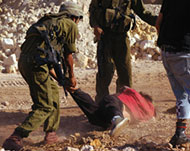 |
|
Israeli soldiers remove a Jewish
protester in Bil'in on 14 August | Two
years ago, at the end of 2003, Israel began constructing a new colony -
Mattit Yahu East - on our land, under the pretext of simply expanding
an older one, called Mattit Yahu. It has no occupants yet and is just
being built to confiscate more land. In addition there is a plan to
build two new outposts on the remaining land.
They say there are "gates" that will allow us to
enter our land, but at this rate, there will be no land left to access.
They are destroying it by first isolating it, preventing us from
accessing it, leaving it to dry, then claiming it as neglected property
that reverts to the state, based on an old Ottoman law that says if the
land is not taken care of for over 10 years it becomes the state's
property.
We are farmers and plant the land in the summer
season, and we harvest in autumn. So in summer it looks like it is
uncared for, and that is when they come and survey it. And this is the
method by which they take our land. This is for land where wheat is
planted. The olive trees are being encircled with the wall.
What is the economic impact on your village?
We depend on farming olives. It is our main source of
income and living. Sixty per cent of villagers are farmers that depend
on selling olive oil and olives. Their future is in peril.
Five to 10% depend on herding, and since part of the
land that was taken by the wall was for cattle grazing, there is no
chance for them to do this anymore, so they are being forced to sell
their animals. The wall is destroying our village and our livelihoods.
It is destroying an entire community.
There is also a sector of people who work as
labourers inside Israel. They are allowed to enter freely, with their
permits, but soon they will not be able to do this with the new system
of gates.
From an economic perspective, this is a catastrophic situation. It will be very, very bad.
Then there is the demographic angle. We cannot
expand. We can't expand vertically because there are no foundations for
this: the building are very old and there is no land left for
horizontal expansion.
Where will the coming generations go to? They will be
forced to migrate to Ram Allah or outside of Palestine. And both
migrations are considered a modern and civilised form of transfer and
expulsion. It is done in a discreet, seemingly unintentional way.
The
Israeli High Court ruled on 15 September that part of the separation
barrier has imposed major hardships on a group of Palestinian villages
and must be rerouted. Was your village included in the
ruling?
The decision was positive
in that it will change the route of wall that affects some of the
villages adversely, but unfortunately that does not include Bil'in. I
was also informed that the High Court's decision further says that in
the future the court will deal with each appeal on a case-by-case
basis, depending on its circumstances, and will take "security" into
consideration.
So the case will not necessarily set a precedent for badly affected areas like us.
Have you attempted to file your own case in the High Court against the wall's encroachment on your land?
We filed an appeal against the route of the wall in Bil'in, and it was approved and we are awaiting a hearing.
We were told that our case is tied to the decision of
the villages around the settlement of Alfei Menashe, on which the High
Court recently ruled. We feel there is a ray of hope and from it we
will proceed with our case.
We are basing our case on the fact that the wall is
built far away from the nearby settlements that it is supposed to
protect - even though it is supposedly a security barrier.
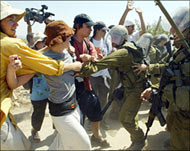 |
|
Foreign protesters clash with
Israeli soldiers on 5 August |
So the argument would be that it is being built not
to protect the current settlements, but to annex land for the
settlements that are planned for the future, while settlements are
being vacated in Gaza and the northern West Bank.
Israeli officials say the wall serves security interests - that it prevents suicide bombers.
It is very clear from anyone who visits our village
that they have used this as a justification and means to annex a large
part of the land of the West Bank and Palestine.
In reality, we have seen areas where the wall was
built that does not prevent bombers, and other areas where nothing
happens and there is no wall. It's not a matter of security but of
stealing land, taking as much land as possible from the West Bank and
eliminating any possibility of creating a Palestinian state in the
future. It is a cancer that kills any dream in Palestine.
Every week you lead nonviolent, creative protests against the wall. Tell us about them.
We try to create a new theme for each of our demonstrations because we realise that this struggle will last a long time.
Persistence requires innovation. Doing the same thing
every time leads to boredom for those who cover it - and I mean the
media. I am sure that as a media person you know this - where there is
something new, you will go after it.
If we have a protest, and someone is hurt, or seven
people die, week after week, soon it becomes the same old news. So
innovation makes it fresh news for the journalists.
At first we began somewhat spontaneously - in
February of this year when we learned our land was being threatened.
Then the demonstrations became organised and planned.
The idea was to send the message to Palestine, to the
Israeli army and to the entire world that there is a small village
called Bil'in whose very existence is at stake and who will not stay
quiet about it.
Which demonstration stands out most in your mind?
The first memorable thing that we did that got the
attention of the media, the army and the world was to tie ourselves to
our olive trees to coincide with beginning of the work of the
bulldozers. We were inspired to continue on this path of innovative,
nonviolent resistance.
An Israeli army officer came and told me that
"tomorrow we are uprooting your olive trees, tell villagers to choose a
location to replant them in". According to Israeli law, the olive trees
that are uprooted in the way of the wall must be replanted somewhere
else. But we refused. What do we want with olive trees if our land
is being taken from us?
We thought hard about what to do. It took a long time.
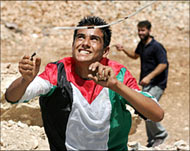 |
|
Palestinians in Bil'in throwing
stones at Israeli border guards | We
made a decision at 10pm that night to tie ourselves to the olive trees
before the bulldozers came. We bought the chains and locks from Ram
Allah; we drew up posters; We also realised we needed someone to
protect us - they could hit us, shoot us, kill us.
So we called the media.
We got out early and tied ourselves to the trees, and
tried not to be conspicuous so the army wouldn't get suspicious early.
At 6am when the army came, they were absolutely shocked. They didn't
know what to do or how to react, so they called their commanders, one
by one they came down.
The media was covering the event live.
The army finally reached a decision to cut the chains
and detain the foreign and Israeli activists in a very violent way.
These were unforgettable moments, and based on them we began our weekly
demonstrations.
In the weeks that followed, we crawled into
barrels and put ourselves in the way of the bulldozers; we carried mock
coffins and gravestones to symbolise the death of our village; we
locked ourselves in large cages; we put ourselves under mock
guillotines in the path of the wall, and in one our more effective
tactics, we held up mirrors in the face of the soldiers to show them
how they appear to us.
What did you do this week?
We brought huge speakers to the roof of my house -
because we were under curfew - and the Jewish pianist Jacob Allegro
Wegloop, a Holocaust survivor, was invited to perform a variety of
music, including the Palestinian national anthem.
He said: "I came in solidarity with villagers of Bil'in who are subject to the same subjugation that we faced."
Children sang along in the streets and from the rooftops. American protest folk singer David Rovics performed also.
After Friday prayers, Palestinians and Israeli and
international activists, including David Rovics, filled the streets
with song and protest. Over 50 other Israeli activists were not allowed
to enter Bil'in because the area was declared a closed military zone.
A clash between military forces and Palestinians
broke out. Eleven people were wounded by rubber bullets, including a
reporter, two children and two elderly people.
What is the role of foreign and Israeli activists in all this?
We heard about them through other committees who had
similar experiences, and when our village first began to be threatened,
sought their help. It started with one or two people and increased to
several dozen supporters.
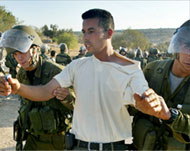 |
|
The idea is 'to tell the world that
Bil'in's very existence is at stake' |
Their presence is very important. When Palestinians
are detained, they try to free them and try to protect them from being
detained in the first place. Also, with their presence in
demonstrations, along with large numbers of Israelis, it becomes very
difficult for the Israeli army to shoot live ammunition at us.
Essentially, they serve as guardians. They bring
video cameras with them to monitor what's going on. So in a situation
where someone is detained and an Israeli soldier lies and accuses that
person of assaulting him or throwing stones at him, the cameras can
prove them wrong. This has helped us more than once.
Don't you ever feel you are fighting a losing battle?
We will lose much more if we stay quiet. We will lose our land, our livelihood, and our community.
And
history will not be merciful to us. Our children will blame us, and ask
us, Where were you and what did you do to try and stop this? We cannot
lose more than what we as a Palestinian people have already lost.
I see a glimmer of hope that drives me to persist and it is planted in all my colleagues and villagers and supporters.
As long as you continue to demand you rights, you
will never lose them. Even if the wall is built around Bil'in, we have
plans to continue our demonstrations, in the same way and same spirit.
Even though it has taken us this long, and the year
is almost over and construction on the wall is almost complete, we will
persevere, we will cling to this hope, and continue on the same path of
non-violent resistance. Because it will be a huge accomplishment for us
if the wall is removed or at least moved back.
 |
Tools:
|
|