
Annan: Let internet help world's poor
Wednesday 16 November 2005, 22:51 Makka Time, 19:51 GMT
UN
Secretary-General Kofi Annan has called for the internet and
information technology to be used to help build a better life for
people in some of the world's poorest countries.
Annan
warned the 170 countries and some 23,000 scheduled participants from
government and industry at the World Summit on the Information Society
(WSIS) in Tunis that "for far too many people, the gains remain out of
reach".
"There
is a tremendous yearning, not for technology per se (in itself), but
for what technology can make possible," he told the opening ceremony on
Wednesday in the Tunisian capital, urging participants to
"respond to that thirst".
"This summit must be a summit of solutions" to build "bridges for a better life" in poor countries.
Host
President Zine El Abidine Ben Ali said he hoped the gathering "will
mark a truly new beginning for a just, balanced and supportive
information society".
The
UN-organised summit is being attended by a number of government
leaders, mainly from Africa, but only a few from rich nations.
Split averted
Earlier,
an eleventh-hour deal avoided a potentially damaging split between the
US and the rest of the world over control of the internet after
diplomats agreed to work towards enhanced international cooperation.
Negotiators struck an agreement on key clauses on internet governance for endorsement during the summit.
 |
|
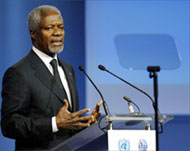
Annan: Internet's gains remain
out of too many people's reach |
But
the deal reached late on Tuesday left intact single-handed US control
over the private body that oversees the key technical and
administrative roots of the global network, despite the challenges
contributing to a three-year deadlock.
Officials had warned that the internet could have been torn into competing or disconnected networks if the split had continued.
The
agreement set up two parallel tracks of multilateral talks, including
an open-ended process "towards enhanced cooperation (by) relevant
international organisations" on oversight and public policy issues.
The
new process will be triggered by UN Secretary-General Kofi Annan in the
first quarter of 2006, according to the final draft, but it set no
target for an outcome.
Despite
sharp criticism, the private, non-profit, Internet Corporation for
Assigned Names and Numbers (ICANN) was expected to have its tender
renewed by the US government next summer.
Unique role
The
accord "preserved the unique role of the US government in ensuring the
reliability and stability of the Internet", top US negotiator David
Gross said on Wednesday.
"It took no action with regard to existing institutions including ICANN. It
created no new international organisations," added Gross, the US
coordinator for international communications and information policy.
 |
|
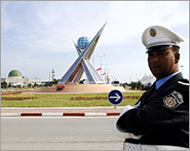
Some 50 government leaders
are participating in the summit |
Countries
such as Iran and China had sought UN oversight of ICANN or internet
governance, while the European Union wanted to water down US powers,
but Washington firmly objected.
The
other track creates an Internet Governance Forum (IGF) for an initial
five-year term to hold talks on all internet issues, including problems
such as as spam, cyber crime and computer viruses.
After
a final session which saw US, Chinese and Iranian diplomats swapping
suggestions for new wording, officials applauded efforts to widen the
scope of formal discussion to industry and civil society.
The
IGF, which Greece has offered to host, will also be allowed to "build
on the existing structures of internet governance" but has no concrete
powers.
Decision welcomed
Business groups at the summit said they were ready to take part in the forum. In
a statement, a coordinating body close to the International Chamber of
Commerce also welcomed "the continued commitment to the private
sector-led technical management of the internet".
Washington's
critics had warned that no single nation could maintain control over
top-level domain or country names - such as .cn, .fr and .uk - without
the threat of their being misused to block a foe's access to the
Internet for political or economic reasons.
 |
|
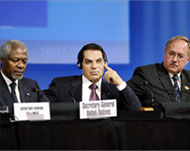
Kofi Annan and Tunisia president
Ben Ali (C) at the opening session |
The
US retorted that regimes that do not allow freedom of speech might
instead be in a position to have leverage over the internet.
The
summit on Wednesday was also marked by sharp warnings that freedom of
speech was a core component of a modern information society, following
incidents involving journalists and campaigners in the Tunisian capital
in recent days.
"For
myself, it goes without question that here in Tunis, inside these walls
and outside, anyone can discuss quite freely," said Swiss President
Samuel Schmid, sitting alongside the Tunisian head of state.
"For us it is one of the conditions sine qua non (essential) for the success of the international conference," he added.
Hunger strike
Seven
Tunisian hunger strikers also made a public appeal to Annan to defend
freedom of speech, while Iranian Nobel Peace prize winner Shirin Ebadi
called for international monitoring to stop political repression on the
internet.
Tunisian
authorities have said two suspects are being questioned by an
investigating magistrate in connection with the assault on Friday on a
French journalist.
|
"It is striking that the 400,000 citizens of Luxembourg have more internet access than the 800 million residents in Africa"
Shashi Tharoor,
UN Under Secretary for Communications | Groups advocating freedom of speech said they had been harassed.
The
gathering's ambition to boost economic and social development in poor
countries revolves around a pledge under the UN's Millennium
Development Goals to connect all the villages of the world to the
Internet by 2015.
"It
is striking that the 400,000 citizens of Luxembourg have more internet
access than the 800 million residents in Africa," the UN Under
Secretary for Communications, Shashi Tharoor, said.
Some
800,000 "villages," mainly in poor nations, still need to be connected
in the next decade, according to the UN's International
Telecommunication Union (ITU).
The cost of the effort, $1 billion, represents 1% of the annual global investment in mobile telephone connections.
Not political
"The hurdle here is more political than financial," Annan told the summit on Wednesday. "These assets - these bridges to a better life - can be made universally affordable and accessible," he added.
Nigerian
President Olusegun Obasanjo and Senegalese counterpart Abdoulaye Wade
appealed for more backing for a Digital Solidarity Fund that has so far
garnered 5.5 million euros.
 |
|
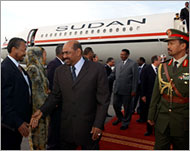
A number of African leaders are
taking part in the Tunis summit | Obasanjo said the global economy was now driven by information technology.
"Unless
those that are now excluded from the benefits of the information
revolution are brought on board, our efforts to achieve sustainable
development as outlined in the Millenium Development Goals, will
continue to elude us," he added.
Rich
nations believe that developing nations must also develop the business
and regulatory environment in their own countries to attract private
investment and some existing aid.
"The
challenge to the developing world is now to make sure they have the
infrastructure, rules, legal processes and the market systems to
attract the investment of the technologies that we see on display at
the summit," said US Assistant Secretary for Commerce Michael Gallagher.
 |
Tools:
|
|