 |
|
|||
| Member Services |  |
|||
 |
 |
 |

   | 
| ||||||||||||||||||||||||||||||||||
London examines flood defenses
Tuesday, September 6, 2005; Posted: 6:23 a.m. EDT (10:23 GMT)
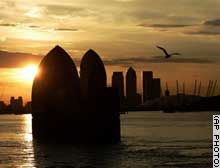 The centerpiece of London's flood network is the Thames Barrier. SPECIAL REPORTLONDON, England (AP) -- Waves of crushing water may seem out of place on the River Thames, which snakes lazily through London. But the British capital has long lived with the threat of catastrophic flooding. London, which sits about 3 feet above sea level, was once extremely vulnerable to surging North Sea tides that would cause the river to suddenly rise. Today the city of 8 million is protected by a combination of barriers, embankments and levees, but authorities warn no system is failproof. "It's not exactly New Orleans," said Sarah Lavery, of the Environment Ministry. "But we are very conscious, and there is always a risk of a bigger flood coming." In 1953, more than 300 people were killed and 30,000 people evacuated because of flooding along the Thames and elsewhere in southeastern England. London was mostly spared but the damage, in today's costs, was more than $9 billion. The last time London itself was flooded was in 1928, when 14 people died. Were the capital flooded again, the loss of life would probably be much higher while the damage would be around $60 billion, according to insurance company estimates. In New Orleans, thousands are feared dead in the flooding caused by Hurricane Katrina, which broke two of the city's levees. It is the costliest storm in U.S. history, with the tab likely to top $100 billion. The most familiar part of London's protective network is the Thames Flood Barrier, completed in 1984 at a cost of nearly $1 billion. Spanning more than 1,700 feet, about a third of a mile, the barrier consists of 10 movable gates supported by concrete piers. When the Thames is at its normal level, the round steel gates are left open and ships can pass through. But if ocean storms whip up strong currents and high waves, the gates go up to help block the water. "Quite simply put, we cannot allow the barrier to fail," Lavery said. There is also concern about global warming, which could raise water levels and -- in a worst-case scenario -- lead to a breach in the barrier that would send a wall of water spilling into London and covering the streets in six feet of water. Such a risk is not farfetched, says Munich Re, the world's largest reinsurer, which has ranked London No. 9 on its list of mega-risk cities. "The city itself has a good degree of protection," said Andreas Siebert, Munich Re's head of Geo Informatics. But he added: "London is at risk by winter storms and thunderstorms and a storm surge." That's why the city, which is to host the 2012 Olympic Games, is looking at ways to keep the estuary protected, said Kelly Flynn, a spokeswoman for the London Authority. Last week, the authority warned Londoners that paving gardens and parks increases the risk of flooding by allowing more rain to run into the river. "London is vulnerable to flooding -- be it from the Thames tide, from rivers as a result of heavy rainfall, or from our drainage system," said Roger Evans, the former chairman of a committee on the issue. The plight of New Orleans has also prompted The Netherlands to review anti-flood measures in regions below sea level to ensure they would be adequate in an emergency. The government upgraded its ancient system of dikes and dunes after a powerful storm breached sea dikes in the south of the Netherlands in 1953, killing more than 1,800 people. Today the Netherlands has some of the world's best defenses against flooding, including a chain of 40-foot-tall steel walls suspended by piers in the open sea. Also-vulnerable Venice, Italy, is putting a similar system in place. Copyright 2005 The Associated Press. All rights reserved.This material may not be published, broadcast, rewritten, or redistributed. 
|

| ||||||||||||||||||||||||||||||||||
 |
|
| © 2005 Cable News Network LP, LLLP. A Time Warner Company. All Rights Reserved. Terms under which this service is provided to you. Read our privacy guidelines. Contact us. |
|