
Features
The forgotten people of Baku
 |
|
By
Jonathan Gorvett in Baku, Azerbaijan
|

Thursday 17 November 2005, 11:02 Makka Time, 8:02 GMT
 |
|
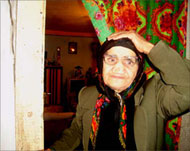
Pari has been living in squalor for 12 years (Photo: Jody Sabral)
|
 |
|
|
For
the past 12 years, 72-year-old Mammadova Pari has had to call the dank
and decrepit basement corridor of an old student dorm in Baku home.
It is a cold space she shares with 3000 others, crammed into half a dozen crumbling and derelict buildings.
She is one of around a million Azerbaijanis who are refugees in their own country, victims of a war now largely forgotten.
When
it rains, she says, the basement floods "up to your shins". Sometimes
the water carries with it untreated sewage too, as makeshift cesspits
brim over and spill into the houses.
Around her, electric cables
dangle dangerously from the ceiling. There are black scorch marks
staining the walls from the frequent fires started by shorting lights.
"We cannot survive here any more," she says, shaking her head.
She lives in a refugee camp with no name. Although
most of its residents have been there for more than a decade, officials
have been wary of giving it a title for fear it would suggest they are
there to stay.
"We are expecting them all to go home one day,"
says camp director Abbas Hasanov, whose job with the university that
owns the ramshackle dorm buildings left him in charge of the refugee
ghetto.
"One day it will become the university again, so we haven't given this place a special title."
Camp forgotten
Perhaps it is no surprise then that the camp has been largely forgotten by the outside world.
"For
the last three of four years, no international or national
organisations have provided any help for the camp," Hasanov continues.
 |
|
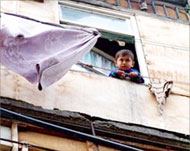
IDPs from conflict zones in
Armenia inhabit the camp |
"There are no resources at all. As for the university, it can barely afford to look after itself, let alone 3000 refugees."
Average incomes in Azerbaijan are low, with 40% of the population officially estimated to be below the local poverty line of $40 a month.
The
people here - officially known as Internally Displaced Persons
(IDPs) - survive on a monthly government hand out of $6 "bread
money", plus 30 litres of kerosene during the winter. The latter is
their only source of fuel for heating and cooking.
The office of the United Nations High Commission for Refugees (UNHCR) in Baku says the problem dates back to 1988 when refugees first started escaping the inter-ethnic violence in neighbouring Armenia.
Many thousands of ethnic Azerbaijanis who had lived in Armenia fled the violence - as did many thousands of ethnic Armenians who had lived in Azerbaijan.
Before 1989, Baku itself had an ethnic Armenian population of some 200,000. Now, few remain.
Ethnic flight
But as the Soviet Union further disintegrated, the next wave of Azerbaijani refugees came to Baku from Nagorno Kharabakh, a majority ethnic Armenian enclave inside Azerbaijani territory.
Many Azerbaijanis living there were forced to flee as the Armenians took control of the region.
"Finally,
the refugees also came from the Azerbaijani provinces around Nagorno
Kharabakh that were occupied by the Armenians in 1993-94," the UNHCR's Vugar Abdusalimov told Aljazeera.net.
Many of the last wave ended up in the camp with no name - and there they have stayed.
And they have harrowing personal stories of fleeing across the River Araxes into neighbouring Iran, a frantic flight in which many drowned.
Others come from
towns that have been allegedly "ethnically cleansed" and which now lie
deserted in the twilight buffer zone between the Azerbaijani and
Armenian front lines to the east.
Pari
herself is a native of Aghdam, 340km west of Baku. Today, Aghdam is
considered a buffer zone between Azerbaijani and Armenian forces.
Run for our lives
"We had to leave everything, to run for our lives," she said.
She says that she only seeks to return home so that she can visit the graves of her relatives and offer prayers to Allah.
The chances of that happening, however, are slim to none.
Since a
ceasefire was reached between Azeri and Armenian forces in 1994, talks
under the sponsorship of the Organisation for Security and Cooperation
in Europe (OSCE) have been stalled.
"There is some speculation
about a resolution next year," says William Tall, the UNHCR's chief
representative in Azerbaijan. "Though, to be honest, we've seen such
speculation quite often before."
Hope
In the meantime, the one million IDPs the government says are now under its care in the country will have to wait.
Out of a population of just eight million, the one million IDPs give Azerbaijan one of the largest per capita refugee populations in the world.
 |
|
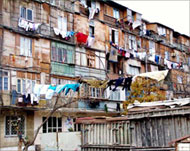
Will oil wealth improve living
conditions for some 3000 IDPs? |
But some hope may lie in the future.
Azerbaijan is now a major oil producer and over the next 20 years, $150 billion in oil revenues are expected to be heading Baku's way.
Some of those funds
are already finding their way to the IDPs and the government is moving
to improve living conditions for its people.
"They've been building some very good new settlements for these people and aim to re-house all the rural IDPs by 2007."
Yet,
city camps such as Pari's have lagged behind. Tall told Aljazeera.net
that it might be several years before the camp got a refurbishment.
Oil wealth distribution
Nevertheless,
there are concerns among Azerbaijanis that the oil wealth may not
get to the right people. This was a major issue in the recent general
elections, as the opposition charged the government with corrupt use of
the country's resources.
"We want transparency in the transfer
of revenues from the oil," says Mayis Gulaliyev, of the Centre for
Civic Initiatives, which monitors the oil industry in Baku.
"In any case, there will be no real benefit to Azerbaijan from the oil revenues until 2008 or 2009, when pay backs on the initial investments will be finished."
Which may mean many more years in the camp for Pari and her fellow IDPs.
Such a timeline has meant that many have given up hope of ever going home.
"When I first came here, I did have my hopes of going back, but now hope cannot exist when the people up there [the government] are only interested in their positions," says Tural Masarov, a father of two, originally from Fizuli.
For Pari, however, day-to-day survival has become almost intolerable.
"We cannot survive here any more," she says. "We live here like rats."
|