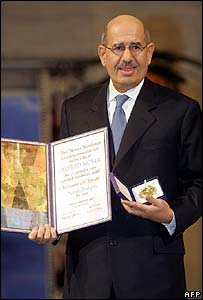
ElBaradei said nuclear weapons had no place in a civilised world
|
Mohamed ElBaradei, the head of the UN's nuclear watchdog, said his
agency's "resolve" had been "strengthened" by winning the Nobel Peace
Prize.
But international co-operation was crucial in combating the nuclear threat, he said at the Oslo ceremony.
The award recognises the agency's efforts to contain the global spread of nuclear weapons.
Mr ElBaradei called on nuclear powers to speed up disarmament and for the "rich to bridge the gap with the poor".
"The Nobel Peace Prize is a powerful message for the
IAEA [International Atomic Energy Agency] and myself," Mr ElBaradei
said in his acceptance speech.
"The message is: endure in our efforts to work for security and development."
He said poverty and the loss of hope that it engendered
was "fertile ground" for organised crime, civil wars, terrorism and
extremism.
"We may have torn down walls between the east and the
west, but we have yet to build bridges between the north and south,
between the rich and poor," he said.
Nuclear 'taboo'
Mr ElBaradei said the agency was working in a context of
a growing black market in nuclear material, the proliferation of
nuclear weapons and technology and the stagnation in disarmament.
"If we hope to escape self-destruction, then I believe
nuclear weapons should have no place in our collective conscience, and
no role in our security," he said.
He said the world needed to reach a point where nuclear
weapons were looked upon like slavery or genocide, "a taboo and a
historical anomaly".
The prize consists of a Nobel diploma, a gold medal and
10 million Swedish kronor ($1.3m, £700,000), to be split between the
agency and its head.
Mr ElBaradei said his half of the prize money would help support orphanages in his home country of Egypt.
The IAEA has said it will spend its share of the money in the field of cancer and nutrition in developing countries.
|










 E-mail this to a friend
 Printable version



