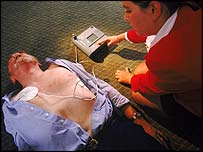
Defibrillators have been placed in public places in the UK
|
Putting electric shock machines in public places to treat cardiac arrest victims saves lives, researchers say.
A US and Italian team analysed data from Brescia before
and after machines were place in the community, the European Heart
Journal said.
The team found the one-year survival rate trebled to three in 100 patients.
Defibrillators have been placed in shopping centres,
railway stations and airports in the UK in recent years to be used by
trained volunteers.
The researchers, from Milan, Brescia and Washington
universities, also said the study proved that defibrillators could
easily and safely be operated by lay people.
And they concluded that if the response time for using
defibrillators was shortened to within eight minutes, it would save the
lives of 15 out of 100 people who collapse with cardiac arrest.
Cardiac arrests cause the heart either to quiver - known as fibrillation - or stop beating altogether.
The defibrillators work by delivering a controlled
electric shock through the chest wall to the heart to restore a normal
heartbeat after a cardiac arrest.
In 2000, over 2,000 people in Brescia were trained how to use a defibrillator.
After analysing nearly 1,400 cardiac arrest victims they
found one in 100 survived to a year after their attack without any
neurological problems before 2000, compared to three in 100 after.
Lead researcher Riccardo Cappato said: "There was an
increase in survival for patients in both urban and rural areas,
although it was significantly larger in the city than the countryside
due to the shorter response time and larger number of defibrillators
available."
Safety
More than 2,000 defibrillators have been earmarked for
public places, such as airports, railway and underground stations,
coach stations, ferry ports and shopping centres, across the UK through
the lottery-funded National Defibrillator Programme.
The move was introduced to help increase the survival rates of the seven in 10 cardiac arrests that happen outside hospital.
Colin Elding, medical spokesman for the British Heart
Foundation, said: "Modern defibrillators are becoming increasingly
quick and easy for the lay person to use, which can mean the difference
between life and death.
"Every second counts when someone's heart goes into cardiac arrest.
"An electric shock needs to be delivered to the chest as quickly as possible to restore the person's heart to a normal rhythm."
|









 E-mail this to a friend
 Printable version
 Modern
defibrillators are becoming increasingly quick and easy for the lay
person to use, which can mean the difference between life and death
Modern
defibrillators are becoming increasingly quick and easy for the lay
person to use, which can mean the difference between life and death



