A bleak, hopeless landscape
By CNN's Steve Goldberg
Tuesday, January 25, 2005 Posted: 11:56 PM EST (0456 GMT)
 | 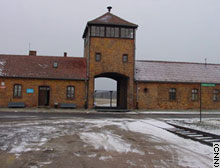 Tracks still pass through the "gate of death" at the entrance to Birkenau. |
|  VIDEO |
 CNN's Chris Burns on Nazi concentration camp survivor Adam Koenig.
 CNN's Jim Bittermann on the lessons of teacher Jules Fainzaing.
 CNN's Brian Todd on two perspectives on genocide.
|
|
OSWIECIM,
Poland (CNN) -- It looked just as it does in all the photos and films
I've seen about Auschwitz. And the winds that blew across the fields,
and the dusting of snow that fell the night before made the camp seem
even starker than I'd imagined.
Yet nothing could prepare me
emotionally as I walked through the main building of Birkenau -- train
tracks still passing under the main watchtower and through the "gate of
death" -- and entered what has been described as the largest Jewish
cemetery in the world and one of the largest cemeteries of any kind,
anywhere.
It is here, at Auschwitz II-Birkenau -- the biggest of
the camps that comprise Auschwitz -- that the Nazis built their death
factory in eerie order and massacred in a matter-of-fact way an
estimated 1.1 million to 1.5 million people, most of them Jews of
Eastern Europe.
I was here as part of a journalists' study tour a
week ahead of the 60th anniversary of the liberation of Auschwitz, on
January 27, 1945. But I was also here as a Jew from America, living in
Britain, pulled in an indescribable way to the place where so many of
my landsmen died.
None of my family perished in the Holocaust, as
far as I know. My ancestors escaped czarist Russia before the 1917
revolution and came to America through Ellis Island, as so many
immigrants did. Still, I needed to see this place firsthand.
The
first thing that struck me as I entered the gate and got my bearings is
the vastness of the camp -- it's the size of some 400 football fields.
Row upon row of barracks once stood here, about 300 buildings in all,
holding as many as 100,000 prisoners at a time.
The infamous
"Arbeit Macht Frei" gate is not here. Auschwitz is actually a group of
camps, and the cynical greeting "Work makes you free" is at the
entrance to the original, smaller Auschwitz I, some 3 km (2 miles) away.
But then there's the rail line, with its notorious siding, where cattle cars filled with deportees arrived constantly.
Its
occupants -- those who survived the days-long trip amid the squalor of
feces, urine and corpses -- were forced off the train and into two
large lines: the strong and healthy on one side, pregnant women,
children, the elderly and invalid on the other.
Some 70 percent
of the prisoners on each transport were sentenced to immediate death,
although they were only told they were being led to showers. The others
were selected for forced labor. It was here that 438,000 Hungarian Jews
were sent to their deaths in a period of 56 days in 1944.
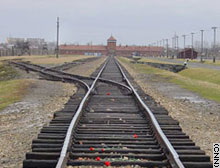 The view from the gas chambers across the siding toward the main gate. | |
Standing
at a crossroads on the siding, I felt pulled in three directions:
wanting to follow the tracks to their obvious end, between the remains
of two of the camp's gas chambers and crematoria; wanting to trudge
down a long road to the right, where many victims were sent to their
deaths at the camp's second set of gas chambers and crematoria; and
wanting to inspect some of the 67 barracks still standing.
Perhaps
instinctively, I first chose life -- such as it was -- and went to the
left, towards the brick barracks, delaying death a bit longer.
The
camp is well sign-posted, with maps, photographs from the war, and
descriptions of each of the camp's sectors and sub-camps and the
barracks within. After walking a bit down the road to the left, a sign
directed me to a block in sector BI, the women's camp, where examples
of prisoners' wall drawings were still intact.
Turning into the
camp, I walked past two columns of barracks, and then right past two
rows, until coming to the block I was looking for. The wooden door was
stuck, but a hard tug pulled it open. The light inside was dim,
filtering in through a handful of windows. I half expected to see rats
scurrying across the floor, but it was silent.
| 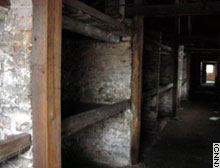 The barracks are more fitting for farm animals than humans. |
Venturing
inside, as my eyes adjusted to the light, the bunks came into view --
and took my breath away. It felt like an old barn -- a pig sty maybe,
or a chicken coop. But there before me was bunk after bunk built for
humans to sleep in, five to a level, stacked three levels high.
Hundreds
of people were forced to live in each barracks. Those on the top bunks
were lucky; as disease and diarrhea passed through the camp, occupants
of the lower bunks bore the brunt.
Camera in hand, I felt
compelled -- as if the horror was being discovered for the first time
-- to document what I saw, including the wall drawings of children
playing and going to school. It was easy to imagine mothers trying to
comfort their children, and themselves, with images of a normal life,
one they would probably never know again.
I could also imagine
young children today, oblivious to the terror of the place, playing
hide and seek amid the bunks. It was one of many discordant moments I
would have at Auschwitz.
The first of those came as we approached Birkenau in the taxi from our hotel.
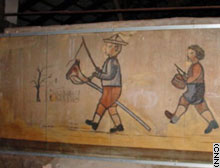 Prisoners' drawings of life before the war remain on barracks walls. | |
Forget
that we had spent the night in relative luxury; as the taxi carried us
through the town of Oswiecim, past signs of ordinary daily life, the
driver had the radio tuned to soft rock. For Poland, life goes on, and
Auschwitz is but a memory, a museum of Nazi monstrosity. It wasn't the
silent, reverent approach I had imagined.
Then, as I left the
barracks, it started snowing. Again, a jarring experience: My first
thought, having grown up in a warm climate, was a joyful, "Wow, it's
snowing!" But I soon remembered I was in Auschwitz, where it's hard to
imagine prisoners feeling any joy at seeing the first snowfall.
Back
at the main road inside the camp, I crossed the tracks and siding and
followed the road many prisoners were herded down to the set of gas
chambers and crematoria on the far side of the camp.
It took 10
minutes to cross the camp, walking between two barbed-wire fences, past
rows of burned-out wooden barracks, their chimneys still standing, a
memory of the thousands of people confined inside their walls.
| 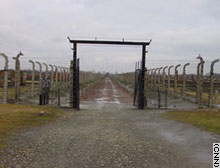 Prisoners were forced to march down this road toward the gas chambers. |
As
I turned left at the end of the road toward the gas chambers, the snow
started up again, this time a driving shower mixed with sleet, the
pellets stinging my face. Keeping my head down, I could imagine the
prisoners' feelings of desolation and despair as they were forced to
wait in a stand of birch trees by the side of the road for their turn
in the "showers."
And then the remains of gas chambers and
crematoria IV and V came into view, one on either side of the road, now
just brick rubble and twisted metal. Like gas chambers and crematoria
II and III at the end of the tracks, V was destroyed by the Nazis as
the Soviet army approached Auschwitz.
IV, though, stands as a
monument to the only armed resistance that ever occurred at the camp.
On October 7, 1944, members of the Sonderkommando -- a special unit of
Jewish prisoners forced to take bodies from the gas chambers and burn
them -- succeeded in destroying the building. More than 450 prisoners
lost their lives in the revolt, either killed by the SS that day or
later in retaliation.
Next to IV lies a "pond of ashes" where
prisoners' cremated remains were dumped. Nearby lies a "field of ashes"
where their remains were scattered.
Both sites, like others where
bones and ashes have been found, are marked by four granite stones with
an inscription in English, Polish, Hebrew and Yiddish: "To the memory
of the men, women and children who fell victim to the Nazi genocide.
... (Here) lie their ashes. May their souls rest in peace."
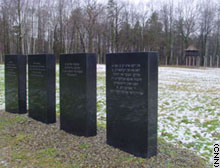 Four stones mark a "field of ashes" near one of the gas chambers. | |
The
stones are surrounded by a small area of pebbles. It's a custom in the
Jewish religion to leave a pebble atop a gravestone when visiting a
loved one's resting place. Despite the driving snow, and not knowing
anyone personally who was killed at Auschwitz, I bend down, pick up a
pebble, place it on one of the stones and stand in silence. It's one of
the few moments when I am truly struck by the enormity of the massacre
that happened here.
Another such moment occurred at the smaller,
original Auschwitz I camp -- once a Polish military base -- where many
of the 28 brick barracks have been turned into exhibits and museum
offices.
Despite being the home of the first gas chamber and
crematorium, as well as the "wall of death" and "block of death" where
thousands of prisoners were tortured and shot, Auschwitz I feels
cleaner, less eerie, more of a museum piece than Birkenau, which still
contains the rawness of death and destruction.
Auschwitz I,
though, still has the power to shock -- as when I ventured into a dimly
lit room with a glass case along one wall. I had seen the piles of
shoes, the stack of eyeglasses, the pictures of victims, the assortment
of prostheses.
But behind this glass was a sight I hadn't
expected -- a room filled with human hair, part of the seven tons of
hair found by the Soviet army after it liberated Auschwitz. Much of the
hair was in locks, some of it still in beautiful braids. All of it
would crumble to dust if handled.
| 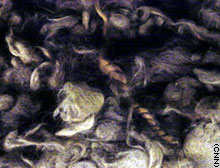 Soviets found literally tons of human hair when they liberated the camp. |
Tests
after the war showed the hair contained traces of hydrogen cyanide, the
poison in Zyklon B -- the gas the Nazis used to kill their victims. The
hair, then, had been shorn from the corpses after they were cremated,
just as the SS pulled gold fillings from their victims' mouths. The
Nazis used the hair to make haircloth for tailor's lining, and the gold
was melted into ingots.
I stood there, staring at the hair, and wanted to sob.