Tsunami came from half a world away
Monday, January 31, 2005 Posted: 2:33 PM EST (1933 GMT)
HAFUN,
Somalia (AP) -- On a wind-swept beach, fishermen patch their boats,
shopkeepers pick through the debris of their businesses and
schoolchildren shout out English vowels under a billowing green tent.
Lives
are slowly being rebuilt a month after this African village was struck
by the same tsunami that devastated Southeast Asia. But fear lingers
from the day a wall of water came crashing down from half a world away.
"I thought it was the end of the world," said school teacher Khalid Said, 40.
Hafun,
a large fishing village at the end of a spit of land jutting into the
Indian Ocean, was worst hit in Somalia when tidal waves triggered by an
earthquake off the Indonesian coast swept across 650 kilometers (400
miles) of Somali coastline. Estimates of the number killed range from
100 to 300, with thousands of others affected.
Across Somalia,
many more have died or lost their homes through years of vicious
faction fighting that has left Somalia without a central government
since 1991. But this remote northeastern corner was spared most of that
violence and the people here quietly prospered.
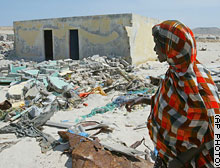
Many have now lost everything -- their homes, their livelihoods and their tenuous security in the midst of anarchy.
Drawing
on a mix of traditional myths and Muslim teachings, the people here
believe the world will end the day the sea runs dry and the earth
shakes. When the ocean suddenly receded on December 26, many thought
that day had come.
"The water ran away for kilometers (a mile)
leaving fish in the sand," said Hadia Khalaf, 55, standing in the
rubble of her flattened home.
Curious villagers ran to the beach
to watch, some scooping up the unexpected catch of lobsters and fish,
which they sell to ships that come from Yemen and United Arab Emirates.
Suddenly the water came back -- three giant waves of it, each more
devastating than the last.
Small wooden fishing boats were tossed
into trees up to a kilometer (more than half a mile) inland, wells
flooded with sea water, and concrete block homes were smashed to pieces.
"I
thought my day had come," Khalaf said. "I was grabbing things inside my
house which I thought I could run with, but all I could save was my
life."
Running and swimming through the churning water, buffeted
and bruised by debris, she clambered to safety on top of a nearby hill.
At the two-room school, Said screamed to his students -- aged 6-14 -- to also run to the hills, saving all their lives.
Others
weren't so lucky. For days, body parts washed ashore. Villagers
confirmed 19 dead among their own. But they say many others were in
town or at sea that day.
The tsunami struck at the height of the
fishing season, which draws people from across Somalia and as far away
as Tanzania and Zanzibar. They erect temporary shelters along the
shore, which were all swept away.
Fearful the tsunami could
strike again, villagers have built a rickety wall of rusting metal
sheeting and pieces of wood between them and the vast blue sea. It
likely offers little more than psychological solace.
 I thought it was the end of the world. 
-- Schoolteacher Khalid Said
|
|  |
When
officials from the U.N. Children's Fund arrived two days after the
tsunami, they found many villagers still in the hills, too fearful to
come down. But when they saw humanitarian workers pitch their tent on
the shore, they started to come back.
Those who lost their homes
initially sheltered in the school. But UNICEF supplied plastic sheeting
with which they have patched together makeshift homes amid the ruins of
what was once the capital of Somalia under Italian rule.
Other agencies have also arrived, distributing food, medicine, water and other supplies.
Mohammed
Ismail, 40, picks through the debris of his tiny grocery store along
what was the main road, salvaging concrete blocks with which to
rebuild. When the tsunami hit, it swept away bags of flour, rice and
sugar.
"I grabbed my son and ran," he said. "But my wife couldn't
swim. When I came back for her, I found her balanced on top of a pile
of rice bags."
Down on the beach, fishermen repair torn nets and
patch together their wooden ships with fiberglass. A few ships from
Yemen have returned and there is money to be made for those who still
have the means to go fishing. Nearby, a few small shops and cafes are
open again.
Classes have resumed at the old school building and
in two tents erected further inland. The lessons help restore a degree
of normalcy for the children, Said said, but the fear lingers.
"Before they would go swim and play in the sea," he said. "Now they don't want to go back and play there."
Copyright 2005 The
Associated Press. All rights reserved.This material may not be published, broadcast, rewritten, or redistributed.