Studios of terror
Al Qaeda's media strategy
By Henry Schuster
CNN
Tuesday, February 15, 2005 Posted: 2:13 PM EST (1913 GMT)
 | 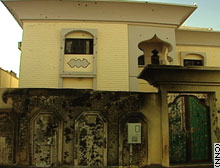 Damage
is clearly visible days after the July 2004 firefight between al Qaeda
militants and Saudi security forces at this house in Riyadh, Saudi
Arabia. |
| |
|  VIDEO |
 Saudi forces raid suspected militant hideout
|
|
(CNN) -- The house at No. 5, Momir Asma bin Mohammed Street should have been unremarkable.
Outside,
it was a two-story structure partially obscured by its surrounding wall
and front gate, halfway down a small side street in the middle-class
King Fahd neighborhood of Riyadh, Saudi Arabia.
Nothing would have revealed what lay inside: a studio of terror, a new front in al Qaeda's war.
I
wrote about the Internet as a front in this war last week. But here was
a place where the word became flesh; where the bricks and mortar of
terrorism intersected with the World Wide Web. (Full story)
Last
July, some jittery al Qaeda members inside had mistaken a routine
police patrol for a security raid, leading to a shootout between the
terrorists inside and the Saudi police and security forces that quickly
surrounded the building. (Full story)
Two days later, during the height of the Saudi summer, I approached the house. It looked more like Baghdad than Riyadh.
The
walls of every house on the street were scarred by pockmarks caused by
the thousands of rounds that had been fired by both sides.
The
stench from the blood that still covered the front steps could be
smelled several houses away, particularly sharp in the 125-degree heat.
As
I peered inside the gates, I could see not only the blood, but also the
detritus of a house that had been efficiently and brutally searched --
including mattresses, papers and dishes strewn about the courtyard.
But the most important items already had been taken away, along with a number of prisoners.
One
grisly discovery in the house was the head of American Paul Johnson. Al
Qaeda had kidnapped and beheaded the American technician several weeks
before. His head had been found inside the house, in a freezer. (Full story)
It
was hard to shake the video image of him posted on the Internet:
Johnson reciting his name, even as his captors surrounded him,
seemingly readying for the kill.
There was more inside the house:
AK-47 assault rifles; a SAM-7 shoulder-fired, surface-to-air missile;
explosives; hand grenades; rocket-propelled grenades; thousands of
rounds of ammunition. All are standard accoutrements of the modern-day
terrorist cell.
But that's not all.
A modern terrorist cell
Because
the modern terrorist cell, be it in Saudi Arabia or Iraq, needs more.
And it was there: video cameras; laptop computers; CD burners; a
high-speed Internet connection.
If you tracked back the Johnson
execution video, which made the rounds of cyberspace just days before,
or other sophisticated Saudi al Qaeda video "documentaries" that had
appeared earlier in the year on the Web, then you'd end up in this
building in Riyadh.
Initial forensic work by the Saudis confirmed
that the rooms inside -- and the weapons, including the SAM-7 missile
-- matched up with those al Qaeda propaganda videos.
The videos
had been part of an al Qaeda media blitz on the Web that also included
two online magazines full of editorials and news digests, along with
advice on how to handle a kidnapping or field-strip an AK-47 assault
rifle.
The videos mixed old appearances by bin Laden with slick
graphics and suicide bombers' on-camera last wills and testaments. They
premiered on the Internet, one after the other, and were aimed at
recruiting Saudi youth.
But was that room full of trainees on a
video the entire cadre or just one of many small cells, a portent of a
young Saudi population about to rise up en masse?
Anyone can run
a Web site and emulate the Wizard of Oz, hiding behind the curtain,
creating grand illusions. That's what some in the Saudi security
establishment suspected -- and others hoped -- was happening. They say
that, behind the slick videos and sporadic but daring attacks, there
was less than met the eye.
But beyond the videos, the threats have proved very real.
Take
the suicide car bomb attacks on the Muhaya compound and other locations
in Riyadh in 2003 and 2004. Or the takeover and siege of the Oasis
compound in Khobar. Or the murder of one American and the kidnapping of
another, followed by a sadistic execution.
All very real and
bloody acts were amplified by Saudi al Qaeda's propaganda machine,
which seemed so polished compared with those generating the crude
pictures coming out of Iraq.
The media strategy behind this had several points -- to win new recruits; to create terror
locally, among the population and the Saudi regime; and to create terror abroad.
It
hasn't worked so far. There is no evidence that Saudi youths are
flocking en masse to join al Qaeda. And just this past week, the Saudi
government felt confident enough to hold an international conference on
counterterrorism (albeit under extraordinary security).
The
government could point to a campaign that killed five self-proclaimed
leaders of Saudi al Qaeda in the past two years, as well as the capture
of many more.
But what took place at No. 5, Momir Asma bin
Mohammed Street nonetheless is a reminder of just how sophisticated al
Qaeda has become.
Al Qaeda -- the group and the wider terrorism
movement -- now uses 21st century technology in pursuit of 14th
century, even 7th century goals.
Internet threat
An
update on last week's story about the Internet war: Jeremy Reynalds,
who traced back the story behind the alleged "hostage doll," has
received a death threat. It was posted on one of the main Web sites
used by al Qaeda sympathizers.
Reynalds, who does his cyber-sleuthing in his spare time, says he won't back down.
"I
am now more determined than ever to keep on pursuing my 'hobby.' If
these thugs think that this will intimidate me, they have picked the
wrong person," he said.